


The Chinese art market plummeted last year, with auction sales of living artists’ works falling by 45 percent as slowing growth and a corruption crackdown under Chinese President Xi Jinping (習近平) took their toll, a survey said on Thursday.
By far the most valuable artist was ink painter Cui Ruzhuo (崔如琢), 72, who is known for his large-scale traditional landscapes, said wealth publisher the Hurun Report, which collated auction results for the 100 most lucrative Chinese artists.
Cui’s works fetched US$120.4 million, it said, far ahead of second-placed oil painter Zeng Fanzhi (曾梵志), who saw his sales value crash by 62 percent. There were no figures to indicate whether the average price of individual works had decreased.
“A heady mix of the continued anti-corruption campaign, which has put a stop to gifting art to government officers, and a slowdown in the economy have combined to see both sales and the number of top works at auction pretty much halve,” Hurun Report chairman Rupert Hoogewerf said.
Even so, greater China surpassed the US last year to become home to the largest population of billionaires in the world, Hurun said in a previous report — indicating an increase in the pool of potential super-wealthy art collectors.
The 100 artists’ auction sales totaled US$565 million.
Only three artists on the list were women. They included Chen Peiqiu (陳佩秋), age 94, at number 16.
A surprising new entry was Jack Ma (馬雲), chief executive officer of Internet giant Alibaba Group Holding Ltd (阿里巴巴), whose inclusion came courtesy of a collaborative painting he executed with Zeng Fanzhi that sold at Sotheby’s in Hong Kong for US$5.3 million.
Cui was one of just eight artists who saw an increase in sales, with his revenues up 69 percent from 2014.
Although many believe China’s art market has been overheated in recent years, Cui told fellow artists that it was a national imperative to increase the value of their work.
“Our current downturn and backwardness shouldn’t discourage us; we artists should unite together and for the sake of our art market and our nation walk out towards the world, hand in hand, striving ardently together,” he said.
Huang Jiannan (黃建南), a self-taught artist ranked seventh on Hurun’s list, saw the auction value of his works drop by 45 percent last year, but he shrugged off the loss.
“These statistics measure the flow of my works in the market — it has nothing to do with me. I do not get the money from these sales directly,” he said.
Huang's auction sales totaled US$13.1 million last year, according to Hurun.
Critics such as Xie Chunyan (謝春彥) believe that focusing on auction values is a poor judge of Chinese artists' worth: "Just because this little British guy Hoogewerf says he wants to find a common standard to measure things one, two, three does not mean that this is the best method."

Taiwanese firms have increased investment in the Philippines in recent years as Manila’s ties with Washington deepen and global supply chains continue to shift away from China, an expert at the Chung-Hua Institution for Economic Research (CIER, 中華經濟研究院) said yesterday. The Philippines had not been among Taiwanese investors’ top choices in Southeast Asia, CIER Taiwan ASEAN Studies Center director Kristy Hsu (徐遵慈) said at a seminar in Taipei. However, Taiwan’s investment in the country has grown significantly since the COVID-19 pandemic, reaching US $257 million last year, a high in recent years, she said. Although Taiwan’s total investment in the Philippines still lags

Intel Corp regards Taiwan Semiconductor Manufacturing Co (TSMC, 台積電) as a longstanding partner, as the US chipmaker would continue outsourcing production of advanced chips to TSMC, Intel chief executive officer Lip-Bu Tan (陳立武) said yesterday. “I don’t look at people as competitors. I look at the collaboration... Nvidia is also, you know, a good friend,” Tan told a news conference following his keynote speech at the Computex trade show in Taipei. “It’s a very trusted partnership for us... We are a big, top customer for them, and we’re going to continue doing that,” he said, referring to TSMC, the world’s largest foundry
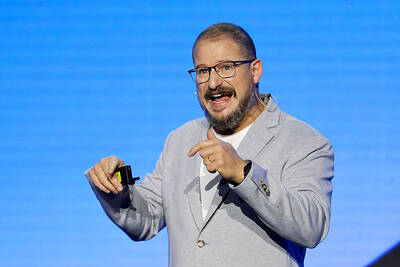
Artificial intelligence (AI) agents would supplant smartphones as the center of people’s digital lives, fundamentally reshaping personal devices and driving a major computing upgrade cycle, Qualcomm Inc CEO Cristiano Amon said yesterday. In his keynote speech for this year’s Computex trade show in Taipei, Amon said that the rise of "agentic AI" — AI systems capable of reasoning, planning and carrying out tasks autonomously — would transform how people interact with technology across phones, PCs, vehicles and wearable devices. Describing the technology as the next major evolution in computing, Amon said that "2026 is the year of agents.” For decades, smartphones have sat

Hon Hai Precision Industry Co (鴻海精密) yesterday said it would work with US chipmaker Intel Corp to jointly develop and deploy next-generation artificial intelligence (AI) infrastructure and intelligent computing platforms in a move to capture booming demand for AI computing systems. Hon Hai, also known as Foxconn Technology Group (富士康), said in a statement that the partnership would combine its global manufacturing scale, system integration expertise and AI data center deployment capabilities with Intel’s strengths in processor architecture, silicon technologies and software ecosystem. The companies said they plan to work on equipment used in AI data centers, including server racks powered by


 RSS
RSS