


Indonesian President Joko Widodo yesterday publicly rebuked one of his Cabinet ministers for a clampdown on ride-hailing services such as Uber and Go-Jek, which triggered outrage on social media in a nation where public transport options are limited.
Indonesian Minister for Transportation Ignasius Jonan’s restriction, which sent shares of taxi companies soaring in morning trade, would be seen as another embarrassment for Widodo, who has struggled to keep Indonesian Cabinet members in line since he took office last year.
Just months earlier he invited dozens of motorbike drivers employed by Go-Jek, whose lime-green colors are now ubiquitous in the traffic-clogged streets of Jakarta, to lunch at his palace.
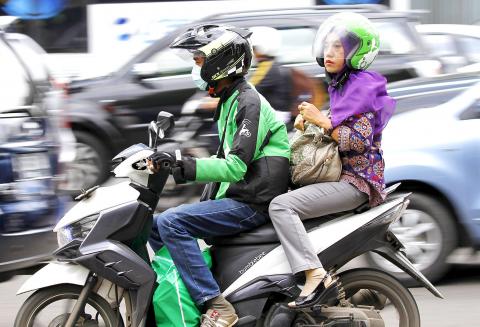
Photo:Reuters
“Don’t let the people be burdened because of regulations,” Widodo said on his official Twitter account, adding that regulations “need to be managed” and he would “immediately” summon Jonan for talks.
Innovation by the younger generation should not be restrained and applications such as Go-Jek exist because they are needed by society, Widodo told reporters yesterday at the palace.
The Kompas newspaper on Thursday reported that Jonan’s ministry had banned the use of personal vehicles for public transport.
The minister yesterday rowed back, saying in a statement that online ride-hailing services could continue to operate until a solution to meet public transport needs is found. He gave no further details.
This episode shows that Widodo is “unable to fully control his ministers,” Indonesian Institute of Sciences political analyst Firman Noor said by telephone.
“There seems to be relative independence at the ministries to make their own internal decisions that might not be communicated to the president,” Noor said. “In some cases they contradict the president’s stand.”
Shares of Indonesian taxi operators PT Express Transindo Utama Tbk and PT Blue Bird Tbk yesterday surged as much 33 percent and 16.4 percent, respectively, after the reported ban. However, they pared gains by the afternoon when Express stood 5.5 percent higher and Blue Bird was up 2.1 percent.
The attempt to cripple ride-hailing services provoked an online outcry: within hours #SaveGojek was the top trending topic on Twitter in Indonesia.
“Thanks to President @Jokowi for his support to 200 thousand Go-Jek drivers and 8 million of our application users,” Go-Jek founder Nadiem Makarim said on Twitter.
GrabTaxi, another online rides service, said it respected regulations and was taking steps to improve safety for passengers, but was in any case not even a transport operator.
“GrabCar and GrabBike are technology partners to licensed transportation companies and do not own any vehicles nor is it a transport operator,” a spokeswoman said in an e-mail.

Cairo’s new monorail slices across the city skyline, running above the familiar chaos of blaring horns and aging buses’ exhaust fumes that mark rush hour below. The US$4.5 billion monorail, opened this month, is among Egypt’s most prominent new transport projects, part of a debt-funded infrastructure drive criticized for sapping state finances while bringing limited benefits to most of the country’s 109 million people. “It feels like you’re in a different country,” said Ramy Sayed, a restaurant manager, aboard a driverless Innovia 300 train. “No noise, no traffic, we’re not used to this.” The eastern line runs 56km from the bustling middle-class

Taiwanese firms have increased investment in the Philippines in recent years as Manila’s ties with Washington deepen and global supply chains continue to shift away from China, an expert at the Chung-Hua Institution for Economic Research (CIER, 中華經濟研究院) said yesterday. The Philippines had not been among Taiwanese investors’ top choices in Southeast Asia, CIER Taiwan ASEAN Studies Center director Kristy Hsu (徐遵慈) said at a seminar in Taipei. However, Taiwan’s investment in the country has grown significantly since the COVID-19 pandemic, reaching US $257 million last year, a high in recent years, she said. Although Taiwan’s total investment in the Philippines still lags

Intel Corp regards Taiwan Semiconductor Manufacturing Co (TSMC, 台積電) as a longstanding partner, as the US chipmaker would continue outsourcing production of advanced chips to TSMC, Intel chief executive officer Lip-Bu Tan (陳立武) said yesterday. “I don’t look at people as competitors. I look at the collaboration... Nvidia is also, you know, a good friend,” Tan told a news conference following his keynote speech at the Computex trade show in Taipei. “It’s a very trusted partnership for us... We are a big, top customer for them, and we’re going to continue doing that,” he said, referring to TSMC, the world’s largest foundry

Artificial intelligence (AI) agents would supplant smartphones as the center of people’s digital lives, fundamentally reshaping personal devices and driving a major computing upgrade cycle, Qualcomm Inc CEO Cristiano Amon said yesterday. In his keynote speech for this year’s Computex trade show in Taipei, Amon said that the rise of "agentic AI" — AI systems capable of reasoning, planning and carrying out tasks autonomously — would transform how people interact with technology across phones, PCs, vehicles and wearable devices. Describing the technology as the next major evolution in computing, Amon said that "2026 is the year of agents.” For decades, smartphones have sat


 RSS
RSS