


When Chen Naibao got into the wine business, he left out the pigeon blood and lamb meat that have been hallmarks of vintages in China’s Xinjiang region for more than a thousand years.
The animal parts are usually added to enhance flavor and increase the supposed medicinal qualities of museles, a traditional wine raved about in Tang Dynasty poetry and long fermented by local Uighurs, despite the Muslim prohibition on alcohol.
Deep red, its unusual ingredients give it a pungent, musty nose and a sweet-sour, spiced taste, akin to a vermouth.
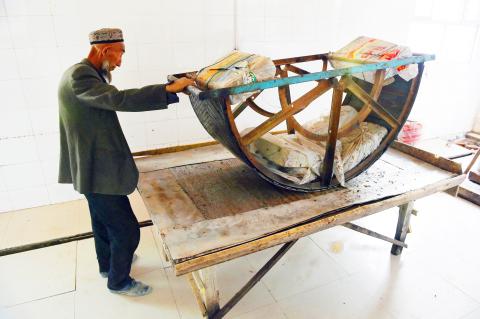
Photo: AFP
Chen’s recipe has extra sugar and his own production is noticeably sweeter, even cloying, with a more golden-brown hue.
Xinjiang, home to most of China’s more than 10 million Uighurs, sees sporadic violence authorities blamed on Muslim separatists, which has increased in intensity and spread beyond its borders in recent years.
Uighurs say they face discrimination and restrictions on language, culture and religion, but China counters it has brought development and raised living standards.
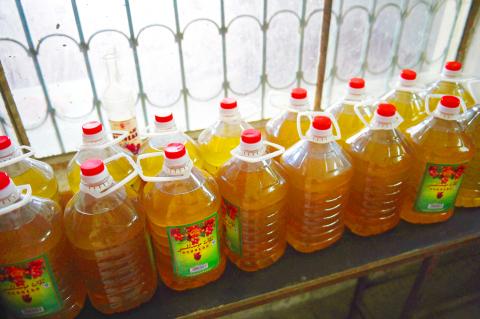
WARNING: EXCESSIVE CONSUMPTION OF ALCOHOL CAN DAMAGE YOUR HEALTH.
Photo: AFP
Nonetheless, Chen’s business shows how the benefits of economic growth often go to immigrants from China’s Han majority rather than Uighur locals, exacerbating ethnic tensions.
It is unclear when exactly Uighurs started making museles, but during the Tang Dynasty (618-907) — considered the peak of Chinese civilization — poets referred to it as “Western nectar.”
Museles is often spiced with saffron or cloves, in addition to pigeon blood, whole pigeon or lamb meat, and is typically aged for two months in ceramic vats.
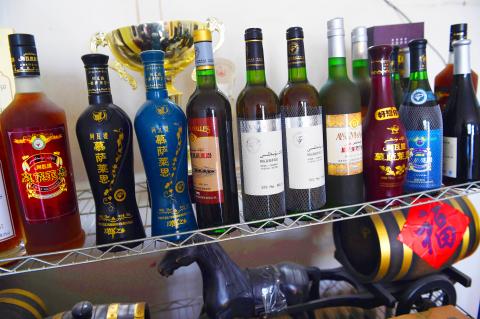
WARNING: EXCESSIVE CONSUMPTION OF ALCOHOL CAN DAMAGE YOUR HEALTH.
Photo: AFP
However, Chen grew up and still lives partly in Jiangsu Province, more than 3,700km away on China’s eastern coast. He set up the business only four years ago after buying an existing winery and has little time for its heritage.
“I took this Uighur wine and made it better,” he boasted in his spartan office at the 2-hectare vineyard — he buys in most of his grapes. “We have science and ordinary Uighurs making wine don’t understand any of that.”
Despite breaking from tradition, Chen’s winery in Awat near the Kyrgyz border has a key advantage over local firms that have been making museles for generations: government financial support.
Chen recently built a 5 million yuan (US$800,000) extension to his winery and upgraded the boilers, raising his potential capacity to 1,000 tonnes a year.
One of Beijing’s subsidy schemes provided 1 million yuan of funding, while smaller Uighur wineries in the area have enjoyed no similar largesse.
“By virtue of having the program, the government can say: ‘Look we’re developing the region,’” said Reza Hasmath, a professor of Chinese politics at Oxford University. “But they don’t take that extra step to create greater awareness and access to the programs for Uighurs.”
Such offers are often only learned of through word-of-mouth among well-connected businesspeople elsewhere in China, but the effects are more pronounced in Xinjiang, Hasmath said.
The Xinjiang government spent 530 million yuan on small and medium business programs in 2013, according to the regional budget.
That does not include central government schemes like Chen’s. Comprehensive figures for them are not made public, but the regional cotton industry alone received 3.5 billion yuan from Beijing last year.
Despite alcohol being forbidden in Islam, many Uighurs view museles more as a type of medicine than wine, taken like vitamins.
“Before, I didn’t drink alcohol or smoke, and I still don’t smoke,” said Iburamzi Emin, 64, a winery caretaker. “Recently I’ve started to drink museles because it’s good for my health and can treat diseases.”
Iburamzi drinks one cup in the morning and one at night, on his doctor’s orders.
Aysha Ghayit and her Awat Ruby Museles Winery stand in contrast to Chen and his venture. Her family has been making museles at home for generations, and have built up their business over the past decade and now produce 100 tonnes a year.
It is just a tenth of Chen’s capacity and Aysha said she would like to expand the business, but has no funds to do so.
“We built this all ourselves, one building at a time,” the tracksuit-clad businesswoman said, gesturing around the winery. “No one helped us, we didn’t get any government subsidies.”
However, some say that official funds given to Uighur-owned businesses generate poor returns.
One Uighur government official in Xinjiang, who declined to be named because he was not authorized to speak to foreign media, said he tried to help his fellow Uighurs by helping them apply for government funding and directing money to Uighur-owned businesses.
“When you give a Uighur subsidies, there’s a chance he won’t follow through,” the official said. “I’ve seen it many times. But the Han are more organized, and in my experience, they finish their projects.”

Cairo’s new monorail slices across the city skyline, running above the familiar chaos of blaring horns and aging buses’ exhaust fumes that mark rush hour below. The US$4.5 billion monorail, opened this month, is among Egypt’s most prominent new transport projects, part of a debt-funded infrastructure drive criticized for sapping state finances while bringing limited benefits to most of the country’s 109 million people. “It feels like you’re in a different country,” said Ramy Sayed, a restaurant manager, aboard a driverless Innovia 300 train. “No noise, no traffic, we’re not used to this.” The eastern line runs 56km from the bustling middle-class

Taiwanese firms have increased investment in the Philippines in recent years as Manila’s ties with Washington deepen and global supply chains continue to shift away from China, an expert at the Chung-Hua Institution for Economic Research (CIER, 中華經濟研究院) said yesterday. The Philippines had not been among Taiwanese investors’ top choices in Southeast Asia, CIER Taiwan ASEAN Studies Center director Kristy Hsu (徐遵慈) said at a seminar in Taipei. However, Taiwan’s investment in the country has grown significantly since the COVID-19 pandemic, reaching US $257 million last year, a high in recent years, she said. Although Taiwan’s total investment in the Philippines still lags
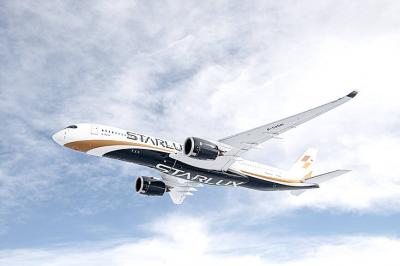
Starlux Airlines Co (星宇航空) today unveiled a long-haul network expansion plan at a shareholders’ meeting in Taipei, including direct flights to Barcelona, Spain, and Zurich, Switzerland, as well as a service connecting Taipei, Sydney and New Zealand. Starlux is to become the first Taiwanese carrier to offer non-stop services to the two European cities, while the inaugural oceanic route is expected to expand transit opportunities within the Australia-New Zealand market, Starlux said. Flight services to Chicago, Dallas, Washington and New York are under evaluation, the airline added. Prior to the shareholders’ meeting, the airline earlier this year announced that it would be

Intel Corp regards Taiwan Semiconductor Manufacturing Co (TSMC, 台積電) as a longstanding partner, as the US chipmaker would continue outsourcing production of advanced chips to TSMC, Intel chief executive officer Lip-Bu Tan (陳立武) said yesterday. “I don’t look at people as competitors. I look at the collaboration... Nvidia is also, you know, a good friend,” Tan told a news conference following his keynote speech at the Computex trade show in Taipei. “It’s a very trusted partnership for us... We are a big, top customer for them, and we’re going to continue doing that,” he said, referring to TSMC, the world’s largest foundry


 RSS
RSS