


Five men, armed to the teeth, have just stormed a home and it did not go well, not well at all.
“You killed a kid,” the instructor screamed.
A glance at the bullet marks on the child-sized mannequin leaves no doubt — the drill must be repeated.
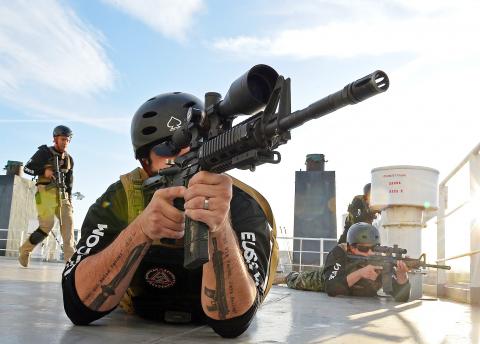
Photo: AFP
The men are training at Poland’s private European Security Academy (ESA), in the western countryside, which prepares security and military contractors from around the globe for missions in danger zones.
Spread across 100 hectares near the village of Wlosciejewki, the center is surrounded by fields, woods, lakes and is considered a top-flight choice for future VIP bodyguards, maritime security officers and private military contractors.
“We search out the whole world for the most realistic places to train,” said Criss Watts, an instructor from the London-based specialist security company Up Close and Personal (UCP).
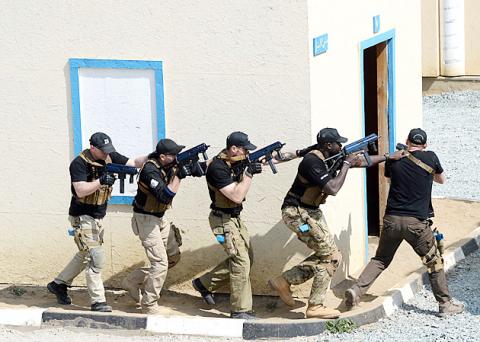
Photo: AFP
“And this is certainly the best place that we consider for our training in the world,” he said.
One thing that sets this program apart: The trainees use real weapons and FX marking cartridges, simulated ammunition that will not kill, but feels like the real thing when the trainee fires.
Members of the commando that stormed the dwelling are all working as UCP security operatives. They include a Briton, a Colombian, an Italian and a Spaniard.
They spent the morning in the Academy’s combat village, a full-scale replica of a central section of Somalia’s capital, Mogadishu — complete with a hotel, coffee shop, bus stop, market and houses painted blue and pink and inscribed with Arabic.
The spring sunshine and windswept sand add a touch of realism to the violent scenarios being acted out.
“In the UK, it’s very difficult to train to this standard. In fact, impossible. Can’t use pistols for training. You can use weapons on a range, but you can’t use them for training,” said Watts, who spent three decades working in high-risk protection.
“In this center, you can use 762, 9mm, 556, M4, AK47, Glock — all assortment of pistols and variants,” the 49-year-old added, describing a range of guns.
He said UCP’s clients pay for them to train at the Academy.
“They want to make sure they stay alive. And we want to make sure these guys come back as well, uninjured,” he said. “Anything can happen. ISIS could be on the hill.”
Another group trains at a large firing range that includes a 350m shooting distance, an area where the men can fire in three directions and a tactical lane allowing them to shoot from moving vehicles.
The course is run by ESA instructor Pawel Brozek, whose boyish face masks his seven years with Poland’s special forces, including several rotations in Afghanistan and Iraq.
“We have trainees from every continent. We train security agents from Saudi Arabia, Bangladesh, Oman, who are on government contracts,” he said. “We also have contractors from protection agencies and individuals who come on their own to get training and find a job.”
Brozek’s current group is training to become maritime security officers, highly sought after to safeguard ships and their crews from pirates. Reinforced security has helped curb a wave of hijackings by pirates in the seas off east Africa.
The 26 trainees from nine countries — Brazil, Colombia, Croatia, Germany, Ghana, Poland, Portugal, South Africa and Spain — have just completed the first part of their course in the Baltic port of Gdynia.
“It’s the realistic aspect that draws people here: The maritime training is done on real boats. All the equipment is the same as what we use at sea,” Brozek said.
“We also work with simulators from the Gdynia Maritime School,” he added, before calling a drill on the bridge of a large roll-on roll-off ship in the port.
Anyone wanting to guard ships has to first obtain a maritime security license.
This means learning about maritime law and specific procedures: how to use radars, identify a boat, define its speed and distance, communicate with the crew and, of course, take action to prevent a boarding.
“There’s a lot of interest in this kind of course,” Brozek said.
At about 2,000 euros (US$2,250), “it was a little bit expensive,” according to Wanderlei Cunha, a 34-year-old trainee who previously served in the Brazilian army’s special forces.
“But I saved some money with this objective. So I’m all in. I pushed all my chips on this,” he said.
Ervin Cahut, a 40-year-old veteran of Croatia’s anti-terrorist military police unit, is also banking on ESA certification, which is recognized around the world.
“I think that some company that needs security guys like me — ex-military — to secure a vessel on the sea maybe will take me,” he said.

Cairo’s new monorail slices across the city skyline, running above the familiar chaos of blaring horns and aging buses’ exhaust fumes that mark rush hour below. The US$4.5 billion monorail, opened this month, is among Egypt’s most prominent new transport projects, part of a debt-funded infrastructure drive criticized for sapping state finances while bringing limited benefits to most of the country’s 109 million people. “It feels like you’re in a different country,” said Ramy Sayed, a restaurant manager, aboard a driverless Innovia 300 train. “No noise, no traffic, we’re not used to this.” The eastern line runs 56km from the bustling middle-class

Taiwanese firms have increased investment in the Philippines in recent years as Manila’s ties with Washington deepen and global supply chains continue to shift away from China, an expert at the Chung-Hua Institution for Economic Research (CIER, 中華經濟研究院) said yesterday. The Philippines had not been among Taiwanese investors’ top choices in Southeast Asia, CIER Taiwan ASEAN Studies Center director Kristy Hsu (徐遵慈) said at a seminar in Taipei. However, Taiwan’s investment in the country has grown significantly since the COVID-19 pandemic, reaching US $257 million last year, a high in recent years, she said. Although Taiwan’s total investment in the Philippines still lags

Intel Corp regards Taiwan Semiconductor Manufacturing Co (TSMC, 台積電) as a longstanding partner, as the US chipmaker would continue outsourcing production of advanced chips to TSMC, Intel chief executive officer Lip-Bu Tan (陳立武) said yesterday. “I don’t look at people as competitors. I look at the collaboration... Nvidia is also, you know, a good friend,” Tan told a news conference following his keynote speech at the Computex trade show in Taipei. “It’s a very trusted partnership for us... We are a big, top customer for them, and we’re going to continue doing that,” he said, referring to TSMC, the world’s largest foundry

Artificial intelligence (AI) agents would supplant smartphones as the center of people’s digital lives, fundamentally reshaping personal devices and driving a major computing upgrade cycle, Qualcomm Inc CEO Cristiano Amon said yesterday. In his keynote speech for this year’s Computex trade show in Taipei, Amon said that the rise of "agentic AI" — AI systems capable of reasoning, planning and carrying out tasks autonomously — would transform how people interact with technology across phones, PCs, vehicles and wearable devices. Describing the technology as the next major evolution in computing, Amon said that "2026 is the year of agents.” For decades, smartphones have sat


 RSS
RSS