


Nokia Oyj is back in the fray.
Just months after selling its ailing handsets business to Microsoft Corp, the Finnish company is planning to go back into the consumer market with a new tablet.
The former top mobile phone maker, which has a history of reinventing itself since it began as a paper maker in the 19th century, said on Tuesday it will launch a 7.9-inch device early next year in China, the world’s biggest market, before selling it elsewhere.
The device will be manufactured by Taiwan-based Hon Hai Precision Industry Co (鴻海精密), which makes Apple Inc’s handsets. It will operate Android instead of the Windows software Nokia used on its cellphones when it began a partnership with Microsoft in 2011. That partnership ended unsuccessfully — in April Nokia sold its cellphones unit to Microsoft for US$7.2 billion.
Hon Hai, known in China as Foxconn Technology Group (富士康科技集團), is fully responsible for business execution from engineering and sales to customer care, including liabilities and warranty costs, inbound intellectual property and software licensing, and contractual agreements with third parties, according to Nokia.
Sebastian Nystrom, head of Nokia’s technologies unit, described the N1 tablet as “a new beginning for Nokia.”
He noted that about 80 percent of the world’s mobile consumers use Android, compared with just 2.5 percent using Windows mobile devices. The aluminum-cased tablet uses Google Inc’s Android Lollipop operating system and will retail for US$250.
For sure, it won’t be an easy shift for Nokia after years of focusing on cellphones and a troubled networks operation that only recently has shown signs of improvement.
“It’s pointing in the right direction, but there are some real challenges,” said Neil Mawston from Strategy Analytics, near London. “It doesn’t have the distribution channels that others like Samsung and Apple enjoy, and nobody is making any profits in Android tablets at the moment.”
Nokia’s brand was wiped out of the handset market last week, when Microsoft unveiled its first Lumia smartphone under its own brand name.
“We are pleased to bring the Nokia brand back into consumers’ hands,” said Nystrom, who announced the launch of the tablet in Helsinki at Slush, one of Europe’s largest startup and investor events with about 10,000 participants expected over two days.
He hinted Nokia was also interested in producing an Android smartphone. That can’t happen before 2016, however, as the Microsoft deal included a commitment that Nokia not enter the smartphone business before then.
“Once that is finalized we have the option to do so,” Nystrom told reporters.
Additional reporting by CNA

Netherlands-based semiconductor equipment supplier ASML Holding NV yesterday said that it is planning to hire an additional 1,000 people in Taiwan this year in response to growing demand from clients. ASML had previously planned to recruit 600 people this year, but that the plan has been adjusted upward, ASML vice president and ASML Taiwan general manager Grace Wang (汪佳慧) told reporters. ASML has a workforce of more than 4,500 in Taiwan, accounting for about 10 percent of its global total, Wang said. This year’s recruitment campaign would focus on adding people in the customer support, manufacturing and supply chain domains to assist ASML
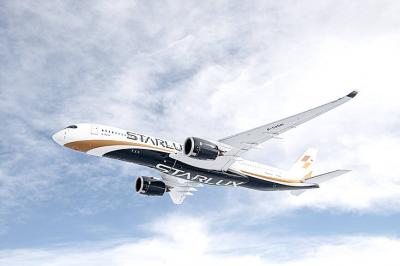
Starlux Airlines Co (星宇航空) today unveiled a long-haul network expansion plan at a shareholders’ meeting in Taipei, including direct flights to Barcelona, Spain, and Zurich, Switzerland, as well as a service connecting Taipei, Sydney and New Zealand. Starlux is to become the first Taiwanese carrier to offer non-stop services to the two European cities, while the inaugural oceanic route is expected to expand transit opportunities within the Australia-New Zealand market, Starlux said. Flight services to Chicago, Dallas, Washington and New York are under evaluation, the airline added. Prior to the shareholders’ meeting, the airline earlier this year announced that it would be
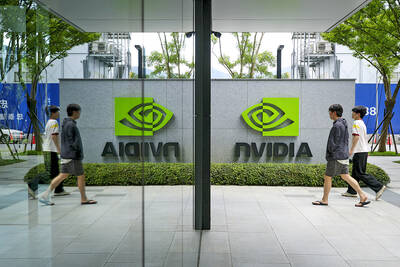
UNDER MICROSCOPE: Taiwan detained three people who allegedly conspired to buy servers in Taiwan and export them using fraudulent documentation, prosecutors said Nvidia Corp chief executive officer Jensen Huang (黃仁勳) on Saturday urged Super Micro Computer Inc to tighten up on compliance after Taiwan detained three people this week for allegedly making fraudulent declarations about artificial intelligence (AI) servers made by its US partner. The development marked the nation’s first crackdown on semiconductor smuggling, which grew after the US slapped restrictions on exports of high-end chips such as Nvidia AI accelerators to China. Nvidia is “rigorous” in explaining regulations to all of its partners, Huang told reporters after arriving in Taipei. “Ultimately Super Micro has to run their own company,” he said in response to
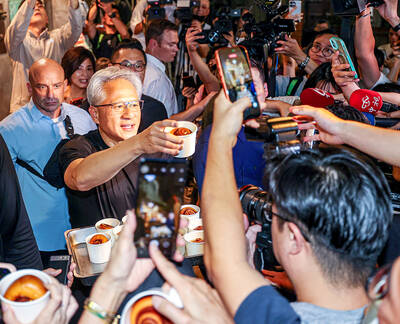
Nvidia Corp yesterday announced that CEO Jensen Huang (黃仁勳) would attend an employee meeting in Taipei tomorrow to celebrate the launch of the company’s Taiwan headquarters project. Huang would attend a gathering at the site of Nvidia’s planned headquarters in Beitou Shilin Technology Park (北投士林科技園區), the company said in a statement. After arriving in Taiwan on Saturday last week, Huang told reporters that he plans to meet with Quanta Computer Inc (廣達) chairman Barry Lam (林百里) and Taiwan Semiconductor Manufacturing Co (TSMC, 台積電) chairman C.C. Wei (魏哲家), and would attend the groundbreaking ceremony for Nvidia’s Taiwan headquarters tomorrow. Nvidia has not yet applied


 RSS
RSS