


XYZprinting Inc (三緯), the second-largest producer of 3D printers in the world, yesterday launched its first 3D food printer. The device — able to print edible chocolate, cookies and pizza — brings 3D printing technology to kitchens.
XYZprinting — the 3D printer arm of the New Kinpo Group (新金寶集團) — said the 3D food printer is a milestone for the company as it combines manufacturing technology with the food industry.
The printer is the company’s first device to use ingredient capsules to produce edible items.
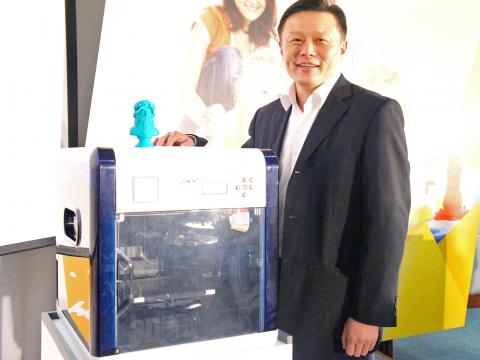
Photo: CNA
“We are working with different suppliers of food ingredients to go with the machine,” company chairman Simon Shen (沈軾榮) told a media briefing yesterday. “We believe that in the future 3D food printers might be used in space to print out food for astronauts, a topic NASA is researching at the moment.”
XYZprinting’s 3D food printer would be on the market by June next year, Shen said. The device would retail at an affordable price, compared with rivals’ expensive price tags of between US$3,000 and US$5,000 per unit, he said.
With new models to hit the market next year, the Greater Taipei-based company aims to more than triple its sales of 3D printers to between 120,000 and 150,000 units next year, from this year’s estimated 40,000 units, Shen said.
The one-year-old company also expects to make a profit next year after reaching the break-even point this quarter, Shen said. The gross margin for its 3D printers is higher than 10 percent, he added.
Research house Gartner Inc forecast that global 3D printer shipments next year would grow to 217,350 units, compared with 108,151 units recorded this year. Shipments would more than double every year over the next four years to reach more than 2.3 million units in 2018, Gartner said last month.
“Next year, we plan to introduce high-end 3D printers for business use [such as jewelry companies]. We are not only capable of making low-cost machines,” XYZprinting’s market development division senior manager Gary Shu (舒家誠) said.
Yesterday, XYZprinting also launched a 3D printer with a built-in scanner, which is the company’s first 3D-printing machine combining a printer and a scanner.
“The new 3D printer should provide 3D-modeling capability for the ordinary consumer,” Shen said.
The device, code-named da Vinci Aio, is available via online retailers, including Taiwan’s PChome Store Inc (商店街市集) and the US-based Amazon.com.
The 3D printer has a price tag of NT$26,990, which is much lower than the NT$76,560 asked for a similar model by AIO Robotics, according to XYZprinting.
SEEKING CLARITY: Washington should not adopt measures that create uncertainties for ‘existing semiconductor investments,’ TSMC said referring to its US$165 billion in the US Taiwan Semiconductor Manufacturing Co (TSMC, 台積電) told the US that any future tariffs on Taiwanese semiconductors could reduce demand for chips and derail its pledge to increase its investment in Arizona. “New import restrictions could jeopardize current US leadership in the competitive technology industry and create uncertainties for many committed semiconductor capital projects in the US, including TSMC Arizona’s significant investment plan in Phoenix,” the chipmaker wrote in a letter to the US Department of Commerce. TSMC issued the warning in response to a solicitation for comments by the department on a possible tariff on semiconductor imports by US President Donald Trump’s

The government has launched a three-pronged strategy to attract local and international talent, aiming to position Taiwan as a new global hub following Nvidia Corp’s announcement that it has chosen Taipei as the site of its Taiwan headquarters. Nvidia cofounder and CEO Jensen Huang (黃仁勳) on Monday last week announced during his keynote speech at the Computex trade show in Taipei that the Nvidia Constellation, the company’s planned Taiwan headquarters, would be located in the Beitou-Shilin Technology Park (北投士林科技園區) in Taipei. Huang’s decision to establish a base in Taiwan is “primarily due to Taiwan’s talent pool and its strength in the semiconductor

An earnings report from semiconductor giant and artificial intelligence (AI) bellwether Nvidia Corp takes center stage for Wall Street this week, as stocks hit a speed bump of worries over US federal deficits driving up Treasury yields. US equities pulled back last week after a torrid rally, as investors turned their attention to tax and spending legislation poised to swell the US government’s US$36 trillion in debt. Long-dated US Treasury yields rose amid the fiscal worries, with the 30-year yield topping 5 percent and hitting its highest level since late 2023. Stocks were dealt another blow on Friday when US President Donald

UNCERTAINTY: Investors remain worried that trade negotiations with Washington could go poorly, given Trump’s inconsistency on tariffs in his second term, experts said The consumer confidence index this month fell for a ninth consecutive month to its lowest level in 13 months, as global trade uncertainties and tariff risks cloud Taiwan’s economic outlook, a survey released yesterday by National Central University found. The biggest decline came from the timing for stock investments, which plunged 11.82 points to 26.82, underscoring bleak investor confidence, it said. “Although the TAIEX reclaimed the 21,000-point mark after the US and China agreed to bury the hatchet for 90 days, investors remain worried that the situation would turn sour later,” said Dachrahn Wu (吳大任), director of the university’s Research Center for


 RSS
RSS