


US online retail giant eBay Inc unveiled plans on Tuesday to spin off PayPal, aiming to help the unit compete better in the fast-moving online payments segment.
The plan, to take effect next year, comes after months of pressure led by activist investor Carl Icahn, who had assailed eBay for poor management and claimed that keeping eBay tied with PayPal depressed the value of both.
An eBay statement said that a board review concluded that “a changing competitive landscape creates enormous opportunities for eBay and PayPal” and that “separation will create sharper strategic focus” for each unit.
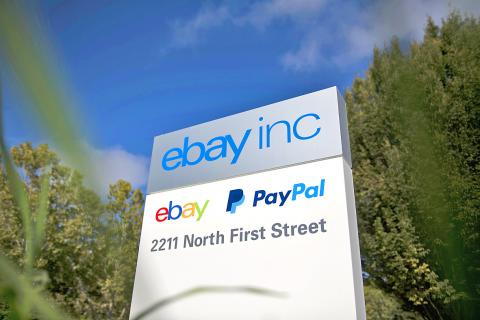
Photo: Bloomberg
Company president and chief executive John Donahoe said that “for more than a decade, eBay and PayPal have mutually benefited from being part of one company,” but that the situation had now changed.
“A thorough strategic review with our board shows that keeping eBay and PayPal together beyond 2015 clearly becomes less advantageous to each business strategically and competitively,” Donahoe said.
The move comes with the online payments segment facing challenges from the likes of Apple Inc, which has introduced a mobile payment platform using its iPhones, and newcomers such as Square.
“The pace of industry change and innovation in commerce and payments requires maximum flexibility to stay competitive and drive global leadership,” the eBay statement said.
The split is to give shareholders “more targeted investment opportunities” and will increase the value of the company over the long term, the statement added.
PayPal accounted for 41 percent of eBay’s revenues last year and has more than 152 million active users.
Donahoe and chief financial officer Bob Swan are to lead the transition of both businesses, the statement said. However, they will not hold executive management roles in the two new companies.
The “new” eBay is to be led by Devin Wenig, current president of eBay Marketplaces.
The independent PayPal is to be headed by Dan Schulman, who comes from American Express after holding top jobs at AT&T, Priceline.com, and Virgin Mobile.
Icahn said the decision was long overdue.
“We are happy that eBay’s board and management have acted responsibly concerning the separation — perhaps a little later than they should have, but earlier than we expected,” Icahn said in a statement. “It is almost a ‘no brainer’ that these companies should be separated to increase the value of these great assets and thus to meaningfully enhance value for all shareholders.”
Icahn also said that the payments sector needs “consolidation” — either through acquisitions by PayPal or by merging it with “another strong player in the industry.”
PayPal over the years has expanded beyond a simple payment mechanism for eBay auctions. According to eBay, PayPal facilitates one in every US$6 spent online today, or about US$203 billion over the past 12 months. And PayPal has moved into mobile payments with the acquisition of the payment processing group Braintree, boosting its own mobile platform called OneTouch.
After the announcement, eBay shares leapt 7.5 percent to close at US$56.63, and analysts reacted positively.
Forrester Research’s Denee Carrington said the plan makes sense because PayPal had “outgrown” eBay.
“The payments landscape is hypercompetitive, the pace of change is accelerating and everyone is gunning for PayPal,” Carrington said. “The split will give PayPal greater agility to help it achieve its full potential.”
Shebly Seyrafi, analyst at FBN Securities, said the split “could be a positive development for eBay as it creates more focused entities and as it allows investors to invest more directly in the faster-growing business [PayPal].”
The plan also comes with eBay facing a potential threat from Alibaba Group Holding Ltd (阿里巴巴), the Chinese online retail giant that raised a record US$25 billion in a stock offering to fuel global expansion plans.

SECOND-RATE: Models distilled from US products do not perform the same as the original and undo measures that ensure the systems are neutral, the US’ cable said The US Department of State has ordered a global push to bring attention to what it said are widespread efforts by Chinese companies, including artificial intelligence (AI) start-up DeepSeek (深度求索), to steal intellectual property from US AI labs, according to a diplomatic cable. The cable, dated Friday and sent to diplomatic and consular posts around the world, instructs diplomatic staff to speak to their foreign counterparts about “concerns over adversaries’ extraction and distillation of US AI models.” Distillation is the process of training smaller AI models using output from larger, more expensive ones to lower the costs of training a powerful new
Shares of Taiwan Semiconductor Manufacturing Co (TSMC, 台積電) have repeatedly hit new highs, but an equity analyst said the stock’s valuation remains within a reasonable range and any pullback would likely be technical. The contract chipmaker’s historical price-to-earnings (P/E) ratio has ranged between 20 and 30, Cathay Futures Consultant Co (國泰證期) analyst Tsai Ming-han (蔡明翰) told Central News Agency. With market consensus projecting that TSMC would post earnings per share of about NT$100 (US$3.17) this year, supported by strong global demand for artificial intelligence (AI) applications, and the stock currently trading at a P/E ratio of below 25, Tsai said the valuation
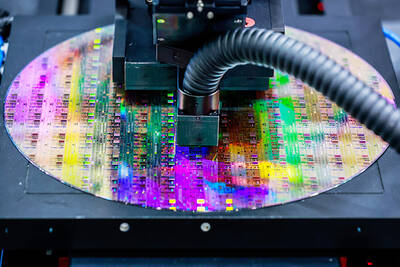
The artificial intelligence (AI) boom has triggered a seismic reshuffling of global equity markets, with Taiwan and South Korea muscling past European nations one by one. With its stock market now valued at nearly US$4.3 trillion, Taiwan surpassed the UK, Europe’s biggest market, earlier this month, data compiled by Bloomberg showed. South Korea is about US$140 billion away from doing the same. The tech-heavy Asian markets have shot past Germany and France in the past seven months. The shift is largely down to massive gains in shares of three companies that provide essential hardware for AI: Taiwan Semiconductor Manufacturing Co (TSMC, 台積電),

The US Department of Commerce last week ordered multiple chip equipment companies to halt shipments of certain tools to China’s second-largest chipmaker, Hua Hong Semiconductor Ltd (華虹半導體), its latest action to slow the country’s development of advanced chips, two people familiar with the matter said. The department sent letters to at least a handful of companies informing them of restrictions on tools and other materials destined for two Hua Hong facilities US officials believe make China’s most sophisticated chips, the people said. Top US chip equipment companies Lam Research Corp, Applied Materials Inc and KLA Corp, each of which has significant


 RSS
RSS