


The Industrial Technology Research Institute (ITRI, 工研院) yesterday signed a NT$100 million (US$3.28 million) technology licensing agreement with Taiwan Mitsui Chemicals Inc (亞太三井化學) to produce safer lithium-ion batteries.
Taiwan Mitsui Chemicals Inc is a fully owned subsidiary of chemicals producer Mitsui Chemicals Inc.
Japan-based Mitsui Chemicals plans to build a production site in Taiwan by the end of 2016 to manufacture materials for lithium-ion batteries using the institute’s self-terminated oligomers with hyper-branched architecture (STOBA) technology to prevent explosions, Mitsui Chemicals managing executive officer Shigeru Isayama told a news conference.
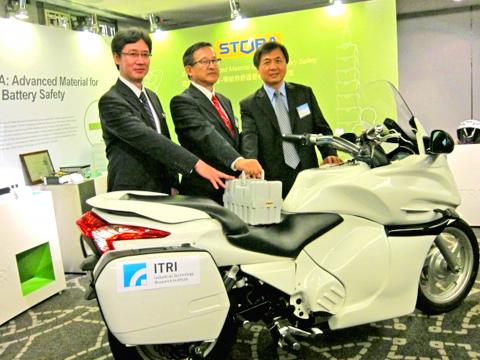
Photo: Hung Yu-fang, Taipei Times
“We will establish close relationships with Taiwanese companies related to lithium-ion batteries,” he said.
Isayama said the company is further studying the market for lithium-ion batteries worldwide, and may build more production sites in other countries if needed.
Mitsui Chemicals expects STOBA batteries to account for 10 percent of total shipments of lithium-ion batteries around the world by 2020, said Akio Hirahara, general manager of the company’s new market development division.
Citing Fuji Keizai, a Japan-based information provider, Mitsui Chemicals said the market for lithium-ion batteries would increase to 80 gigawatt hours in 2020 from an estimated 40 gigawatt hours this year.
Mitsui Chemicals said it plans to use the new technology to make materials for batteries used in cellphones, personal computers and cars.
“Compared with local chemical companies, Mitsui Chemicals has stronger ties with car makers, which can help promote STOBA technology in the car industry,” said Pan Jing-pin (潘金平), a division director at the institute.
Pan said Mitsui Chemicals’ electrolytic solution is used in batteries for Boeing 787 and electric vehicles developed by Nissan Motor Co.
Mitsui Chemicals is also the largest producer of polypropylene compounds around the world, with Toyota Motor Corp and Honda Motor Co its two major clients, the company said.
STOBA materials can form films in lithium-ion batteries to stop the chemical reaction and terminate the batteries safely when the batteries’ internal temperature rise to abnormal levels, the institute said, adding that STOBA batteries last twice as long as than other lithium-ion batteries.
The technology won the R&D 100 Awards in Energy Devices in 2009, the institute said, adding that STOBA batteries manufactured by Amita Technologies Inc (有量科技) are now used in China Motor Corp’s (中華汽車) E-moving 100 electric scooters.
In addition to Amita Technologies, the institute licensed the technology for manufacturing STOBA batteries to three other Taiwanese lithium battery makers — E-One Moli Energy Corp (能元科技), Lion Tech Co (精極科技) and Synergy ScienTech Corp (興能高科技) — last year, it said.
SECOND-RATE: Models distilled from US products do not perform the same as the original and undo measures that ensure the systems are neutral, the US’ cable said The US Department of State has ordered a global push to bring attention to what it said are widespread efforts by Chinese companies, including artificial intelligence (AI) start-up DeepSeek (深度求索), to steal intellectual property from US AI labs, according to a diplomatic cable. The cable, dated Friday and sent to diplomatic and consular posts around the world, instructs diplomatic staff to speak to their foreign counterparts about “concerns over adversaries’ extraction and distillation of US AI models.” Distillation is the process of training smaller AI models using output from larger, more expensive ones to lower the costs of training a powerful new
Shares of Taiwan Semiconductor Manufacturing Co (TSMC, 台積電) have repeatedly hit new highs, but an equity analyst said the stock’s valuation remains within a reasonable range and any pullback would likely be technical. The contract chipmaker’s historical price-to-earnings (P/E) ratio has ranged between 20 and 30, Cathay Futures Consultant Co (國泰證期) analyst Tsai Ming-han (蔡明翰) told Central News Agency. With market consensus projecting that TSMC would post earnings per share of about NT$100 (US$3.17) this year, supported by strong global demand for artificial intelligence (AI) applications, and the stock currently trading at a P/E ratio of below 25, Tsai said the valuation
The artificial intelligence (AI) boom has triggered a seismic reshuffling of global equity markets, with Taiwan and South Korea muscling past European nations one by one. With its stock market now valued at nearly US$4.3 trillion, Taiwan surpassed the UK, Europe’s biggest market, earlier this month, data compiled by Bloomberg showed. South Korea is about US$140 billion away from doing the same. The tech-heavy Asian markets have shot past Germany and France in the past seven months. The shift is largely down to massive gains in shares of three companies that provide essential hardware for AI: Taiwan Semiconductor Manufacturing Co (TSMC, 台積電),
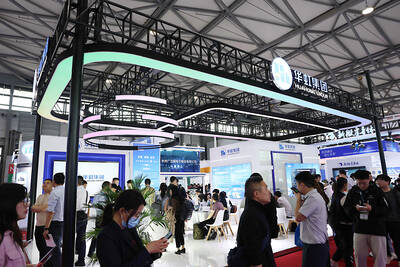
The US Department of Commerce last week ordered multiple chip equipment companies to halt shipments of certain tools to China’s second-largest chipmaker, Hua Hong Semiconductor Ltd (華虹半導體), its latest action to slow the country’s development of advanced chips, two people familiar with the matter said. The department sent letters to at least a handful of companies informing them of restrictions on tools and other materials destined for two Hua Hong facilities US officials believe make China’s most sophisticated chips, the people said. Top US chip equipment companies Lam Research Corp, Applied Materials Inc and KLA Corp, each of which has significant


 RSS
RSS