


The UK’s British Sky Broadcasting Group (BSkyB) has agreed to pay US$9 billion to buy Rupert Murdoch-owned pay-TV companies in Germany and Italy, taking its hunt for growth into Europe by creating a media powerhouse with about 20 million customers.
Under the deal, BSkyB is to pay Murdoch’s 21st Century Fox for the pay-TV companies using cash, debt, its stake in a TV channel and a placing of shares that represents around 10 percent of its issued share capital. Murdoch is also the largest shareholder of BSkyB.
The deal, which is set to make BSkyB the leading pay-TV provider in Europe, adds to a flurry of consolidation in the global media sector as traditional entertainment companies bulk up to compete against Internet-based rivals.
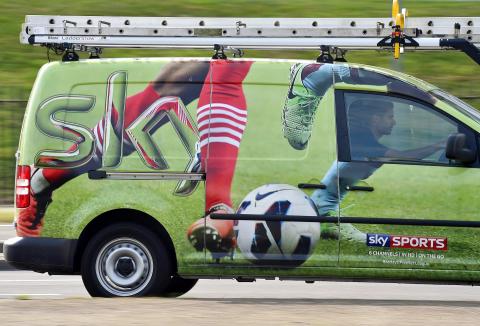
Photo: Reuters
Fox is expected to use the proceeds to fuel its pursuit of Time Warner Inc, which recently rejected a bid by Fox of US$80 billion.
BSkyB signaled a possible deal for Sky Deutschland and Sky Italia in May. The price announced on Friday was slightly lower than analysts’ predictions and the potential cost and revenue benefits higher.
However, BSkyB’s shares fell 5 percent, pulled lower by the plan to issue stock and suspend a share buyback.
“It is a bit of a step into the unknown for Sky,” said Conor O’Shea, an analyst at Kepler Capital Markets. “For the first time, it will go from UK-focused to European and be asked to prove that it can add value from being larger.”
O’Shea has a “buy” rating on BSkyB shares.
Facing the toughest market conditions in its 25-year history, BSkyB has decided future growth lies in creating a European pay-TV leader that would operate in the UK, Ireland, Germany, Austria and Italy.
BSkyB dominates the British pay-TV market, offering premium sports, movies and US drama programs to more than 10 million homes. Of the 97 million households in the five countries it wants to target, 66 million are yet to take pay TV.
“Sky is clearly taking the strategic view that pay TV, already ingrained in US culture, will become prevalent in Europe,” said Richard Hunter, head of equities at Hargreaves Lansdown.
Fox owns 100 percent of Sky Italia, 57 percent of Sky Deutschland and 39 percent of BSkyB. BSkyB will pay £2.45 billion (US$4.2 billion) for Sky Italia and £2.9 billion for Fox’s 57 percent stake in Sky Deutschland.
Under German takeover law, BSkyB also has to make an offer for minority investors in Sky Deutschland, but with only a small premium on the table, analysts expressed doubt that many would sell. The overall price for the deal would rise to around £7 billion if German investors did sell out.
In the eyes of many media executives and investors, programming and content are now seen as more valuable than the infrastructure carrying it to people’s homes.
That change is driven in part by firms such as Netflix and Youtube, which have taken away viewers from traditional pay-TV services.
The shift has led some companies such as Murdoch’s Fox to concentrate more on content, but for those like BSkyB that remain in both content and distribution, they need to invest in technology and fresh programming to see off the challenge.

The domestic unit of the Chinese-owned, Dutch-headquartered chipmaker Nexperia BV will soon be able to produce semiconductors locally within China, according to two company sources. Nexperia is at the center of a global tug-of-war over critical semiconductor technology, with a Dutch court in February ordering a probe into alleged mismanagement at the company. The geopolitical tussle has disrupted supply chains, with some carmakers reportedly forced to cut production due to chip shortages. Local production would allow Nexperia’s domestic arm, Nexperia Semiconductors (China) Ltd (安世半導體中國), to bypass restrictions in place since October on the supply of silicon wafers — etched with tiny components to

Singapore-based ride-hailing and delivery giant Grab Holdings Ltd has applied for regulatory approval to acquire the Taiwan operations of Germany-based Delivery Hero SE's Foodpanda in a deal valued at about US$600 million. Grab submitted the filing to the Fair Trade Commission on Friday last week, with the transaction subject to regulatory review and approval, the company said in a statement yesterday. Its independent governance structure would help foster a healthy and competitive market in Taiwan if the deal is approved, Grab said. Grab, which is listed on the NASDAQ, said in the filing that US-based Uber Technologies Inc holds about 13 percent of
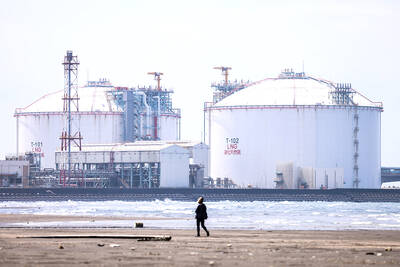
Taiwan is open to joining a global liquefied natural gas (LNG) program if one is created, but on the condition that countries provide delivery even in a scenario where there is a conflict with China, an energy department official said yesterday. While Taiwan’s priority is to have enough LNG at home, the nation is open to exploring potential strategic reserves in other countries such as Japan or South Korea, Energy Administration Deputy Director-General Chen Chung-hsien (陳崇憲) said. While the LNG market does not have a global reserve for emergencies like that of oil, the concept has been raised a few times —

Taiwan Semiconductor Manufacturing Co (TSMC, 台積電) yesterday received government approval to deploy its advanced 3-nanometer (3nm) process at its second fab currently under construction in Japan, the Ministry of Economic Affairs said in a news release. The ministry green-lit the plan for the facility in Kumamoto, which is scheduled to start installing equipment and come online in 2028 with a monthly production capacity of 15,000 12-inch wafers, the ministry said. The Department of Investment Review in June 2024 authorized a US$5.26 billion investment for the facility, slated to manufacture 6- to 12nm chips, significantly less advanced than 3nm process. At a meeting with


 RSS
RSS