


State-run First Securities Investment Trust Co (第一金投信, FSITC) agreed yesterday to compensate investors for losses from funds managed by three former employees who were allegedly involved in stock manipulation.
The fund house, the asset management arm of First Financial Holding Co (第一金控), said in a statement that it would set aside a provision of NT$19 million (US$640,400), equivalent to losses linked to potentially tainted investments in Prescope Technologies Co (普格) last year, and make payments after independent accountants confirm the accuracy of the figures.
FSITC’s move came after the Financial Supervisory Commission on Monday suspended the firm from issuing new funds and asked it to propose compensation and remedy plans.
“FSITC is conducting a thorough review of its operational and investment procedures, and will come up with enhancement measures to prevent any repeat incident,” the company said in a statement.
Last week, the company sacked three fund managers — Hsu Hung-cheng (許弘政), Hsu Shun-chen (許訓誠) and Chaio Jen-chieh (喬仁傑) — who reportedly bought shares in Prescope in exchange for kickbacks, incurring losses for funds under their management.
The scandal broke after investigators probing irregularities at Prescpoe spotted abnormal transactions.
The incident drew the wrath of the Ministry of Finance, the largest shareholder in all state-run financial institutions, including First Financial.
On Monday, the board of First Financial approved the resignation of FSITC chairwoman Hung Hsin-shih (洪新湜), who will retain her position as the group’s spokeswoman.
The behavior of the three fund managers has cast a further shadow over the integrity of the industry four months after their peers at ING Securities Investment and Trust Co (安泰投信), the local unit of Dutch financial services provider ING Group, reportedly mismanaged government-owned funds in order to line their own pockets.
The Dutch-owned fund house agreed in November last year to pay full compensation to institutions and individual investors for losses related to investments in Ablerex Electronics Co (盈正豫順電子).

Merida Industry Co (美利達) has seen signs of recovery in the US and European markets this year, as customers are gradually depleting their inventories, the bicycle maker told shareholders yesterday. Given robust growth in new orders at its Taiwanese factory, coupled with its subsidiaries’ improving performance, Merida said it remains confident about the bicycle market’s prospects and expects steady growth in its core business this year. CAUTION ON CHINA However, the company must handle the Chinese market with great caution, as sales of road bikes there have declined significantly, affecting its revenue and profitability, Merida said in a statement, adding that it would
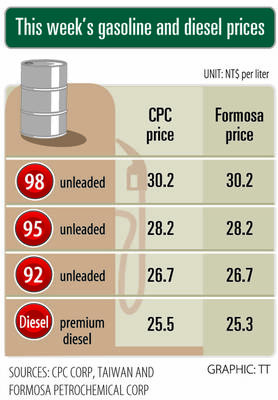
i Gasoline and diesel prices at fuel stations are this week to rise NT$0.1 per liter, as tensions in the Middle East pushed crude oil prices higher last week, CPC Corp, Taiwan (台灣中油) and Formosa Petrochemical Corp (台塑石化) said yesterday. International crude oil prices last week rose for the third consecutive week due to an escalating conflict between Israel and Iran, as the market is concerned that the situation in the Middle East might affect crude oil supply, CPC and Formosa said in separate statements. Front-month Brent crude oil futures — the international oil benchmark — rose 3.75 percent to settle at US$77.01
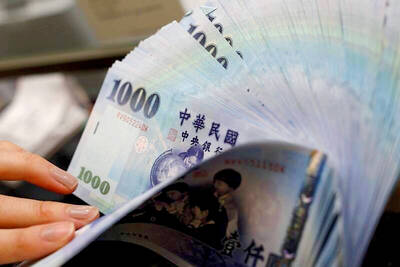
RISING: Strong exports, and life insurance companies’ efforts to manage currency risks indicates the NT dollar would eventually pass the 29 level, an expert said The New Taiwan dollar yesterday rallied to its strongest in three years amid inflows to the nation’s stock market and broad-based weakness in the US dollar. Exporter sales of the US currency and a repatriation of funds from local asset managers also played a role, said two traders, who asked not to be identified as they were not authorized to speak publicly. State-owned banks were seen buying the greenback yesterday, but only at a moderate scale, the traders said. The local currency gained 0.77 percent, outperforming almost all of its Asian peers, to close at NT$29.165 per US dollar in Taipei trading yesterday. The

RECORD LOW: Global firms’ increased inventories, tariff disputes not yet impacting Taiwan and new graduates not yet entering the market contributed to the decrease Taiwan’s unemployment rate last month dropped to 3.3 percent, the lowest for the month in 25 years, as strong exports and resilient domestic demand boosted hiring across various sectors, the Directorate-General of Budget, Accounting and Statistics (DGBAS) said yesterday. After seasonal adjustments, the jobless rate eased to 3.34 percent, the best performance in 24 years, suggesting a stable labor market, although a mild increase is expected with the graduation season from this month through August, the statistics agency said. “Potential shocks from tariff disputes between the US and China have yet to affect Taiwan’s job market,” Census Department Deputy Director Tan Wen-ling


 RSS
RSS