


The Financial Supervisory Commission yesterday pledged to maintain strict oversight of Transglobe Life Insurance Inc’s (全球人壽) financial status and operations after lawmakers questioned its suitability to acquire the insolvent Kuo Hua Life Insurance Co (國華人壽).
The life insurer, which last month won a bid to receive a record government subsidy of NT$88.37 billion (US$3.04 billion) to cover losses at Kuo Hua, promised to meet all requirements and dismissed ties with a local developer embroiled in a kickback scandal. Transglobe is likely to obtain the money by the end of March.
“The commission will take necessary action if Translglobe’s major shareholders prove unfit to run the company,” FSC Chairman Chen Yuh-chang (陳裕璋) told the legislature’s Finance Committee.
Chen made the statements when answering questions from lawmakers over a disputed office-building deal last year in which Taipei-based Meifu Property Development Group (美孚建設集團) chairman Tom Peng (彭誠浩) allegedly bilked money from the buyer by unfairly inflating the property’s value.
Peng is the father of Stiven Peng (彭騰德), chairman of Zhongwei Co (中瑋一) which bought the local unit of Dutch insurer Aegon NV in 2009 and renamed it Transglobe. Stiven Peng currently doubles as Transglobe vice chairman.
Chen said Transglobe will be banned from making investments in Meifu or related parties, or lending money to the developer.
The commission will also require Transglobe to meet the capital adequacy ratio at 250 percent, compared with 200 percent for local peers, upon integration with Kuo Hua in March next year, Chen said, adding that Transglobe needs to appoint three independent board directors and obtain board approval before allocating the compensation fund from the government.
The insurer should take proper care of Kuo Hua employees and strengthen capital structure quickly, if the commission deems injections of new capital as being necessary later, Chen said.
“Transglobe must keep the FSC up to date on its asset allocation and board meeting minutes,” Chen said.
The committee invited Transglobe chairman James Liu (劉先覺) to give accounts of the planned acquisition, but asked him to leave later over concerns of conflict of interest.
“I respect the lawmakers’ decision,” Liu said.
Later yesterday, Transglobe issued a long statement saying it had achieved a capital adequacy level of over 250 percent over the past two years and would have no difficulty maintaining the figure this year.
The company said it aimed to boost its financial position next year through increasing stakes in foreign investments.
Transglobe arrived at the bidding price for Kuo Hua after conducting a due diligence review and consulting its financial adviser, the Swiss banking group UBS AG, the statement said.
The insurer also denied unfair pricing when divesting its 45 percent stake in the disputed office building in Taipei’s Neihu District (內湖), saying it charged an average of NT$540,000 per ping, which was on a par with market rates.
Transglobe voiced its confidence in a smooth takeover of Kuo Hua, saying that the company is well experienced in acquisitions. It called for public support for the transition that would be positive for Kuo Hua policyholders and employees, as well as for wider society, after a three-year limbo.
The FSC had unsuccessfully sought to secure a buyer for Kuo Hua in two previous auctions.
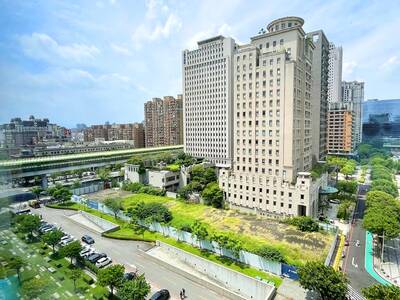
Taichung reported the steepest fall in completed home prices among the six special municipalities in the first quarter of this year, data compiled by Taiwan Realty Co (台灣房屋) showed yesterday. From January through last month, the average transaction price for completed homes in Taichung fell 8 percent from a year earlier to NT$299,000 (US$9,483) per ping (3.3m²), said Taiwan Realty, which compiled the data based on the government’s price registration platform. The decline could be attributed to many home buyers choosing relatively affordable used homes to live in themselves, instead of newly built homes in the city’s prime property market, Taiwan Realty
The government yesterday approved applications by Alphabet Inc’s Google to invest NT$27.08 billion (US$859.98 million) in Taiwan, the Ministry of Economic Affairs said in a statement. The Department of Investment Review approved two investments proposed by Google, with much of the funds to be used for data processing and electronic information supply services, as well as inventory procurement businesses in the semiconductor field, the ministry said. It marks the second consecutive year that Google has applied to increase its investment in Taiwan. Google plans to infuse NT$25.34 billion into Charter Investments Ltd (特許投資顧問) through its Singapore-based subsidiary Fructan Holdings Singapore Pte Ltd, and
Micron Technology Inc is a driving force pushing the US Congress to pass legislation that would put new export restrictions on equipment its Chinese competitors use to make their chips, according to people familiar with the matter. A US House of Representatives panel yesterday was to vote on the “MATCH Act,” a bill designed to close gaps in restrictions on chipmaking equipment. It would also pressure foreign companies that sell equipment to Chinese chipmaking facilities to align with export curbs on US companies like Lam Research Corp and Applied Materials Inc. The bill targets facilities operated by China’s ChangXin Memory Technologies Inc

Japan’s reliance on the Middle East for aluminum is forcing companies to cut back on production and scramble for alternative supply sources after key shipping routes were severed due to the Iran conflict. Among the most exposed are auto and parts makers such as Toyota Motor Corp and Denso Corp. Domestic automakers get about 70 percent of their aluminum imports from the Middle East, the nation’s top auto lobby said. The price of the lightweight alloy — used in everything from engine parts to wheels — has jumped about 13 percent since hostilities started in late February. “It’s only been a month, but it’s


 RSS
RSS