


Taiwan Liposome Co (台灣微脂體) is expected to raise NT$591.36 million (US$20.31 million) from its initial public offering (IPO) on Friday next week, with the firm planning to use the proceeds to improve its gross margin and strengthen its bottom line.
The biopharmaceutical company, headquartered in Taipei’s Nangang Software Park (南港軟體園區), plans to issue 4.62 million new shares on its the GRETAI Securities Market debut and has tentatively set the IPO price at NT$128, the company said.
On Monday, Taiwan Liposome began book building for institutional investors after receiving regulatory approval. The book building, whereby institutional investors make bids for the stock on offer, ends on Thurday, the company said.
Taiwan Liposome currently trades on the smaller Emerging Stock Market, a preparatory board for the nation’s two main bourses. Its shares closed 1.64 percent higher yesterday at NT$279.50, rising 288.9 percent so far this year, according to stock exchange data.
The company reported a net income of NT$24.3 million, or earnings per share of NT$0.62, in the third quarter, after posting a net loss of NT$40.69 million, or a net loss per share of NT$1.04 per share, in the first half of the year.
In the first three quarters of the year, Taiwan Liposome posted a net loss of NT$16.34 million, or loss per share of NT$0.42, much lower than a net loss of NT$137.43 million, or NT$5.11 per share, a year earlier, company data showed.
During the first 11 months of the year, sales surged 210.7 percent to NT$233.195 million from NT$75.048 million a year ago, the company said on Monday.
Analysts say the company is likely to swing into profit next year on the back of certain milestone payments and royalties on product sales. Taiwan Liposome reported a net loss of NT$216.99 million last year, NT$190.21 million in 2010 and NT$184.07 million in 2009.
Established in 1997, Taiwan Liposome focuses on the research and development of pharmaceutical products based on its proprietary drug delivery technologies.
“Traditionally, drugs are transmitted via blood, and the amount of drugs that can reach infected organs is little,” Taiwan Liposome president George Yeh (葉志鴻) said at a pre-IPO conference for investors on Nov. 28.
“We use lipid-based formulation that delivers the drug to infected body parts and releases the drug there, creating better efficacy and lower toxicity for the drugs,” Yeh said.
Lipid-based formulations can also be used to control the amount of drugs released in a given period of time, prolonging the product lifecycle of drugs.
In the past few years, Taiwan Liposome has developed drugs used to treat breast cancer and ovarian cancer, such as Lipo-Dox and Doxisome, as well as ProFlow, a drug used to treat peripheral vascular disease. The company is expected to invest NT$1.15 billion into new drug development from this year through 2016.

Cairo’s new monorail slices across the city skyline, running above the familiar chaos of blaring horns and aging buses’ exhaust fumes that mark rush hour below. The US$4.5 billion monorail, opened this month, is among Egypt’s most prominent new transport projects, part of a debt-funded infrastructure drive criticized for sapping state finances while bringing limited benefits to most of the country’s 109 million people. “It feels like you’re in a different country,” said Ramy Sayed, a restaurant manager, aboard a driverless Innovia 300 train. “No noise, no traffic, we’re not used to this.” The eastern line runs 56km from the bustling middle-class
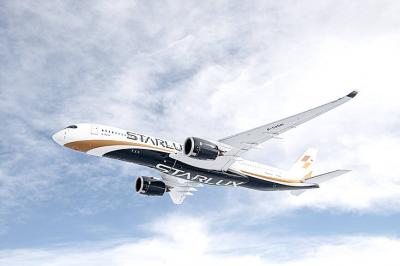
Starlux Airlines Co (星宇航空) today unveiled a long-haul network expansion plan at a shareholders’ meeting in Taipei, including direct flights to Barcelona, Spain, and Zurich, Switzerland, as well as a service connecting Taipei, Sydney and New Zealand. Starlux is to become the first Taiwanese carrier to offer non-stop services to the two European cities, while the inaugural oceanic route is expected to expand transit opportunities within the Australia-New Zealand market, Starlux said. Flight services to Chicago, Dallas, Washington and New York are under evaluation, the airline added. Prior to the shareholders’ meeting, the airline earlier this year announced that it would be

Taiwanese firms have increased investment in the Philippines in recent years as Manila’s ties with Washington deepen and global supply chains continue to shift away from China, an expert at the Chung-Hua Institution for Economic Research (CIER, 中華經濟研究院) said yesterday. The Philippines had not been among Taiwanese investors’ top choices in Southeast Asia, CIER Taiwan ASEAN Studies Center director Kristy Hsu (徐遵慈) said at a seminar in Taipei. However, Taiwan’s investment in the country has grown significantly since the COVID-19 pandemic, reaching US $257 million last year, a high in recent years, she said. Although Taiwan’s total investment in the Philippines still lags

Intel Corp regards Taiwan Semiconductor Manufacturing Co (TSMC, 台積電) as a longstanding partner, as the US chipmaker would continue outsourcing production of advanced chips to TSMC, Intel chief executive officer Lip-Bu Tan (陳立武) said yesterday. “I don’t look at people as competitors. I look at the collaboration... Nvidia is also, you know, a good friend,” Tan told a news conference following his keynote speech at the Computex trade show in Taipei. “It’s a very trusted partnership for us... We are a big, top customer for them, and we’re going to continue doing that,” he said, referring to TSMC, the world’s largest foundry


 RSS
RSS