


Chinese PC maker Lenovo Group Ltd (聯想) has seen rapid growth in China’s smartphone market and aims at raising its share in the high-end market by cooperating with Taiwanese chip designer MediaTek Inc (聯發科), a Taipei-based research firm said recently.
DRAMeXchange Technology Inc, a research arm of advisory firm TrendForce (集邦科技), said in a report on Thursday that Lenovo led all Chinese smartphone makers in terms of shipments in the third quarter of this year.
Altogether, Chinese smartphone makers shipped about 60 million units in the July-to-September period, an increase of 8 percent from the second quarter.
Lenovo, which entered the smartphone sector only in the second quarter of this year, led all local vendors with 9 million units shipped, followed by Huawei Technologies Co’s (華為) 8.5 million units and ZTE Corp’s (中興) 7.5 million units, the report said.
In comparison to other PC makers that have turned to the smartphone market, Lenovo has a stronger pricing strategy and established sales channels, the report said.
EXPANSION
By meeting demand from various consumer groups, Lenovo is strengthening its market share and brand acceptance in the run-up to the company’s attempt to expand through strategies such as adding higher-priced models to its lineup and offering its products internationally, the report added.
As part of an attempt to strengthen its presence in the high-end market and expand to the global market, next year Lenovo may introduce new quad-core and dual-core chips, developed in cooperation with MediaTek, the report said.
The computer maker appears to be determined not to miss the boat on smartphones as the market is growing fast and has a lot of potential.
Lenovo and other Chinese companies are becoming a key part of the smartphone industry. Morgan Stanley forecast in July that China’s smartphone shipments will likely hit the range of between 150 million to 170 million units this year, thanks to rapid upgrades of feature phones.
Meanwhile, Taiwanese companies are also trying to stay ahead in this competitive industry by offering special features to their phones.
Last month, Taiwanese computer maker Acer Inc (宏碁) launched its first smartphone supporting its own personal cloud service in Taiwan as part of efforts to boost its smartphone sales next year. Carrying a price tag of NT$14,900 (US$510) in Taiwan, the cloud service-enabled S500 will go on sale in other Asian countries later this year, the company said.
HYBRID
Asustek Computer Inc (華碩) also launched its second-generation hybrid smartphone last month. The 4.7 inch Padfone 2 can be combined with a 10.1 inch tablet to provide the integrated functions of a mobile phone and a tablet computer.
Asustek said the Padfone lineup is seen as a “restart point” for its smartphone business and the company is dedicated to making its products more user-friendly.
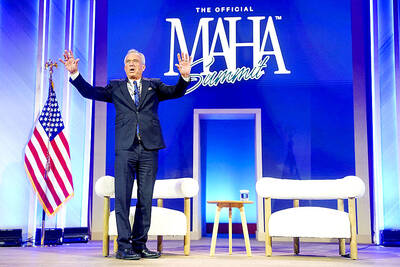
Sweeping policy changes under US Secretary of Health and Human Services Robert F. Kennedy Jr are having a chilling effect on vaccine makers as anti-vaccine rhetoric has turned into concrete changes in inoculation schedules and recommendations, investors and executives said. The administration of US President Donald Trump has in the past year upended vaccine recommendations, with the country last month ending its longstanding guidance that all children receive inoculations against flu, hepatitis A and other diseases. The unprecedented changes have led to diminished vaccine usage, hurt the investment case for some biotechs, and created a drag that would likely dent revenues and
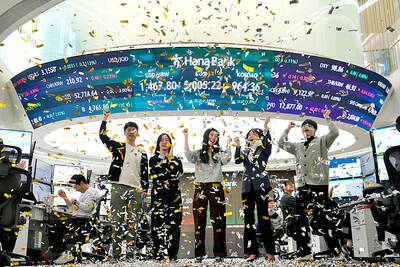
Global semiconductor stocks advanced yesterday, as comments by Nvidia Corp chief executive officer Jensen Huang (黃仁勳) at Davos, Switzerland, helped reinforce investor enthusiasm for artificial intelligence (AI). Samsung Electronics Co gained as much as 5 percent to an all-time high, helping drive South Korea’s benchmark KOSPI above 5,000 for the first time. That came after the Philadelphia Semiconductor Index rose more than 3 percent to a fresh record on Wednesday, with a boost from Nvidia. The gains came amid broad risk-on trade after US President Donald Trump withdrew his threat of tariffs on some European nations over backing for Greenland. Huang further
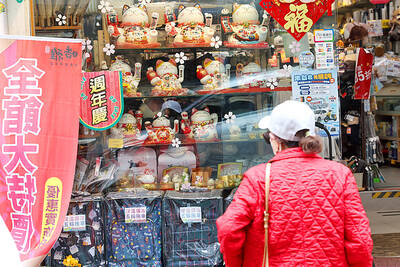
CULPRITS: Factors that affected the slip included falling global crude oil prices, wait-and-see consumer attitudes due to US tariffs and a different Lunar New Year holiday schedule Taiwan’s retail sales ended a nine-year growth streak last year, slipping 0.2 percent from a year earlier as uncertainty over US tariff policies affected demand for durable goods, data released on Friday by the Ministry of Economic Affairs showed. Last year’s retail sales totaled NT$4.84 trillion (US$153.27 billion), down about NT$9.5 billion, or 0.2 percent, from 2024. Despite the decline, the figure was still the second-highest annual sales total on record. Ministry statistics department deputy head Chen Yu-fang (陳玉芳) said sales of cars, motorcycles and related products, which accounted for 17.4 percent of total retail rales last year, fell NT$68.1 billion, or

MediaTek Inc (聯發科) shares yesterday notched their best two-day rally on record, as investors flock to the Taiwanese chip designer on excitement over its tie-up with Google. The Taipei-listed stock jumped 8.59 percent, capping a two-session surge of 19 percent and closing at a fresh all-time high of NT$1,770. That extended a two-month rally on growing awareness of MediaTek’s work on Google’s tensor processing units (TPUs), which are chips used in artificial intelligence (AI) applications. It also highlights how fund managers faced with single-stock limits on their holding of market titan Taiwan Semiconductor Manufacturing Co (TSMC, 台積電) are diversifying into other AI-related firms.


 RSS
RSS