


Taiwan Research Institute (TRI, 台灣綜合研究院) founder Liu Tai-ying (劉泰英) yesterday said it was too early to tell whether the nation’s economy had bottomed out in the third quarter, citing weak confidence in the private sector.
Both exports and export orders for last month showed annual increases that ended six consecutive months of decline, but Liu said the nation needed to see more positive signs in the leading economic indicators to confirm the strength of economic recovery.
The government must implement measures to increase domestic demand and boost confidence in the financial market, he said.
“Confidence will be a key factor in leading Taiwan’s economy to rebound,” Liu told a media briefing after hosting an economic forum on global central banks’ quantitative easing measures.
The global economic slowdown has been the major downside for Taiwan’s economy this year.
Despite major economies adopting quantitative easing measures in a bid to support growth momentum and solve financial problems, the effect of these measures would be limited, Liu said.
The persistent eurozone debt crisis and a grim outlook on corporate earnings have negatively affected investors’ confidence, driving down transaction volume in the local stock market, Taiwan Stock Exchange’s data showed.
Daily trading volume was NT$45.875 billion yesterday on the main bourse, down from NT$49.081 billion on Monday, data showed.
Liu said Taiwan still has abundant human resources and does not lack capital.
However, the lack of confidence among domestic companies about the prospects of their businesses has led to weak private investment, which is detrimental to the national economy, he said.
Private investment is forecast to fall 1.03 percent this year from last year, the Directorate-General of Budget, Accounting and Statistics (DGBAS) said on Aug. 17, when it revised downward its forecast for GDP growth this year to 1.66 percent from its previous estimate of 2.08 percent.
Given that the growth momentum of external demand is not likely to recover substantially over the next few years, and the DGBAS forecast Taiwan’s exports to contract 1.72 percent this year, the first contraction since the global financial crisis, the government should launch solid industrial policies to help rebuild the private sector’s confidence and boost domestic demand, Liu said.
However, National Taiwan University finance professor Shen Chung-hua (沈中華) expressed a more optimistic view, saying that he expected the economy to recover slightly next year due to the regular business cycle.
The DGBAS forecast the economy would expand 3.67 percent next year on the back of recovering global trading momentum.

Nanya Technology Corp (南亞科技) yesterday said the DRAM supply crunch could extend through 2028, as the artificial intelligence (AI) boom has led the world’s major memory makers to dramatically reduce production of standard DRAM and allocate a significant portion of their capacity for high-bandwidth memory (HBM) chips. The most severe supply constraints would stretch to the first half of next year due to “very limited” increases in new DRAM capacity worldwide, Nanya Technology president Lee Pei-ing (李培瑛) told a news briefing. The company plans to increase monthly 12-inch wafer capacity to 20,000 in the first half of 2028 after a

Taiwan has enough crude oil reserves for more than 100 days and sufficient natural gas reserves for more than 11 days, both above the regulatory safety requirement, Minister of Economic Affairs Kung Ming-hsin (龔明鑫) said yesterday, adding that the government would prioritize domestic price stability as conflicts in the Middle East continue. Overall, energy supply for this month is secure, and the government is continuing efforts to ensure sufficient supply for next month, Kung told reporters after meeting with representatives from business groups at the ministry in Taipei. The ministry has been holding daily cross-ministry meetings at the Executive Yuan to ensure
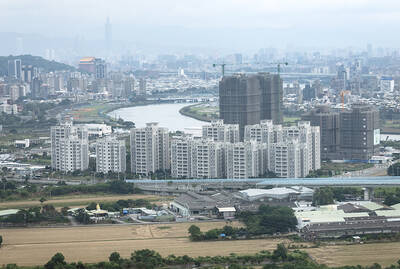
Property transactions in the nation’s six special municipalities plunged last month, as a lengthy Lunar New Year holiday combined with ongoing credit tightening dampened housing market activity, data compiled by local land administration offices released on Monday showed. The six cities recorded a total of 10,480 property transfers last month, down 42.5 percent from January and marking the second-lowest monthly level on record, the data showed. “The sharp drop largely reflected seasonal factors and tighter credit conditions,” Evertrust Rehouse Co (永慶房屋) deputy research manager Chen Chin-ping (陳金萍) said. The nine-day Lunar New Year holiday fell in February this year, reducing

HORMUZ ISSUE: The US president said he expected crude prices to drop at the end of the war, which he called a ‘minor excursion’ that could continue ‘for a little while’ The United Arab Emirates (UAE) and Kuwait started reducing oil production, as the near-closure of the crucial Strait of Hormuz ripples through energy markets and affects global supply. Abu Dhabi National Oil Co (ADNOC) is “managing offshore production levels to address storage requirements,” the company said in a statement, without giving details. Kuwait Petroleum Corp said it was lowering production at its oil fields and refineries after “Iranian threats against safe passage of ships through the Strait of Hormuz.” The war in the Middle East has all but closed Hormuz, the narrow waterway linking the Persian Gulf to the open seas,


 RSS
RSS