


The Taipei Computer Application Show, to be held from Thursday through Monday the following week, will feature bargains for the newest notebook PCs, computer peripherals, consumer electronics and communications products from first-tier brand vendors.
The show will host 200 exhibitors at 1,300 booths this year, the organizers said in a statement.
“The show is for consumers to look for better prices and promotional deals,” said Reyming Tu (杜瑞敏), deputy executive director of the Taiwan External Trade Development Council (外貿協會).
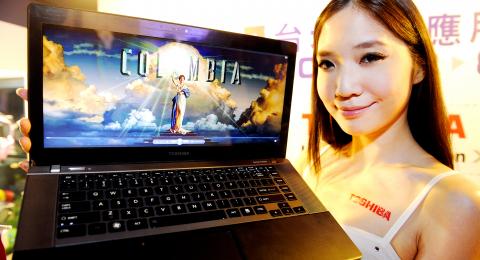
Photo: George Tsorng, Taipei Times
“It is also a good indicator of what consumers favor in terms of size, design and technology,” said Charles Huang (黃鋆鋇), deputy secretary-general of the Taipei Computer Association (台北市電腦公會).
The organizers said that they had seen some trends in exhibitors’ products. One is having distinctive features to differentiate themselves from competitors. For notebook PCs, examples include the hidden I/O port in Acer Inc’s (宏碁) Aspire S Ultrabook series, the trusted platform module and fingerprint identification system in Fujitsu Ltd’s Lifebook U772 and the 21:9 ultra-wide-screen of Toshiba Corp’s Satellite U840W Ultrabook.
Wi-Fi connectivity is another trend for computer peripherals and consumer electronics products, such as printers and digital cameras, the organizers said.
Shipments of printers and digital cameras with wireless connections have been growing, organizers said.
Wi-Fi-equipped printers accounted for 13 percent of all printer shipments in the market last year and are expected to account for 20 percent this year, they said.
The admission to the six-day show is free and the first 100 visitors on the first two days will receive a gift bag containing multiple valuable items, organizers said.

Taiwan Semiconductor Manufacturing Co (TSMC, 台積電) last week recorded an increase in the number of shareholders to the highest in almost eight months, despite its share price falling 3.38 percent from the previous week, Taiwan Stock Exchange data released on Saturday showed. As of Friday, TSMC had 1.88 million shareholders, the most since the week of April 25 and an increase of 31,870 from the previous week, the data showed. The number of shareholders jumped despite a drop of NT$50 (US$1.59), or 3.38 percent, in TSMC’s share price from a week earlier to NT$1,430, as investors took profits from their earlier gains
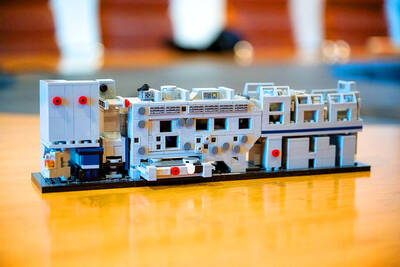
In a high-security Shenzhen laboratory, Chinese scientists have built what Washington has spent years trying to prevent: a prototype of a machine capable of producing the cutting-edge semiconductor chips that power artificial intelligence (AI), smartphones and weapons central to Western military dominance, Reuters has learned. Completed early this year and undergoing testing, the prototype fills nearly an entire factory floor. It was built by a team of former engineers from Dutch semiconductor giant ASML who reverse-engineered the company’s extreme ultraviolet lithography (EUV) machines, according to two people with knowledge of the project. EUV machines sit at the heart of a technological Cold
AI TALENT: No financial details were released about the deal, in which top Groq executives, including its CEO, would join Nvidia to help advance the technology Nvidia Corp has agreed to a licensing deal with artificial intelligence (AI) start-up Groq, furthering its investments in companies connected to the AI boom and gaining the right to add a new type of technology to its products. The world’s largest publicly traded company has paid for the right to use Groq’s technology and is to integrate its chip design into future products. Some of the start-up’s executives are leaving to join Nvidia to help with that effort, the companies said. Groq would continue as an independent company with a new chief executive, it said on Wednesday in a post on its Web

CHINA RIVAL: The chips are positioned to compete with Nvidia’s Hopper and Blackwell products and would enable clusters connecting more than 100,000 chips Moore Threads Technology Co (摩爾線程) introduced a new generation of chips aimed at reducing artificial intelligence (AI) developers’ dependence on Nvidia Corp’s hardware, just weeks after pulling off one of the most successful Chinese initial public offerings (IPOs) in years. “These products will significantly enhance world-class computing speed and capabilities that all developers aspire to,” Moore Threads CEO Zhang Jianzhong (張建中), a former Nvidia executive, said on Saturday at a company event in Beijing. “We hope they can meet the needs of more developers in China so that you no longer need to wait for advanced foreign products.” Chinese chipmakers are in


 RSS
RSS