


Wafts of perfume thrill visitors as soon as they set foot in the frescoed halls of the Santa Maria Novella pharmacy in Florence, Italy, a perfumer to poets, film stars and noblewomen through the ages.
The perfumer actually traces its roots back to 1221 by Dominican friars who cultivated medicinal herbs to make potions and balms. The company is housed in medieval halls with spectacular views on a cloister in the city center.
The fame of its products soon spread beyond the walls of the monastery and in 1612 the pharmacy opened its doors to the public under the patronage of the Medici family, which became an ambassador for the brand in royal courts.
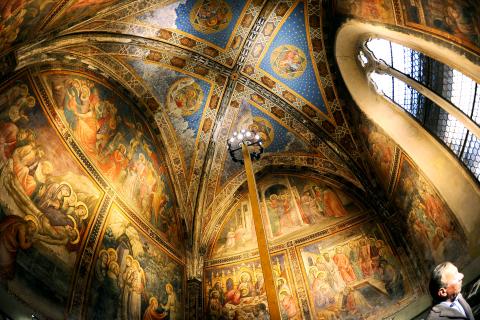
Photo: AFP
When she married French King Henry II, Catherine de Medici brought a bergamot-based perfume with her called “Eau de la Reine,” a revolutionary new fragrance that became wildly popular at the royal court.
“Perfumes were mixed with oil or vinegar before, but the monks had the intuition to use alcohol. ‘Eau de la Reine’ was the first famous European perfume to be produced with alcohol,” said Gianluca Foa, the pharmacy’s commercial director.
“Eau de la Reine” is still being produced by Santa Maria Novella, one of the products that have secured the success of the company despite the troubled world economy. Last year, Santa Maria Novella’s turnover went up 37 percent.
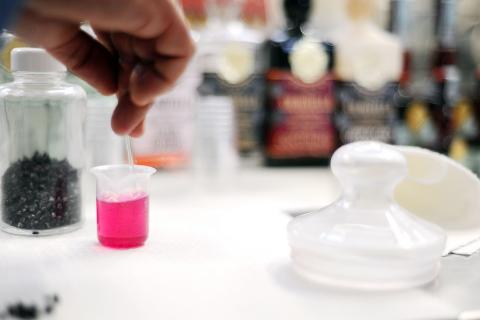
Photo: AFP
The windows and the counter are unchanged since 1612, even though the Dominicans were forced to leave in 1886 when the Italian state seized the monastery as part of a large-scale confiscation of church property.
It was then sold to the nephew of the last Dominican abbot and four generations of that same family have run the company ever since.
Eighty percent of the company’s clients now are foreign — like Sabrina from China.
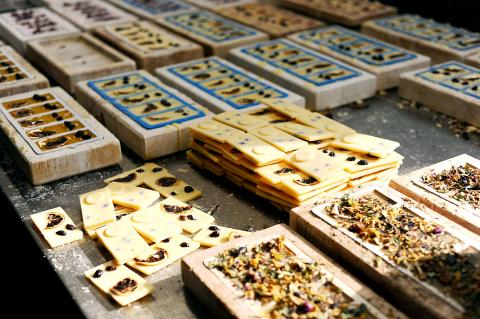
Photo: AFP
“I thought it was just a shop before coming here, but this is fabulous,” she said, admiring the frescoes.
Different products sell better in different countries. Calendula cream sells well in China, mint geranium pastilles in Japan, idralia cream in South Korea.
The firm has also invested in refurbishing the deconsecrated church next door, San Niccolo, into a very special kind of archive.
The shelves are filled with beauty creams, perfumes, liquors and candles, all wrapped in simple yet elegant packaging.
Many of the ingredients come from Santa Maria Novella’s own plantations of medicinal herbs — far from the monastery garden walls.
The main laboratory is a 4,500m2 space outside of the historical center, where production is still very much handmade — from making soap bars, to decorating candles, to labeling.
Soap bars — like rolls of cheese — are dried out for two months in large airing cupboards before being sold off around the world.
The complexity of the production methods and the expense of the raw materials also help ensure there are few counterfeits around.
Santa Maria Novella’s discreet quality has attracted big names over the centuries: from the poets Dante and Lord Byron to actresses Penelope Cruz and Monica Bellucci, to aristocrats such as Princess Caroline of Monaco.
Santa Maria Novella has 200 outlets, including in Auckland and Hong Kong.
“Today, Santa Maria Novella’s clients are getting younger and younger. It’s good. They transmit the enthusiasm for our products and they live longer,” said Eugenio Alphandery, the company’s chief executive.
The quality comes at a price, however. A small perfume bottle sells for 80 euros (US$105) and a potpourri — a specialty of the house — is 15 euros.
The cheapest gift? A box of delicious pastilles at 5 euros.

KEEPING UP: The acquisition of a cleanroom in Taiwan would enable Micron to increase production in a market where demand continues to outpace supply, a Micron official said Micron Technology Inc has signed a letter of intent to buy a fabrication site in Taiwan from Powerchip Semiconductor Manufacturing Corp (力積電) for US$1.8 billion to expand its production of memory chips. Micron would take control of the P5 site in Miaoli County’s Tongluo Township (銅鑼) and plans to ramp up DRAM production in phases after the transaction closes in the second quarter, the company said in a statement on Saturday. The acquisition includes an existing 12 inch fab cleanroom of 27,871m2 and would further position Micron to address growing global demand for memory solutions, the company said. Micron expects the transaction to

Vincent Wei led fellow Singaporean farmers around an empty Malaysian plot, laying out plans for a greenhouse and rows of leafy vegetables. What he pitched was not just space for crops, but a lifeline for growers struggling to make ends meet in a city-state with high prices and little vacant land. The future agriculture hub is part of a joint special economic zone launched last year by the two neighbors, expected to cost US$123 million and produce 10,000 tonnes of fresh produce annually. It is attracting Singaporean farmers with promises of cheaper land, labor and energy just over the border.

US actor Matthew McConaughey has filed recordings of his image and voice with US patent authorities to protect them from unauthorized usage by artificial intelligence (AI) platforms, a representative said earlier this week. Several video clips and audio recordings were registered by the commercial arm of the Just Keep Livin’ Foundation, a non-profit created by the Oscar-winning actor and his wife, Camila, according to the US Patent and Trademark Office database. Many artists are increasingly concerned about the uncontrolled use of their image via generative AI since the rollout of ChatGPT and other AI-powered tools. Several US states have adopted

A proposed billionaires’ tax in California has ignited a political uproar in Silicon Valley, with tech titans threatening to leave the state while California Governor Gavin Newsom of the Democratic Party maneuvers to defeat a levy that he fears would lead to an exodus of wealth. A technology mecca, California has more billionaires than any other US state — a few hundred, by some estimates. About half its personal income tax revenue, a financial backbone in the nearly US$350 billion budget, comes from the top 1 percent of earners. A large healthcare union is attempting to place a proposal before


 RSS
RSS