


The Bhote Koshi river rises in Tibet and cuts a mighty swathe through the Himalayas, carving out gorges as it tumbles into Nepal in a series of thundering rapids.
Regarded as one of the best waterways in the world for whitewater rafting, the river attracts thrill-seekers of all nationalities, keen to test their mettle in the adrenaline-pumping sport.
Since the end of Nepal’s 10-year civil war in 2006, a surge in popularity has made rafting a multi-million dollar industry and a vital contributor to tourism in the impoverished nation. However, many sections of Nepal’s famed river network could soon be tamed as the energy-starved country plans a huge expansion in hydro-electricity in the face of a shortage that has brought power cuts lasting up to 16 hours a day.
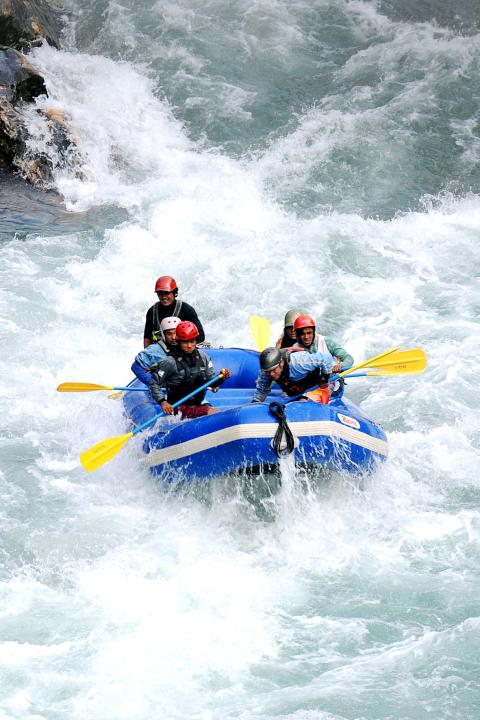
Photo: AFP
“When people talk about whitewater rafting, they think of the Bhote Koshi river. It is for adventure seekers what Everest and Annapurna are for climbers,” Nepal River Conservation Trust president Megh Ale said. “So, it is the world’s heritage — not only Nepal’s. We are not against development in itself, but the government should clearly state which river is for what.”
Experts say Nepal’s mountain river system could be generating 83,000 megawatts of power. The nation currently produces a paltry 692 megawatts.
Nepal’s dire power shortage has crippled industry and dissuaded foreign investment, with crucial infrastructure development having ground to a halt in the years of political paralysis following the 1996-2006 Maoist insurgency. The country has 23 hydropower plants, according to the Independent Power Producers’ Association Nepal, but a further 36 have been mooted or are already being built.
One plant under construction on the Bhote Koshi will include a gated weir near the Tibetan border, choking the fast flow of water for rafters, with may people expressing horror at the threat to their sport.
Five major resorts and 21 rafting companies operate along its banks, bringing in more than 100,000 tourists a year and providing hundreds of jobs.
Campaigners have called on the government to take rafting into account when planning locations for hydropower projects.
However, the energy industry insists power generation in the impoverished nation should take priority over adventure.
“Hydropower development is the need of the hour,” Welcome Energy Development Co general manager L.B. Thapa said. “We should ask the right question — what is the need of our country? Is it energy or rafting?”
The Chilime Hydropower Co, which is behind the Bhote Koshi project, insists it would lose half of its capacity and all its profits were it to build further away from rafting hotspots.
“We are not against tourism. We believe that the sector needs to flourish,” Chilime Hydropower general manager Prakash Shrestha said. “But if we go by the theory of utilization of water, the first priority should be given to drinking water, second to irrigation, third hydropower and only then rafting.”
Whitewater rafting was introduced to Nepal in the middle of the 1970s by foreign diplomats and has been embraced by tourism businesses who now offer packages to holidaymakers lasting up to 12 days.
Chudamani Aryal, 37, has spent 16 years as a rafting guide on Nepal’s longest river, the Karnali, which flows through dense forest near the Bardiya National Park in the country’s south. For him, the appeal is clear.
“We start off as soon as the sun rises to see crocodiles come ashore to bask in the sun. We come across spotted deer, barking deer and other rare animals like endangered dolphins,” Aryal said. “The tourists constantly say ‘wow.’ We can see the glow of satisfaction on their faces. We should not sacrifice all this for the sake of hydropower development.”
Indian developer GMR is building a 900 megawatt hydro plant, which Aryal believes will severely curtail rafting on the Karnali, reducing its appeal to foreign tourists who may go elsewhere in search of thrills.
Tourism contributes more than US$1 billion to the economy and the Nepal River Conservation Trust says rafting pulls in more than 20 percent of foreign holidaymakers, counted at a record 719,547 visitors last year.
“We have nearly 6,000 streams and rivers. Why can’t we spare some for rafting? We need to promote nature-based tourism,” Ale said. “Countries that don’t have any natural beauty erect buildings to attract tourism. Despite being bestowed with immense natural beauty, we are destroying it.”

Cairo’s new monorail slices across the city skyline, running above the familiar chaos of blaring horns and aging buses’ exhaust fumes that mark rush hour below. The US$4.5 billion monorail, opened this month, is among Egypt’s most prominent new transport projects, part of a debt-funded infrastructure drive criticized for sapping state finances while bringing limited benefits to most of the country’s 109 million people. “It feels like you’re in a different country,” said Ramy Sayed, a restaurant manager, aboard a driverless Innovia 300 train. “No noise, no traffic, we’re not used to this.” The eastern line runs 56km from the bustling middle-class

Taiwanese firms have increased investment in the Philippines in recent years as Manila’s ties with Washington deepen and global supply chains continue to shift away from China, an expert at the Chung-Hua Institution for Economic Research (CIER, 中華經濟研究院) said yesterday. The Philippines had not been among Taiwanese investors’ top choices in Southeast Asia, CIER Taiwan ASEAN Studies Center director Kristy Hsu (徐遵慈) said at a seminar in Taipei. However, Taiwan’s investment in the country has grown significantly since the COVID-19 pandemic, reaching US $257 million last year, a high in recent years, she said. Although Taiwan’s total investment in the Philippines still lags

Intel Corp regards Taiwan Semiconductor Manufacturing Co (TSMC, 台積電) as a longstanding partner, as the US chipmaker would continue outsourcing production of advanced chips to TSMC, Intel chief executive officer Lip-Bu Tan (陳立武) said yesterday. “I don’t look at people as competitors. I look at the collaboration... Nvidia is also, you know, a good friend,” Tan told a news conference following his keynote speech at the Computex trade show in Taipei. “It’s a very trusted partnership for us... We are a big, top customer for them, and we’re going to continue doing that,” he said, referring to TSMC, the world’s largest foundry

Artificial intelligence (AI) agents would supplant smartphones as the center of people’s digital lives, fundamentally reshaping personal devices and driving a major computing upgrade cycle, Qualcomm Inc CEO Cristiano Amon said yesterday. In his keynote speech for this year’s Computex trade show in Taipei, Amon said that the rise of "agentic AI" — AI systems capable of reasoning, planning and carrying out tasks autonomously — would transform how people interact with technology across phones, PCs, vehicles and wearable devices. Describing the technology as the next major evolution in computing, Amon said that "2026 is the year of agents.” For decades, smartphones have sat


 RSS
RSS