


Cathay Financial Holding Co (國泰金控), the nation’s largest financial services provider by assets, yesterday said it plans to increase its capital to accelerate its cross-strait expansion. The firm also urged the government to ease restrictions on purchases of undeveloped commercial land by life insurers.
“I cannot comment on the use of the new capital until things are finalized,” Cathay Financial president Lee Chang-ken (李長庚) told an investors’ conference.
It is the first time in at least two decades that Cathay Financial will embark on a plan to increase its capital — which still needs the approval of shareholders — and it is expected to raise NT$40 billion (US$1.35 billion) via a new share issue and NT$12 billion of European convertible bonds.
The plan has fueled speculation that the conglomerate is on the verge of closing an acquisition or merger with a Chinese peer.
“We are exploring all the legal options to accelerate cross-strait expansion,” Lee said. “Banks are the most likely investment target for both sides, compared with life insurance or financial holding companies.”
Under existing rules, Cathay Financial may acquire up to a 20 percent stake in a Chinese bank, while Chinese banks can own a 5 percent stake in a Taiwanese peer or a combined 10 percent stake in association with other Chinese investors.
Cathay Financial chairman Tsai Hong-tu (蔡宏圖) told local media last week that his company was looking to set up a cross-shareholding arrangement with a major Chinese financial institution.
Potential targets include Bank of China (中國銀行), Industrial and Commercial Bank of China (中國工商銀行), Agriculture Bank of China (中國農業銀行) and China Construction Bank (中國建設銀行), as well as other smaller Chinese financial institutions.
UBS financial analyst Pandora Lee (李懿璇) said that not all cross-strait partnerships would be beneficial to Cathay Financial in terms of earnings growth or gains in market share.
“Something is definitely going on, judging by the plan to increase capital,” Pandora Lee said. “However, I doubt Cathay Financial is capable of acquiring a significant stake in a major Chinese bank, given their size.”
Domestically, Cathay Financial reiterated its intention to increase real-estate investments and it considers constraints imposed on purchases of undeveloped plots of land by life insurance companies unnecessary, Lee Chang-ken said.
The company urged the Financial Supervisory Commission to ease the restrictions, saying such tightening slows business activity, but does little to advance adjustments of prices in the housing market.
“The restriction should apply only to residential land transactions to curb rising house prices,” he said. “Commercial land deals help bring prosperity for society and there should be more flexibility.”
The commission requires purchases of plots of land by life insurance companies to be coupled with applications for construction licenses to avoid land hoarding.

Cairo’s new monorail slices across the city skyline, running above the familiar chaos of blaring horns and aging buses’ exhaust fumes that mark rush hour below. The US$4.5 billion monorail, opened this month, is among Egypt’s most prominent new transport projects, part of a debt-funded infrastructure drive criticized for sapping state finances while bringing limited benefits to most of the country’s 109 million people. “It feels like you’re in a different country,” said Ramy Sayed, a restaurant manager, aboard a driverless Innovia 300 train. “No noise, no traffic, we’re not used to this.” The eastern line runs 56km from the bustling middle-class
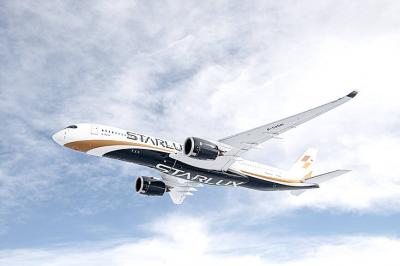
Starlux Airlines Co (星宇航空) today unveiled a long-haul network expansion plan at a shareholders’ meeting in Taipei, including direct flights to Barcelona, Spain, and Zurich, Switzerland, as well as a service connecting Taipei, Sydney and New Zealand. Starlux is to become the first Taiwanese carrier to offer non-stop services to the two European cities, while the inaugural oceanic route is expected to expand transit opportunities within the Australia-New Zealand market, Starlux said. Flight services to Chicago, Dallas, Washington and New York are under evaluation, the airline added. Prior to the shareholders’ meeting, the airline earlier this year announced that it would be

Taiwanese prosecutors suspect that three people successfully smuggled at least one shipment of Nvidia Corp artificial intelligence (AI) chips to China after first exporting them to Japan, people familiar with the matter said. The trio was detained last week by the Keelung District Prosecutors’ Office for allegedly falsifying documents related to exports of Super Micro Computer Inc servers containing advanced Nvidia chips, which the US has barred from sale to China without a license from Washington. The move marked Taiwan’s first public crackdown on AI chip diversion after years of pressure from the US to take a more active role in curtailing
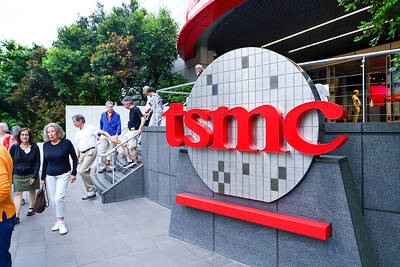
Taiwan Semiconductor Manufacturing Co (TSMC, 台積電) employee bonuses are likely to grow more than 30 percent this year, in line with the past few years as the company’s profits continue to set new records, an anonymous source cited TSMC chairman C.C. Wei (魏哲家) as saying yesterday. TSMC, the world’s largest contract chipmaker, is committed to taking care of its workers, the source said, citing Wei’s meeting with employees yesterday morning. Wei also expressed gratitude to employees for their contribution to the company’s improving bottom line, the source added. Since 2023, TSMC’s employee bonuses have grown at an annual rate of


 RSS
RSS