


Taishin Financial Holding Co (台新金控), which owns the nation’s third-largest credit card issuer, Taishin International Bank (台新銀行), is aiming to expand through mergers and acquisitions (M&As), although there is no timetable for expansion, senior executives said on Saturday.
The conglomerate will first seek to increase the size of the banking subsidiary to make it one of the leading lenders in the local market, chief financial officer Welch Lin (林維俊) told a media gathering.
The bank-centric group posted NT$9.44 billion (US$320.42 million) in net income last year, which translated into earnings of NT$1.27 per share and was 20 percent higher than the previous year, company data showed.
Last year’s results, the best in seven years, were underpinned by earnings at Taishin Bank that more than offset losses incurred by the securities brokerage unit, company data showed.
“The expansion strategy will target banks, insurance companies and other financial services to strengthen our earnings and product lines,” Lin said.
Market share gains for Taishin Bank are based on the expansion plans, and these plans accounted for the group’s 2005 acquisition of a 22.5 percent stake in Chang Hwa Commercial Bank (彰化銀行), Lin said.
The deal gave Taishin Financial majority control of Chang Hwa’s board, but political challenges have prevented further integration.
Taishin Financial is still interested in acquiring a life insurance company after losing the bid for MetLife Inc’s Taiwanese unit to Chinatrust Financial Holding Co (中信金控) in March last year, Lin said.
Having a life insurance subsidiary would strengthen the group’s product lines and bring synergistic benefits, Lin said.
Taishin Financial also aims to deepen its presence in other financial service businesses that will help boost earnings, Lin said.
“This explains why in December 2010 we acquired IBT Asset Management Co (台灣工銀投信),” a subsidiary of the Industrial Business Bank (台灣工銀), for NT$437.5 million, he said.
Taishin Securities Investment Trust Co (台新投信) saw its assets under management advance 50 percent to NT$90 billion in January from NT$60 billion upon the integration 14 months ago, Taishin Investment Trust chairman Johnson Chen (陳瓊讚) said.
The figures meant a 10 percent increase from one month earlier and a 50 percent gain from the year-ago level, company data indicated.
The performance pushed Taishin Securities Trust’s ranking in the local market to ninth place from 24th, Chen said, adding that it was approaching the NT$100 billion goal set to be achieved next year.
The fund manager will continue to differentiate itself from its peers by specializing in emerging markets, Chen said.
Taishin Financial president Joseph Jao (饒世湛) said the group planned to open its second capital leasing company in Tianjin, China, in July, as long as Chinese regulators approve the application.
Jao said he hoped that Taiwan and China would ease access rules faster to allow so that service providers could expand more quickly.
Taishin Financial is scheduled to hold an investor conference tomorrow.
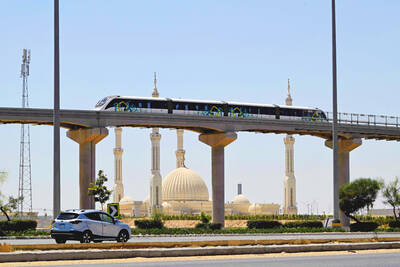
Cairo’s new monorail slices across the city skyline, running above the familiar chaos of blaring horns and aging buses’ exhaust fumes that mark rush hour below. The US$4.5 billion monorail, opened this month, is among Egypt’s most prominent new transport projects, part of a debt-funded infrastructure drive criticized for sapping state finances while bringing limited benefits to most of the country’s 109 million people. “It feels like you’re in a different country,” said Ramy Sayed, a restaurant manager, aboard a driverless Innovia 300 train. “No noise, no traffic, we’re not used to this.” The eastern line runs 56km from the bustling middle-class
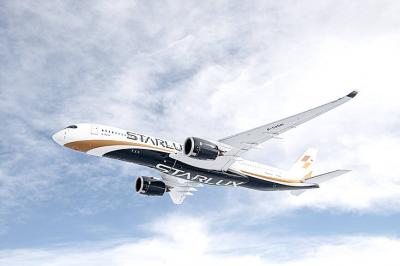
Starlux Airlines Co (星宇航空) today unveiled a long-haul network expansion plan at a shareholders’ meeting in Taipei, including direct flights to Barcelona, Spain, and Zurich, Switzerland, as well as a service connecting Taipei, Sydney and New Zealand. Starlux is to become the first Taiwanese carrier to offer non-stop services to the two European cities, while the inaugural oceanic route is expected to expand transit opportunities within the Australia-New Zealand market, Starlux said. Flight services to Chicago, Dallas, Washington and New York are under evaluation, the airline added. Prior to the shareholders’ meeting, the airline earlier this year announced that it would be

Netherlands-based semiconductor equipment supplier ASML Holding NV yesterday said that it is planning to hire an additional 1,000 people in Taiwan this year in response to growing demand from clients. ASML had previously planned to recruit 600 people this year, but that the plan has been adjusted upward, ASML vice president and ASML Taiwan general manager Grace Wang (汪佳慧) told reporters. ASML has a workforce of more than 4,500 in Taiwan, accounting for about 10 percent of its global total, Wang said. This year’s recruitment campaign would focus on adding people in the customer support, manufacturing and supply chain domains to assist ASML
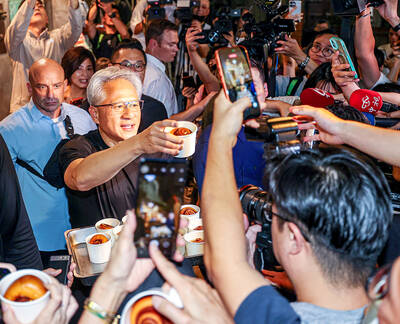
Nvidia Corp yesterday announced that CEO Jensen Huang (黃仁勳) would attend an employee meeting in Taipei tomorrow to celebrate the launch of the company’s Taiwan headquarters project. Huang would attend a gathering at the site of Nvidia’s planned headquarters in Beitou Shilin Technology Park (北投士林科技園區), the company said in a statement. After arriving in Taiwan on Saturday last week, Huang told reporters that he plans to meet with Quanta Computer Inc (廣達) chairman Barry Lam (林百里) and Taiwan Semiconductor Manufacturing Co (TSMC, 台積電) chairman C.C. Wei (魏哲家), and would attend the groundbreaking ceremony for Nvidia’s Taiwan headquarters tomorrow. Nvidia has not yet applied


 RSS
RSS