


Want to know what’s in store for 2012? Who will win the US election? Will the eurozone implode? As Chinese communities around the world prepared to ring in the new lunar year last night, astrologers and geomancers were predicting the Year of the Dragon will bring natural disasters and financial volatility, especially to crisis-hit Europe.
“The world economy will be unstable in the Year of the Dragon, because the economies in Europe and the US are still suffering from the effects of the recession,” Hong Kong feng shui master Anthony Cheng (鄭棋之) said.
Celebrity astrologer Peter So (蘇民峰) says the US will provide some good news late in the year, but his charts for Europe make grim reading.
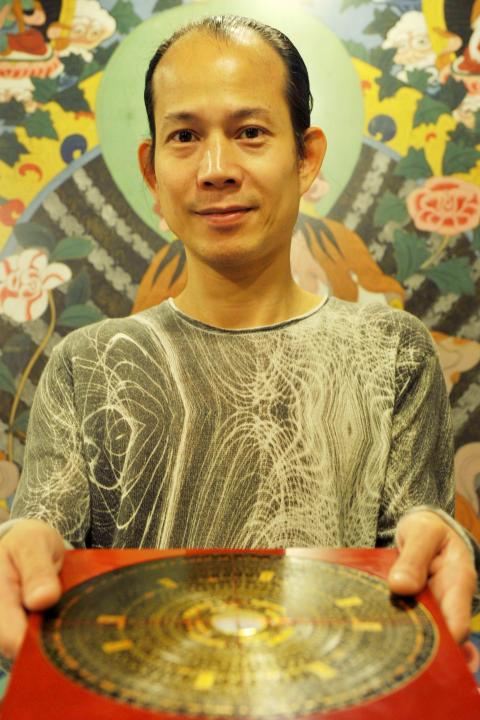
Photo: AFP
“Europe will not recover so soon — it is expected to suffer at least until 2014, but what I can say is this: A recovery for the US economy is possible in 2013,” he said.
If you’re prepared to ride the dragon and invest this year, Russia and China could be your best bets. The two emerging markets will be the best performers in a volatile year, Cheng said.
However, be prepared for surprises, especially out of China, where the Chinese Communist Party will hold its 18th Congress to select a new generation of leaders.
“In the second half of the year, a scandalous corruption case will be exposed in China,” Cheng warned, refusing to elaborate about who will be implicated. “I can also predict that in Hong Kong and in mainland China, a number of high-ranking officials will be forced to step down. Some may be thrown behind bars, or even pass away.”
Many Chinese take such predictions seriously and adjust their lives accordingly. Feng shui, the ancient study of the forces of chi, or life energy, is a daily part of life in the Chinese world.
One of Hong Kong’s largest brokerages, CLSA, releases a Feng Shui Index every year, offering its “tongue-in-cheek” predictions for global markets and world affairs.
Lest anyone takes it seriously, CLSA admits that feng shui’s “original purpose was to locate auspicious burial spots, not call the twists and turns of the equity markets or individual sectors.”
However, it has a stab anyway, even if some of its predictions are less than audacious. For example, it says the stars point to a “job opening” for Chinese Vice President Xi Jinping (習近平), the man everyone expects to become China’s next ruler after the 18th Congress in October or November.
As for US politics, the soothsayers are more cautious. When asked who will win the US elections, So refuses to make a prediction without precise information about the dates and times of the candidates’ births.
“Sometimes luck depends on the country itself, rather than an individual president,” he said enigmatically. “For the US, they are starting to have luck on their side again, so it is going to be a good year no matter who’s elected.”
The five Chinese elements are wood, fire, earth, metal and water, and this year is tipped to be big on water. This could mean riches and abundance, but it could also spell disaster.
Well-known Hong Kong astrologer Alion Yeo (楊天命) said we should brace for storms and floods.
“Expect to see a lot of flooding in areas like Thailand and southeast China,” he said.
So sees similar portents, but with an earthy twist.
“Indonesia, Pakistan, India and places in China like Sichuan, Yunnan and Guizhou are particularly disaster-prone. They are likely to experience frequent earthquakes,” he said.
While the ancient Chinese were developing their systems of astrology and geomancy, people across the Pacific were finding other ways to predict the future.
The Mayans of modern-day South America purportedly had a calendar that showed the world would come to an end on Dec. 21, 2012.
Like the historians who rubbish such interpretations of Mayan belief, So said there is no need to fear the end is nigh.
“Doomsday is just a bunch of make-believe,” he said.
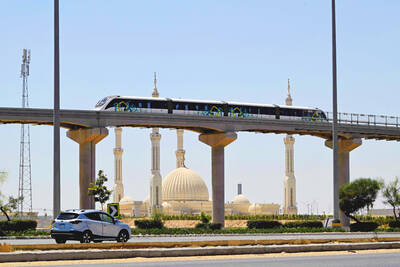
Cairo’s new monorail slices across the city skyline, running above the familiar chaos of blaring horns and aging buses’ exhaust fumes that mark rush hour below. The US$4.5 billion monorail, opened this month, is among Egypt’s most prominent new transport projects, part of a debt-funded infrastructure drive criticized for sapping state finances while bringing limited benefits to most of the country’s 109 million people. “It feels like you’re in a different country,” said Ramy Sayed, a restaurant manager, aboard a driverless Innovia 300 train. “No noise, no traffic, we’re not used to this.” The eastern line runs 56km from the bustling middle-class

Taiwanese firms have increased investment in the Philippines in recent years as Manila’s ties with Washington deepen and global supply chains continue to shift away from China, an expert at the Chung-Hua Institution for Economic Research (CIER, 中華經濟研究院) said yesterday. The Philippines had not been among Taiwanese investors’ top choices in Southeast Asia, CIER Taiwan ASEAN Studies Center director Kristy Hsu (徐遵慈) said at a seminar in Taipei. However, Taiwan’s investment in the country has grown significantly since the COVID-19 pandemic, reaching US $257 million last year, a high in recent years, she said. Although Taiwan’s total investment in the Philippines still lags

Intel Corp regards Taiwan Semiconductor Manufacturing Co (TSMC, 台積電) as a longstanding partner, as the US chipmaker would continue outsourcing production of advanced chips to TSMC, Intel chief executive officer Lip-Bu Tan (陳立武) said yesterday. “I don’t look at people as competitors. I look at the collaboration... Nvidia is also, you know, a good friend,” Tan told a news conference following his keynote speech at the Computex trade show in Taipei. “It’s a very trusted partnership for us... We are a big, top customer for them, and we’re going to continue doing that,” he said, referring to TSMC, the world’s largest foundry
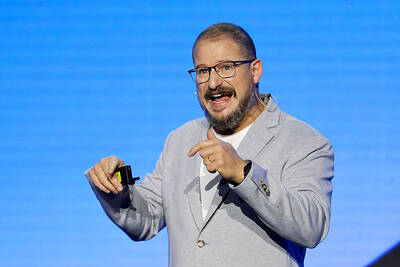
Artificial intelligence (AI) agents would supplant smartphones as the center of people’s digital lives, fundamentally reshaping personal devices and driving a major computing upgrade cycle, Qualcomm Inc CEO Cristiano Amon said yesterday. In his keynote speech for this year’s Computex trade show in Taipei, Amon said that the rise of "agentic AI" — AI systems capable of reasoning, planning and carrying out tasks autonomously — would transform how people interact with technology across phones, PCs, vehicles and wearable devices. Describing the technology as the next major evolution in computing, Amon said that "2026 is the year of agents.” For decades, smartphones have sat


 RSS
RSS