


Taipei Times (TT): The global economic momentum gradually lost ground over the second half of last year. How did this impact DHL Express’ business and sales?
Jerry Hsu (許克威): Despite the weak global economy, the company’s revenues in the Asia-Pacific region remained steady with double-digit growth last year amid relative strong demand from Asia’s emerging markets.
Meanwhile, the US market showed strong-than-expected growth last year, with full-year revenues in the region up 25 percent. The [low] base effect would be the main factor driving up growth in the US last year, as the company quit the domestic express business in the US market a year earlier.
As for the European region, annual expansion in revenues did slow last year, but momentum in some Eastern European countries supported the company’s sales to prop up growth.
TT: How do you view the business outlook for the company this year?
Hsu: Although economic momentum may continue to slow in the first half of the year, I’m confident that the company’s sales will keep growing this year following still growing revenues in the fourth quarter of last year.
Since we had expected a downturn in DHL’s business, the better-than-expected performance indicates a good start for this year.
For the Asia-Pacific region, we expect Southeast Asian countries, including India, to show the highest growth this year, while China might post the strongest expansion in terms of overall volume.
In addition, revenues in Europe will probably continue to grow this year, which means the question is: How much will the growth level be? instead of: Will it grow?
I expect the company to outperform its peers, just like we did in the fourth quarter of last year. We have to keep increasing revenues by controlling costs, while expanding market share amid deepening localization, which will help us understand our customers better.
TT: How about the outlook for the industry this year?
Hsu: Basically, for the express delivery sector, in which DHL has about a 30 percent global market share, business is expected grow steadily even if the global economy slows.
That is because the company transports all kinds of goods for industries as varied as the high-tech, automotive and fashion sectors. If demand falls in one industry, that might be made up for with increasing demand in another.
As for global forwarding freight and supply chain, it is difficult to say how the overall industry will go this year, but we will definitely pursue a higher market share in these two sectors as well.
As of the end of last year, DHL held an 8.5 percent market share in the global supply chain business, with 12.9 percent in the air forwarding freight sector, followed by 9.1 percent in ocean forwarding and 2.1 percent in road forwarding.
TT: Do you have any plans to expand in the Asia-Pacific region?
Hsu: DHL’s newly built hub for North Asia, which is located at Shanghai Pudong International Airport, will be officially launched in June or July.
It will be the company’s seventh hub worldwide. Currently, DHL has six hubs, located in Bahrain, Cincinnati, Hong Kong, Lagos, Leipzig and Miami.
The hub in Shanghai is second only in terms of size to the Leipzig hub, while its operating volume is expected to be the third largest, after the hubs in Leipzig and Hong Kong.
TT: Will the launch of the Shanghai hub drag down the traffic volume in Hong Kong?
Hsu: It won’t since the traffic volume at Hong Kong’s hub is over capacity, which means either increasing capacity in Hong Kong or transferring some volume to Shanghai is necessary.
We have invested US$400 million since 2007 to expand the Hong Kong hub’s facilities to manage the growing trading volume in Asian markets, especially in China.
TT: What will be DHL’s plan for China during the near term?
Hsu: For now, the company focuses more on the B2B [business-to-business] market in China, as average consumers in China are not accustomed to express services with high speed, high reliability, but also high prices.
However, we will keep setting up new offices, facilities and routes in China. We plan to expand our coverage to 30 percent of third-tier cities in China by 2015.
TT: How do you view Taiwan’s market this year? Are there any expansion plans for DHL in Taiwan this year?
Hsu: We took a 35 percent market share in Taiwan last year, making us the largest logistics company locally, with revenues growing despite the overall volume of Taiwan’s air transport sector dropping 8 percent as of the end of November.
For this year, we still expect double-digit growth in revenues and are eyeing the launch of new routes, such as Taipei Songshan Airport to Shanghai, in the first half of the year.
Since the launch of new routes needs government approval on air rights, we will opt to cooperate with local airlines, such as China Airlines [Ltd] (中華航空) and EVA [Airways Corp] (長榮航空), for transporting goods.
Taiwan’s long-term economic competitiveness will hinge not only on national champions like Taiwan Semiconductor Manufacturing Co. (TSMC, 台積電) but also on the widespread adoption of artificial intelligence (AI) and other emerging technologies, a US-based scholar has said. At a lecture in Taipei on Tuesday, Jeffrey Ding, assistant professor of political science at the George Washington University and author of "Technology and the Rise of Great Powers," argued that historical experience shows that general-purpose technologies (GPTs) — such as electricity, computers and now AI — shape long-term economic advantages through their diffusion across the broader economy. "What really matters is not who pioneers

In a high-security Shenzhen laboratory, Chinese scientists have built what Washington has spent years trying to prevent: a prototype of a machine capable of producing the cutting-edge semiconductor chips that power artificial intelligence (AI), smartphones and weapons central to Western military dominance, Reuters has learned. Completed early this year and undergoing testing, the prototype fills nearly an entire factory floor. It was built by a team of former engineers from Dutch semiconductor giant ASML who reverse-engineered the company’s extreme ultraviolet lithography (EUV) machines, according to two people with knowledge of the project. EUV machines sit at the heart of a technological Cold
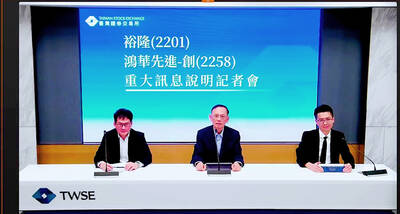
TAIWAN VALUE CHAIN: Foxtron is to fully own Luxgen following the transaction and it plans to launch a new electric model, the Foxtron Bria, in Taiwan next year Yulon Motor Co (裕隆汽車) yesterday said that its board of directors approved the disposal of its electric vehicle (EV) unit, Luxgen Motor Co (納智捷汽車), to Foxtron Vehicle Technologies Co (鴻華先進) for NT$787.6 million (US$24.98 million). Foxtron, a half-half joint venture between Yulon affiliate Hua-Chuang Automobile Information Technical Center Co (華創車電) and Hon Hai Precision Industry Co (鴻海精密), expects to wrap up the deal in the first quarter of next year. Foxtron would fully own Luxgen following the transaction, including five car distributing companies, outlets and all employees. The deal is subject to the approval of the Fair Trade Commission, Foxtron said. “Foxtron will be

INFLATION CONSIDERATION: The BOJ governor said that it would ‘keep making appropriate decisions’ and would adjust depending on the economy and prices The Bank of Japan (BOJ) yesterday raised its benchmark interest rate to the highest in 30 years and said more increases are in the pipeline if conditions allow, in a sign of growing conviction that it can attain the stable inflation target it has pursued for more than a decade. Bank of Japan Governor Kazuo Ueda’s policy board increased the rate by 0.2 percentage points to 0.75 percent, in a unanimous decision, the bank said in a statement. The central bank cited the rising likelihood of its economic outlook being realized. The rate change was expected by all 50 economists surveyed by Bloomberg. The


 RSS
RSS