


As part of a modern lifestyle, more people choose to eat out. However, the importance of a kitchen in a home has never waned, especially for upscale home owners, pundits say.
“For the rich, the kitchen has become a token of social status. Most of their high-end kitchens are worth at least NT$1 million [US$33,000],” said Tseng Chun-hao (曾俊豪), project engineer at Kaohsiung-based Metal Industries Research & Development Center (MIRD).
“A home kitchen is more than a place for preparing food. It has joined the living room to become a place for family gathering or parties with friends,” Oddo Kitchen International Co Ltd (雅登廚飾) chairman Tseng Ming-ching (曾明敬) said.
Citing surveys by the Industry & Technology Intelligence Service, the output value of the nation’s kitchen furniture sector for both home and commercial uses had nearly doubled from NT$9.8 billion in 2001 to NT$15.2 billion in 2009, Tseng Chun-hao said.
In total, there were around 1,600 players in the domestic kitchen furniture marketplace including brand agents, the surveys found.
And the current market size is estimated at between NT$12 billion and NT$15 billion including kitchens embedded in new property projects, Oddo Kitchen president Angus Tseng (曾俊源) said. The market for high-end kitchens, dominated mostly by foreign brands, is about NT$2 billion, he added.
Foreign brands, such as Miele of Germany, have entered the local market in the past few years.
Tseng Chun-hao said in a report that a standard kitchen set costs at least NT$100,000, depending on how well equipped it is. He said the market demand for kitchen sets in the future could reach billions because less than 50 percent of homes do not have full-function kitchens.
Wei Wen-lung (魏文龍), owner of an Oddo outlet in Tainan, agreed, saying most of his customers for full-scale kitchens in Tainan are willing to budget between NT$500,000 and NT$700,000, compared with 10 years ago, when the average budget was between NT$200,000 and NT$400,000.
Wei’s businesses suffered a mild decline during the recent economic downturn, but quickly rebounded last year to a 10 percent growth rate.
On average, a kitchen accounts for betwen 0.8 percent and 2 percent of a house’s worth, Taiwan Sakura Co Ltd (台灣櫻花) senior manager Jesse Lee (李肇興) said.
Taiwan Sakura and Oddo Kitchen are two leading domestic brands for European-style kitchens, with NT$7.5 billion and NT$3 billion in annual revenues respectively.
Taiwan Sakura is also the nation’s biggest supplier of large cooking appliances — oven and ventilation hoods, etc — with a retail volume of NT$35.3 million last year, followed by Rinnai Corp’s (林內) NT$12 million and Jyethelih Taiwan Inc’s (喜特麗) NT$8.9 million, Euromonitor International’s data showed.
The market research institute’s statistics showed that BSH Bosch & Siemens claimed the largest market share of dishwashers in Taiwan, with a retail volume of NT$48 million last year, while Panasonic Corp sold the most microwaves and refrigeration appliances, with a retail volume of NT$35.5 million and NT$23.4 million last year.
Overall, the market for kitchen appliances, including dishwashers, microwaves, and cooking appliances, totaled NT$28.7 billion last year, the institute’s statistics show.
Lee was optimistic about growth for kitchen sets in the local market, saying that Taiwan Sakura’s revenue target for a year or two from now is NT$1 billion.
Both companies feature total solutions, designing and building the kitchens themselves, while using hardware or techniques either from Germany or Italy.
Most foreign-style kitchens are dominated by Japanese and European looks, since US-style kitchens mostly use classic logs, which do not appeal to local consumers, Tseng Chun-hao said.
Most domestic brands are very competitive against foreign brands, which are at least twice expensive, when it comes to quality, design, use of materials and functionalities. However, they lack pricing power because their brand awareness among local consumers is still weak, he added.
Lack of differentiation among domestic brands is another problem facing the sector, which tends toward price wars, he said.
Price cuts are common, especially in bulk sales of kitchens embedded into property projects, which are a major source of business.
However, such kitchens are rarely tailor-made for homeowners, Taipei Kitchen Commercial Association chairman Jimmy Tsai (蔡方中) said.
The association has long advocated the certification of kitchen specialists, who could ensure the safety of kitchen installations.
Such specialists can also work as kitchen designers to make sure that every piece of kitchen furniture meets the requirements or daily habits of users, since a kitchen often lasts 20 years, he added.
The biggest challenge for the facilitation of such a system is the lack of standards.
The association is now working with related agencies, hoping to come up with a set of standards, he said.
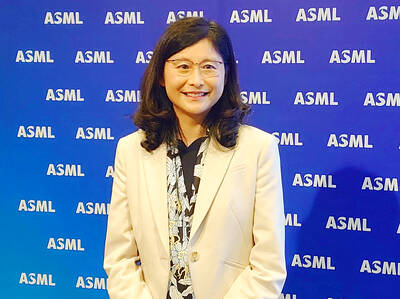
Netherlands-based semiconductor equipment supplier ASML Holding NV yesterday said that it is planning to hire an additional 1,000 people in Taiwan this year in response to growing demand from clients. ASML had previously planned to recruit 600 people this year, but that the plan has been adjusted upward, ASML vice president and ASML Taiwan general manager Grace Wang (汪佳慧) told reporters. ASML has a workforce of more than 4,500 in Taiwan, accounting for about 10 percent of its global total, Wang said. This year’s recruitment campaign would focus on adding people in the customer support, manufacturing and supply chain domains to assist ASML

UNDER MICROSCOPE: Taiwan detained three people who allegedly conspired to buy servers in Taiwan and export them using fraudulent documentation, prosecutors said Nvidia Corp chief executive officer Jensen Huang (黃仁勳) on Saturday urged Super Micro Computer Inc to tighten up on compliance after Taiwan detained three people this week for allegedly making fraudulent declarations about artificial intelligence (AI) servers made by its US partner. The development marked the nation’s first crackdown on semiconductor smuggling, which grew after the US slapped restrictions on exports of high-end chips such as Nvidia AI accelerators to China. Nvidia is “rigorous” in explaining regulations to all of its partners, Huang told reporters after arriving in Taipei. “Ultimately Super Micro has to run their own company,” he said in response to
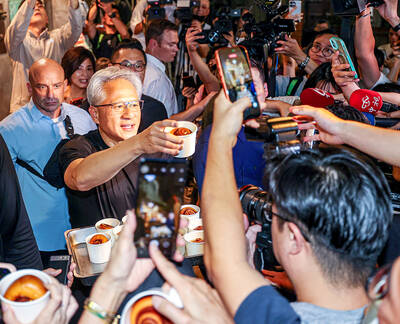
Nvidia Corp yesterday announced that CEO Jensen Huang (黃仁勳) would attend an employee meeting in Taipei tomorrow to celebrate the launch of the company’s Taiwan headquarters project. Huang would attend a gathering at the site of Nvidia’s planned headquarters in Beitou Shilin Technology Park (北投士林科技園區), the company said in a statement. After arriving in Taiwan on Saturday last week, Huang told reporters that he plans to meet with Quanta Computer Inc (廣達) chairman Barry Lam (林百里) and Taiwan Semiconductor Manufacturing Co (TSMC, 台積電) chairman C.C. Wei (魏哲家), and would attend the groundbreaking ceremony for Nvidia’s Taiwan headquarters tomorrow. Nvidia has not yet applied

Huawei Technologies Co (華為) said it has come up with a new pathway to shorten its gap with industry leader Taiwan Semiconductor Manufacturing Co (TSMC, 台積電), potentially achieving a breakthrough in making advanced semiconductors without cutting-edge equipment. Right now there is about a five-year gap between what TSMC is capable of and what Huawei, together with its manufacturing partner Semiconductor Manufacturing International Corp (中芯), can produce. Huawei is to start making 1.4-nanometer chips by 2031 with its own “LogicFolding” technology, Huawei semiconductor chief He Tingbo (何庭波) said in a rare public appearance during a chip conference yesterday, while TSMC has


 RSS
RSS