


He started as a carpenter with a humble upbringing and no financial backing, but after 40 years in the kitchen furniture business, Tseng Ming-ching (曾明敬) has grown his Oddo Kitchen International Co Ltd (雅登廚飾) into a leading domestic brand of European-style kitchens with NT$300 million (US$9.92 million) in revenues annually.
Sales of kitchen furniture at Oddo’s 15 financially independent outlets nationwide total nearly NT$700 million a year, according to the company.
Many attribute the success of the 59-year-old Oddo Kitchen chairman to his perseverance — a value commonly shared among Taiwanese entrepreneurs, who just “keep [their] heads down and work hard,” said Mark Stocker, managing & strategic director of Taipei-based brand consultancy DDG (方策顧問).
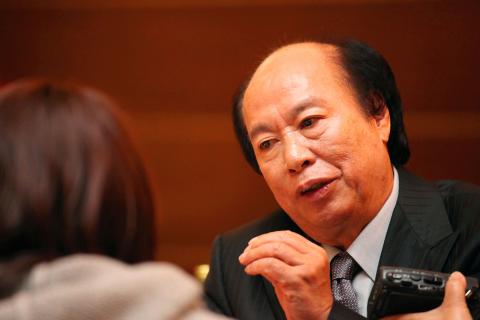
Photo courtesy of Oddo Kitchen International
Tseng’s talent for identifying the next trends or kitchen styles, creating new market demand, is key to Oddo’s business success, Stocker said, adding that “each time there has been a new kitchen sold in Taiwan, it’s basically because he [Tseng] started it.”
The carpenter-turned-entrepreneur has achieved many “firsts” in his four-decade career, including the nation’s first, or possibly the world’s first, plastics-steel kitchen cabinets, which Tseng invented in 1976.
The new kitchen cabinets, made of fiber-reinforced plastic, easily outrivaled either wooden ones, which were not waterproof, or stiff stainless steel cabinets, which carried no patterns, at that time.
They immediately won consumers’ hearts and became the company’s hottest-selling items for five consecutive years.
“That [success] was the turning point of my life because those cabinets earned me enough capital to buy up a plot of land, on which our first manufacturing factory was built,” Tseng said at the launch of his biography on Monday.
However, his inspiration at that time was the seamless bathroom furniture of a Tokyo hotel, which amazed him and his wife during a holiday there in spring.
“We stayed in the bathroom for more than four hours to study, measure and deconstruct every piece of bathroom furniture. And we forgot to have dinner,” Tseng said.
Based on the bathroom design, the couple spent seven months hard at work building the new kitchen cabinets after returning to Taiwan.
As the saying goes, there is no short-cut to success.
In 1980, Tseng followed a trader friend to visit the world-renowned furniture design trade fair IMM Cologne in Germany and was wowed although he could not understand a single word.
Like a sponge, Tseng spent every minute absorbing new technology, concepts and ideas for furniture design during the entire seven-day exhibition.
He even flew back with 38kg of product catalogs, which he still refers to as “my treasure and teacher” and which he has continued to use until this very day whenever he comes across product design problems, whether color palette, functionalities or specs.
“That was the second turning point of my life,” Tseng said.
The broad range of knowledge and know-how that Tseng brought back from Cologne paved a solid foundation for Oddo to design quality European-style kitchens in Taiwan and to enjoy design competitiveness for decades to come.
And that eye-opening experience in Germany also inspired Tseng to forge a partnership between his small company and 3B SpA at a time when “many Europeans believed working with Chinese [including Taiwanese] companies would be a very risky affair,” 3B communications director Fabrizio Bergamo wrote in his prelude to Tseng’s biography.
Ambitious and undeterred, Tseng returned to IMM Cologne in 1982 by himself for another journey of discovery about furniture manufacturing and interior, communicating with body language since he does not speak any English.
“Come to think of it, I was so brave. Wasn’t I?” Tseng said.
Taipei Kitchen Commercial Association chairman Jimmy Tsai (蔡方中) said Tseng embodied “the typical spirit of Taiwanese, who just go to the mattress.”
Tseng struck a deal with 3B to introduce its products to Taiwan and befriended 3B representatives for decades with the help of Italian-English and English-Mandarin translators.
Unlike his Taiwanese rivals, most of which imported solid German kitchen furniture to Taiwan, Tseng has long favored fancy Italian designs, which he believed would be the market’s next trend.
And he was right because an increasing number of people are willing to pay more for a well-designed kitchen.
“Design is the first thing that determines what customers want to pay for the kitchens these days,” said Tseng Chun-hao (曾俊豪), a project engineer at the Kaohsiung-based Metal Industries Research & Development Center.
Bergamo best summarizes the qualities that make Tseng Ming-ching a strong and successful leader: “The ability to direct and manage with suitable manners, the capacity of gaining respect from the team, the competence of being a trustworthy guide — not always being right, but with the authority and commitment to deliver without any hesitation — and mostly being able to take the positive parts forward, while understanding the negative ones and learning from mistakes.”
“The chairman treats employees, customers and even peer businesses with great sincerity,” said Wei Wen-lung (魏文龍), who owns Oddo’s outlet in Tainan.
Unlike many bosses, Tseng Ming-ching encourages company employees to be their own bosses and start up their own Oddo outlets because “it will be a win-win-win situation for the parent company Oddo, employees, who understand Oddo culture the best, and customers, who will be in good hands,” he said, adding that his boss takes great pride if he sees copycat kitchen furniture manufactured and launched by competitors.
Tsai also said that Tseng Ming-ching is a driving force in uniting rival companies and fostering benign competition in the domestic market.
Tseng Ming-ching did not require a prestigious education to acquire these managerial qualities. Instead, he taught himself as he lifted himself from childhood poverty.
At the age of 17, Tseng was sent to work as an apprentice at a wood furniture store in Taipei because his poor fruit farmer father was unable to afford a high school education for him. And his hard-learned carving expertise later not only earned his bread and butter, but also a reputation as the best craftsman at creating new dressers for dowries in Beitou.
What makes Tseng Ming-ching even more proud is that he passed on the company torch to his three children in 2005, with eldest son Angus Tseng (曾俊源) as Oddo president and Ken Tseng (曾俊豪) heading Oddo subsidiary top-tier kitchen furniture supplier, Huapin International (樺品國際).
Under Angus Tseng’s helm in the past five years, Oddo’s sales grew 50 percent, according to Tseng Ming-ching.
In the next five years, Oddo plans to open five more outlets, including two or three in New Taipei City (新北市), for a total of 20 nationwide. Seventy percent of the company’s income is currently generated from markets north of Hsinchu, Angus Tseng said.
The kitchen furniture company will also diversify into sales of open kitchen-related peripheral furniture, he added.
Though Huapin has no plans to expand beyond its two showrooms, those showrooms will strive to be one of the three largest players in their respective markets, Angus Tseng added.

Netherlands-based semiconductor equipment supplier ASML Holding NV yesterday said that it is planning to hire an additional 1,000 people in Taiwan this year in response to growing demand from clients. ASML had previously planned to recruit 600 people this year, but that the plan has been adjusted upward, ASML vice president and ASML Taiwan general manager Grace Wang (汪佳慧) told reporters. ASML has a workforce of more than 4,500 in Taiwan, accounting for about 10 percent of its global total, Wang said. This year’s recruitment campaign would focus on adding people in the customer support, manufacturing and supply chain domains to assist ASML

UNDER MICROSCOPE: Taiwan detained three people who allegedly conspired to buy servers in Taiwan and export them using fraudulent documentation, prosecutors said Nvidia Corp chief executive officer Jensen Huang (黃仁勳) on Saturday urged Super Micro Computer Inc to tighten up on compliance after Taiwan detained three people this week for allegedly making fraudulent declarations about artificial intelligence (AI) servers made by its US partner. The development marked the nation’s first crackdown on semiconductor smuggling, which grew after the US slapped restrictions on exports of high-end chips such as Nvidia AI accelerators to China. Nvidia is “rigorous” in explaining regulations to all of its partners, Huang told reporters after arriving in Taipei. “Ultimately Super Micro has to run their own company,” he said in response to
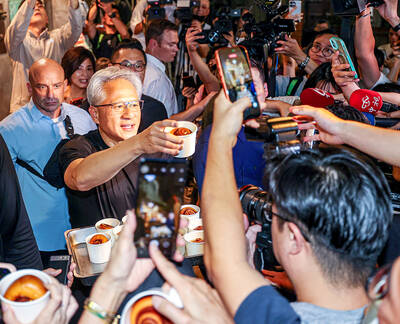
Nvidia Corp yesterday announced that CEO Jensen Huang (黃仁勳) would attend an employee meeting in Taipei tomorrow to celebrate the launch of the company’s Taiwan headquarters project. Huang would attend a gathering at the site of Nvidia’s planned headquarters in Beitou Shilin Technology Park (北投士林科技園區), the company said in a statement. After arriving in Taiwan on Saturday last week, Huang told reporters that he plans to meet with Quanta Computer Inc (廣達) chairman Barry Lam (林百里) and Taiwan Semiconductor Manufacturing Co (TSMC, 台積電) chairman C.C. Wei (魏哲家), and would attend the groundbreaking ceremony for Nvidia’s Taiwan headquarters tomorrow. Nvidia has not yet applied

Huawei Technologies Co (華為) said it has come up with a new pathway to shorten its gap with industry leader Taiwan Semiconductor Manufacturing Co (TSMC, 台積電), potentially achieving a breakthrough in making advanced semiconductors without cutting-edge equipment. Right now there is about a five-year gap between what TSMC is capable of and what Huawei, together with its manufacturing partner Semiconductor Manufacturing International Corp (中芯), can produce. Huawei is to start making 1.4-nanometer chips by 2031 with its own “LogicFolding” technology, Huawei semiconductor chief He Tingbo (何庭波) said in a rare public appearance during a chip conference yesterday, while TSMC has


 RSS
RSS