


The Ministry of Economic Affairs yesterday said it aims to attract up to 300 foreign firms to establish their regional headquarters in Taiwan by 2015, up from the current 100.
“The prowess of research and development (R&D) in Taiwan is second only to that in Japan in the Asia-Pacific region. That makes Taiwan very attractive to multinational corporations,” said Weng Ming-ter (翁明德), a section chief at the ministry’s department of investment.
Taiwan’s advantages in manufacturing, its talent pool and its cluster of technology supply chains make setting up a regional headquarters here a feasible choice, he told reporters.
The ministry plans to promote Taiwan as a regional headquarters hub by attracting 50 foreign firms per year to establish offices here, aiming for 300 regional headquarters by 2015.
These headquarters would be mainly responsible for operations in China and Southeast Asia, in the areas of logistics, financial management and technical transfer.
Compared with regional headquarters in Hong Kong — which normally employ fewer than 50 staff members — headquarters in Taiwan mostly recruit 100 to 500 employees, the ministry said.
Nearly half of the 100 regional headquarters currently set up in Taiwan are interested in expanding their business scope, with tentative investment plans of NT$30 billion (US$1 billion) over the next three years, Weng said.
Corporations that have a regional headquarters in Taiwan include Garmin Ltd, Applied Materials Taiwan, DuPont Taiwan Ltd, Cardif Assurance Vie Taiwan branch and Kuozui Motors Ltd (國瑞汽車).
Garmin, the US’ No. 1 portable navigation devices maker, said it increased R&D investment in Taiwan by 10 percent this year and plans to maintain the same momentum next year. The maker spent US$270 million on global R&D last year. Of that, Taiwan took a 9 percent share, said P.C. Huang (黃寶藏), Garmin’s Taiwan general manager.
The company has more than 8,000 staff worldwide and half of them are based in Taiwan, with the bulk of employees working on its production lines.
Despite labor costs in Taiwan being five times higher than in China, Huang said Garmin prefers Taiwan’s investment environment.
Kuozui, an automaker in which Toyota Motors Corp controls a 70 percent stake, also plans to grow its export business in Taiwan.
In 2009, Kuozui beat other Toyota affiliates in a bid for a project to produce and export its first model, Corolla Altis, to markets in the Middle East.
The export volume of Corolla Altis is expected to rise to 50,000 units this year, up from last year’s 30,000, Kuozui planning manager Chiang Lu-chung (蔣祿中) said.
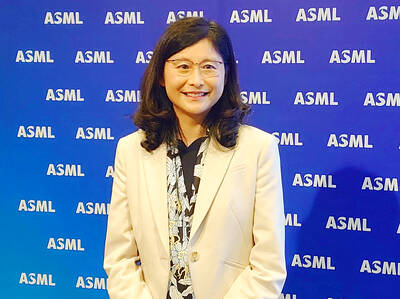
Netherlands-based semiconductor equipment supplier ASML Holding NV yesterday said that it is planning to hire an additional 1,000 people in Taiwan this year in response to growing demand from clients. ASML had previously planned to recruit 600 people this year, but that the plan has been adjusted upward, ASML vice president and ASML Taiwan general manager Grace Wang (汪佳慧) told reporters. ASML has a workforce of more than 4,500 in Taiwan, accounting for about 10 percent of its global total, Wang said. This year’s recruitment campaign would focus on adding people in the customer support, manufacturing and supply chain domains to assist ASML
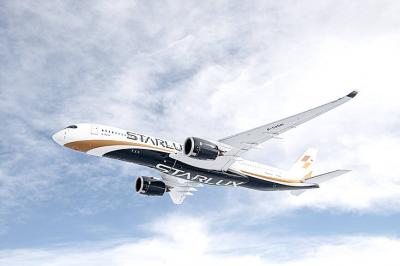
Starlux Airlines Co (星宇航空) today unveiled a long-haul network expansion plan at a shareholders’ meeting in Taipei, including direct flights to Barcelona, Spain, and Zurich, Switzerland, as well as a service connecting Taipei, Sydney and New Zealand. Starlux is to become the first Taiwanese carrier to offer non-stop services to the two European cities, while the inaugural oceanic route is expected to expand transit opportunities within the Australia-New Zealand market, Starlux said. Flight services to Chicago, Dallas, Washington and New York are under evaluation, the airline added. Prior to the shareholders’ meeting, the airline earlier this year announced that it would be
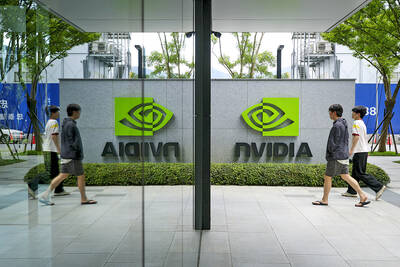
UNDER MICROSCOPE: Taiwan detained three people who allegedly conspired to buy servers in Taiwan and export them using fraudulent documentation, prosecutors said Nvidia Corp chief executive officer Jensen Huang (黃仁勳) on Saturday urged Super Micro Computer Inc to tighten up on compliance after Taiwan detained three people this week for allegedly making fraudulent declarations about artificial intelligence (AI) servers made by its US partner. The development marked the nation’s first crackdown on semiconductor smuggling, which grew after the US slapped restrictions on exports of high-end chips such as Nvidia AI accelerators to China. Nvidia is “rigorous” in explaining regulations to all of its partners, Huang told reporters after arriving in Taipei. “Ultimately Super Micro has to run their own company,” he said in response to

Nvidia Corp yesterday announced that CEO Jensen Huang (黃仁勳) would attend an employee meeting in Taipei tomorrow to celebrate the launch of the company’s Taiwan headquarters project. Huang would attend a gathering at the site of Nvidia’s planned headquarters in Beitou Shilin Technology Park (北投士林科技園區), the company said in a statement. After arriving in Taiwan on Saturday last week, Huang told reporters that he plans to meet with Quanta Computer Inc (廣達) chairman Barry Lam (林百里) and Taiwan Semiconductor Manufacturing Co (TSMC, 台積電) chairman C.C. Wei (魏哲家), and would attend the groundbreaking ceremony for Nvidia’s Taiwan headquarters tomorrow. Nvidia has not yet applied


 RSS
RSS