


An enterprising Chinese man has come up with a solution for gadget-crazy people who desperately want Apple’s popular iPad tablet computer but cannot afford it — DIY.
In a 20-minute video posted on Youku — the Chinese YouTube equivalent — Liu Xinying (劉新營) demonstrates how to assemble an iPad look-alike using computer parts, a touch screen and a case with a keypad, to the sound of metal music.
At the end of the video dubbed “DIY IPAD 3,” the IT whiz shows off the finished version — an apparently functional tablet computer that looks like a thick iPad, but runs on Windows, an operating system made by rival Microsoft.
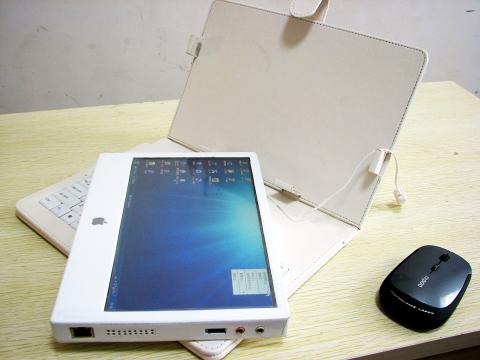
Photo: AFP/HO
News of Liu’s apparent feat spread on several foreign and Chinese technology Web sites, as well as on the nation’s Twitter-like Weibo (微博) service.
When contacted by AFP, the 21-year-old from the eastern province of Shandong said that since he posted the video online a month ago, he has knocked back requests from a dozen people wanting him to make them a DIY iPad.
“I did this for fun,” said Liu, who works at a computer store in Jinan city. “It cost me 2,000 yuan [US$309] to make it, so I guess that’s how much it’s worth.”
By comparison, the cheapest 16-gigabyte version of the iPad 2 sells for 3,688 yuan in China, while the most expensive 64-gigabyte model costs 5,288 yuan.
iPads and iPhones are hugely popular in China — the world’s largest Internet market with 457 million online users — and the launch of new models has been known to trigger fights and even crimes.
Last month, a court in the southern province of Guangdong sentenced three people to prison for stealing the design to the iPad 2 and using it to make fake tablet computers.
Apple also was forced to -compensate a customer who sustained injuries in a fight at its Beijing flagship store in May, when the iPad 2 was launched.

NEW IDENTITY: Known for its software, India has expanded into hardware, with its semiconductor industry growing from US$38bn in 2023 to US$45bn to US$50bn India on Saturday inaugurated its first semiconductor assembly and test facility, a milestone in the government’s push to reduce dependence on foreign chipmakers and stake a claim in a sector dominated by China. Indian Prime Minister Narendra Modi opened US firm Micron Technology Inc’s semiconductor assembly, test and packaging unit in his home state of Gujarat, hailing the “dawn of a new era” for India’s technology ambitions. “When young Indians look back in the future, they will see this decade as the turning point in our tech future,” Modi told the event, which was broadcast on his YouTube channel. The plant would convert

Nanya Technology Corp (南亞科技) yesterday said the DRAM supply crunch could extend through 2028, as the artificial intelligence (AI) boom has led the world’s major memory makers to dramatically reduce production of standard DRAM and allocate a significant portion of their capacity for high-bandwidth memory (HBM) chips. The most severe supply constraints would stretch to the first half of next year due to “very limited” increases in new DRAM capacity worldwide, Nanya Technology president Lee Pei-ing (李培瑛) told a news briefing. The company plans to increase monthly 12-inch wafer capacity to 20,000 in the first half of 2028 after a

Property transactions in the nation’s six special municipalities plunged last month, as a lengthy Lunar New Year holiday combined with ongoing credit tightening dampened housing market activity, data compiled by local land administration offices released on Monday showed. The six cities recorded a total of 10,480 property transfers last month, down 42.5 percent from January and marking the second-lowest monthly level on record, the data showed. “The sharp drop largely reflected seasonal factors and tighter credit conditions,” Evertrust Rehouse Co (永慶房屋) deputy research manager Chen Chin-ping (陳金萍) said. The nine-day Lunar New Year holiday fell in February this year, reducing

Zimbabwe’s ban on raw lithium exports is forcing Chinese miners to rethink their strategy, speeding up plans to process the metal locally instead of shipping it to China’s vast rechargeable battery industry. The country is Africa’s largest lithium producer and has one of the world’s largest reserves, according to the US Geological Survey (USGS). Zimbabwe already banned the export of lithium ore in 2022 and last year announced it would halt exports of lithium concentrates from January next year. However, on Wednesday it imposed the ban with immediate effect, leaving unclear what the lithium mining sector would do in the


 RSS
RSS