


State oil group Petrovietnam and its partners may buy US$1.5 billion in Vietnamese oil assets in the contentious South China Sea from ConocoPhillips, according to Petrovietnam’s chief executive.
The plan demonstrates a commitment to help protect Vietnam’s sovereignty in the East Sea, as it calls the disputed area, company chief executive Phung Dinh Thuc was quoted as saying.
Petrovietnam will not change its production and exploration activities in the region, Thuc said in a statement published by PV Oil, PetroVietnam’s marketing arm.
The resource-rich area has been the scene of several clashes in recent months between China, the Philippines and Vietnam.
Vietnam and the Philippines have accused China of cutting seismic cables on oil and gas exploration ships, threatening to ram vessels and firing shots at fishermen.
Taiwan, China, Vietnam, the Philippines, Malaysia and Brunei claim parts or all of the South China Sea, a territory believed to be sitting on rich deposits of oil, gas and minerals, as well as being a major shipping lane.
Officials at ConocoPhillips in Vietnam could not be reached for comment.
Thuc spoke with domestic media on Tuesday, but his comments were not released until yesterday.
“The reason this firm is withdrawing is probably because they are restructuring,” Thuc was quoted as referring to ConocoPhillips, while speaking at the Tuesday briefing, which excluded foreign media organizations.
“There is also an opinion that this oilfield is at a complicated stage” and they are no longer increasing production, he said. He did not say when a deal might be made.
ConocoPhillips owns a 23.3 percent stake in a complex of five oilfields in block 15-1 in the area. It owns 36 percent of the Rang Dong oilfield in block 15-2 in the Cuu Long Basin and 16.3 percent in the Nam Con Son gas pipeline project, the statement said.
ConocoPhillips’ assets in Vietnam are believed to total about US$1.5 billion.
In Block 15-1 its partners include Petrovietnam with a 50 percent interest, state-run Korea National Oil Corp with 14.2 percent, Korea’s SK Corp with 9 percent and 3.5 percent owned by Monaco’s Geopetrol.
The firm’s partners in block 15-2 are Japan Vietnam Petroleum Co with a 46.5 percent stake and Petrovietnam with 17.5 percent.
In the Nam Con Son gas pipeline project, BP has 32.7 percent and Petrovietnam owns 17.5 percent.
Late last year Petrovietnam said it considered buying BP’s stakes in offshore oil projects, but later waived the option, paving the way for BP to sell them to its Russian joint venture, TNK-BP, for US$1.8 billion.

Cairo’s new monorail slices across the city skyline, running above the familiar chaos of blaring horns and aging buses’ exhaust fumes that mark rush hour below. The US$4.5 billion monorail, opened this month, is among Egypt’s most prominent new transport projects, part of a debt-funded infrastructure drive criticized for sapping state finances while bringing limited benefits to most of the country’s 109 million people. “It feels like you’re in a different country,” said Ramy Sayed, a restaurant manager, aboard a driverless Innovia 300 train. “No noise, no traffic, we’re not used to this.” The eastern line runs 56km from the bustling middle-class
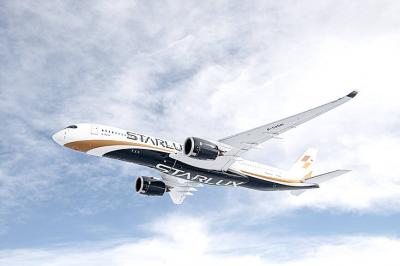
Starlux Airlines Co (星宇航空) today unveiled a long-haul network expansion plan at a shareholders’ meeting in Taipei, including direct flights to Barcelona, Spain, and Zurich, Switzerland, as well as a service connecting Taipei, Sydney and New Zealand. Starlux is to become the first Taiwanese carrier to offer non-stop services to the two European cities, while the inaugural oceanic route is expected to expand transit opportunities within the Australia-New Zealand market, Starlux said. Flight services to Chicago, Dallas, Washington and New York are under evaluation, the airline added. Prior to the shareholders’ meeting, the airline earlier this year announced that it would be

Taiwanese prosecutors suspect that three people successfully smuggled at least one shipment of Nvidia Corp artificial intelligence (AI) chips to China after first exporting them to Japan, people familiar with the matter said. The trio was detained last week by the Keelung District Prosecutors’ Office for allegedly falsifying documents related to exports of Super Micro Computer Inc servers containing advanced Nvidia chips, which the US has barred from sale to China without a license from Washington. The move marked Taiwan’s first public crackdown on AI chip diversion after years of pressure from the US to take a more active role in curtailing
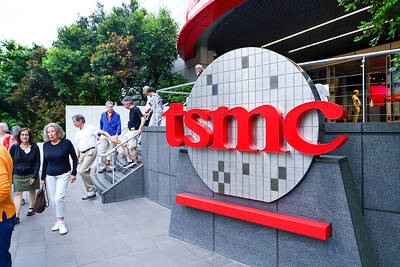
Taiwan Semiconductor Manufacturing Co (TSMC, 台積電) employee bonuses are likely to grow more than 30 percent this year, in line with the past few years as the company’s profits continue to set new records, an anonymous source cited TSMC chairman C.C. Wei (魏哲家) as saying yesterday. TSMC, the world’s largest contract chipmaker, is committed to taking care of its workers, the source said, citing Wei’s meeting with employees yesterday morning. Wei also expressed gratitude to employees for their contribution to the company’s improving bottom line, the source added. Since 2023, TSMC’s employee bonuses have grown at an annual rate of


 RSS
RSS