


Growing up, Cherie Zhang tended to eat dim sum for breakfast while her parents preferred rice with soup or noodles. Today, Zhang, 30, who lives in Shanghai, regularly gives her two-year-old son bread or cake for breakfast.
Baked goods are not a staple of a traditional Chinese diet, but they have been quickly catching on among China’s urban middle class over the past 10 years.
The retail value of baked goods like bread, pastries and cakes sold in China has risen to 7.8 billion yuan (US$1.2 billion) this year, from 3.7 billion yuan in 2000, according to data from Euromonitor International, a market researcher. Revenue could grow to 11.1 billion yuan by 2015.
“Young Chinese city dwellers influenced by Western culture increasingly favor bread as a morning staple over traditional breakfast foods” like rice porridge, said Anastasia Alieva, a food analyst at Euromonitor.
UPWARD TREND
Per capita consumption of bakery products in China stood at 4kg last year, nearly double the 2kg per capita 10 years earlier.
This compares with 38kg per capita in Britain and 35kg per capita in the US, but the upward trend is in place.
The rising demand, mainly in China’s big cities, has offered great business opportunities for foreign bakery chains, many of which have quickly expanded, gaining ground on large Chinese bakery companies such as Christine and Holiland.
Paris Baguette, a South Korean chain, now has 37 stores in China, and the Taiwanese chain 85oC Bakery Cafe has about 145.
Leading the foreign pack is BreadTalk, a Singapore chain, which opened its first outlet in China in 2003 and now has 170 shops spread mainly across the wealthier coastal cities.
Frankie Quek(郭瑞興), chief executive of BreadTalk’s operations in China, said by phone that the company had plans to expand that number to 500 over the next three years.
LESS THAN A DECADE
Started in Singapore in 2001 and listed on the SGX Catalist Board of the Singapore Exchange in 2003, the same year it expanded into China, the chain was the first bakery in Singapore to adopt a glass design for its kitchens, enabling the public to view its bakers.
The concept has proved particularly popular in China, where food safety is a consumer concern.
It is one of the elements that Zhang appreciates most because it means to her the products are fresh.
BreadTalk quickly established a good reputation and captured imaginations with its unusual baked goods, which can include green tea, pork floss (dried Chinese meat that has a light and fluffy texture similar to coarse cotton) or curry.
The names of the products are lively: Hidden Dragon, Crouching Bacon or Himala-Yes.
Its buns today cost 7 yuan to 10 yuan on average, equivalent to the price of a plate of noodles in Shanghai, and more expensive than most of its competitors’.
However, the company is staying ahead of its competition by keeping its recipes and designs varied, constantly introducing new bakery items as well as investing heavily in its branding, Quek said.
“We’ve tried to create a lot of talking points among the media, from product to design and our open kitchen, even the funny names. We also do fashion shows with our buns as hairpieces,” he said.
However, competition is intense, and the company has had to face down the copycats, which Quek says he thinks cannot be avoided in China.
Quek said that he had seen people in the stores measuring the height of their shelves, even the spacing.
BLATANT PIRACY
“They use camera video-recording. I’ve seen so many personally. They even take our storyboards, the little note we put next to our buns,” he said.
BreadTalk started out operating retail outlets selling baked goods but quickly expanded into managing food courts and franchise operations of restaurants.
Last year, the company posted revenue of S$246 million (US$187 million), up 16.1 percent from the previous year, while net profit was S$11.6 million, up 39.3 percent. China accounted for 34.7 percent of total revenue, and Quek said he hoped to increase China’s contribution to total group revenue to 45 percent this year.
The bakery business still represents about 50 percent of overall revenue in China, Quek said, and he expects this number to remain stable as the company builds its three business pillars.
BreadTalk plans to increase the number of its food courts to about 60 over the next three years. As of early October, the group had 356 bakery outlets (170 in China), 31 food courts (20 in China) and 20 restaurants (eight in Shanghai).
Quek sees good growth opportunities in the cake market in China, noting that Chinese consumers are increasingly buying them for special occasions like birthdays.
“Our cake market in China is almost 35 to 40 percent of our overall sales,” he said.
FRANCHISING
Over the next three years, the company is planning to increase its franchise ratio to 70-30 from the current 60-40.
“Franchising is a great way to expand your business in China, but you have to do it right,” Quek said. “You need to have a really strict first interview and check out the background of your franchisee. And you should talk about money first before you talk further. That’s one ugly fact, but that is why up to today we have zero bad debt in China.”
The BreadTalk formula seems to be working for customers.
Zhang shops at BreadTalk two or three times a month.
She said it was even catching on with her husband, who preferred bread with sausage, ham or a strong cheese flavor — a far cry from the typical dim sum breakfasts they enjoyed as children.

Netherlands-based semiconductor equipment supplier ASML Holding NV yesterday said that it is planning to hire an additional 1,000 people in Taiwan this year in response to growing demand from clients. ASML had previously planned to recruit 600 people this year, but that the plan has been adjusted upward, ASML vice president and ASML Taiwan general manager Grace Wang (汪佳慧) told reporters. ASML has a workforce of more than 4,500 in Taiwan, accounting for about 10 percent of its global total, Wang said. This year’s recruitment campaign would focus on adding people in the customer support, manufacturing and supply chain domains to assist ASML
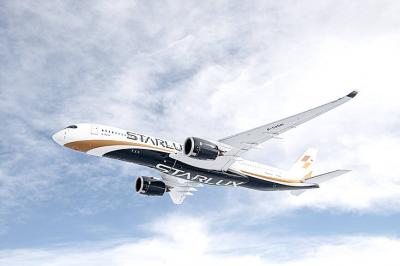
Starlux Airlines Co (星宇航空) today unveiled a long-haul network expansion plan at a shareholders’ meeting in Taipei, including direct flights to Barcelona, Spain, and Zurich, Switzerland, as well as a service connecting Taipei, Sydney and New Zealand. Starlux is to become the first Taiwanese carrier to offer non-stop services to the two European cities, while the inaugural oceanic route is expected to expand transit opportunities within the Australia-New Zealand market, Starlux said. Flight services to Chicago, Dallas, Washington and New York are under evaluation, the airline added. Prior to the shareholders’ meeting, the airline earlier this year announced that it would be

UNDER MICROSCOPE: Taiwan detained three people who allegedly conspired to buy servers in Taiwan and export them using fraudulent documentation, prosecutors said Nvidia Corp chief executive officer Jensen Huang (黃仁勳) on Saturday urged Super Micro Computer Inc to tighten up on compliance after Taiwan detained three people this week for allegedly making fraudulent declarations about artificial intelligence (AI) servers made by its US partner. The development marked the nation’s first crackdown on semiconductor smuggling, which grew after the US slapped restrictions on exports of high-end chips such as Nvidia AI accelerators to China. Nvidia is “rigorous” in explaining regulations to all of its partners, Huang told reporters after arriving in Taipei. “Ultimately Super Micro has to run their own company,” he said in response to

Nvidia Corp yesterday announced that CEO Jensen Huang (黃仁勳) would attend an employee meeting in Taipei tomorrow to celebrate the launch of the company’s Taiwan headquarters project. Huang would attend a gathering at the site of Nvidia’s planned headquarters in Beitou Shilin Technology Park (北投士林科技園區), the company said in a statement. After arriving in Taiwan on Saturday last week, Huang told reporters that he plans to meet with Quanta Computer Inc (廣達) chairman Barry Lam (林百里) and Taiwan Semiconductor Manufacturing Co (TSMC, 台積電) chairman C.C. Wei (魏哲家), and would attend the groundbreaking ceremony for Nvidia’s Taiwan headquarters tomorrow. Nvidia has not yet applied


 RSS
RSS