


Gourmet Master Co (美食達人), which operates the popular 85°C (85度C) bakery and coffee chain in Taiwan, China, Australia and the US, yesterday saw its shares surge 138 percent on its main bourse debut to NT$400, compared with the benchmark TAIEX’s 0.83 percent rise.
The much-touted initial public offering (IPO) was oversubscribed 200 times by the public, with each application standing only slightly over a 1 percent chance of landing stock.
In a move to fund overseas expansion by opening 100 more outlets in China next year, Gourmet Master issued 3.85 million shares for its IPO, with one share set at NT$168.

PHOTO: MAURICE TSAI, BLOOMBERG
“Investors are pinning hopes on the company’s expansion into the Chinese market,” Grand Cathay Investment Services Corp (大華投顧) chairman Tu Jin-lung (杜金龍) said. “People believe in these China leads and they are eager to jump on the bandwagon.”
Gourmet Master president and general manager Wu Cheng-hsueh (吳政學) said on Thursday last week that the company would have 170 85°C outlets in China by the end of this year. The firm aims to expand to more Chinese cities and have a total of 1,000 stores by 2016, he said.
The Chinese business produced 43 percent of Gourmet Master’s total revenue last year. The percentage is expected to rise to 57 percent this year and further to 68 percent next year, Macquarie Equities Research said in a report on Wednesday last week.
“Gourmet Master has established a strong foothold in the most prosperous eastern China region. We expect significant earnings growth, as Chinese consumption of bakery products and coffee is set to grow,” Macquarie said.
It gave Gourmet Master an “outperform” rating with a target price of NT$300.
Judging from the significant gains in the share price, Taiwan International Securities Corp (金鼎證券) analyst Michael Chiang said he suspected buying largely came from institutional investors.
“Today’s closing price was much higher than the range of NT$250 to NT$300 anticipated by the market,” Chiang said. “I’m guessing institutional investors, including foreign investors, served as the major force pushing up the share price.”
Chiang predicted that -institutional investors would likely continue to hold the stock because of their upbeat outlook over the company’s bottom line.
“The price tag of NT$400 is by no means a ceiling for the stock in the near term,” he said.
Gourmet Master posted NT$758 million (US$25 million) in net -income, or NT$5.80 earnings per share (EPS) this year, up about 130 percent from 2008. Macquarie predicted the company’s EPS would hit NT$6.92 this year and NT$9.91 next year.
Gourmet Master’s initial share sale is the second-largest on the local bourse so far this year, -second only to the NT$6.2 billion raised by TPK Holding Co (宸鴻) last month. TPK’s share price also more than doubled on its first day of trading in Taipei and rose 3.9 percent to NT$566 yesterday, compared with its IPO price of NT$220.
“The enthusiastic response the new stocks received from the Taiwanese market should lure more foreign companies to trade on the local bourse,” Yuanta Securities Co (元大證券) investment and corporate banking chief Sam Lee (李明山) said.
Yuanta was the underwriter for both Gourmet Master and TPK.

BUSINESS UPDATE: The iPhone assembler said operations outlook is expected to show quarter-on-quarter and year-on-year growth for the second quarter Hon Hai Precision Industry Co (鴻海精密) yesterday reported strong growth in sales last month, potentially raising expectations for iPhone sales while artificial intelligence (AI)-related business booms. The company, which assembles the majority of Apple Inc’s smartphones, reported a 19.03 percent rise in monthly sales to NT$510.9 billion (US$15.78 billion), from NT$429.22 billion in the same period last year. On a monthly basis, sales rose 14.16 percent, it said. The company in a statement said that last month’s revenue was a record-breaking April performance. Hon Hai, known also as Foxconn Technology Group (富士康科技集團), assembles most iPhones, but the company is diversifying its business to
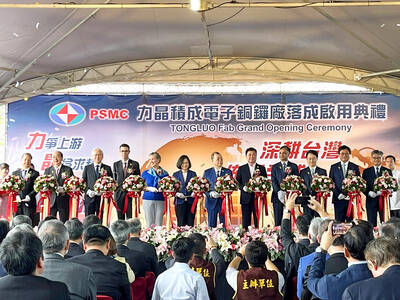
ARTIFICIAL INTELLIGENCE: The chipmaker last month raised its capital spending by 28 percent for this year to NT$32 billion from a previous estimate of NT$25 billion Contract chipmaker Powerchip Semiconductor Manufacturing Corp (力積電子) yesterday launched a new 12-inch fab, tapping into advanced chip-on-wafer-on-substrate (CoWoS) packaging technology to support rising demand for artificial intelligence (AI) devices. Powerchip is to offer interposers, one of three parts in CoWoS packaging technology, with shipments scheduled for the second half of this year, Powerchip chairman Frank Huang (黃崇仁) told reporters on the sidelines of a fab inauguration ceremony in the Tongluo Science Park (銅鑼科學園區) in Miaoli County yesterday. “We are working with customers to supply CoWoS-related business, utilizing part of this new fab’s capacity,” Huang said, adding that Powerchip intended to bridge

Qualcomm Inc, the world’s biggest seller of smartphone processors, gave an upbeat forecast for sales and profit in the current period, suggesting demand for handsets is increasing after a two-year slump. Revenue in the three months ended in June will be US$8.8 billion to US$9.6 billion, the company said in a statement Wednesday. Excluding certain items, earnings will be US$2.15 to US$2.35 a share. Analysts had projected sales of US$9.08 billion and earnings of US$2.16 a share. The outlook signals that the smartphone market has begun to bounce back, tracking with Qualcomm’s forecast that demand would gradually recover this year. The San

Clambering hand-over-hand, sweat dripping into his eyes, a durian laborer expertly slices a cumbersome fruit from a tree before tossing it down to land with a soft thump in his colleague’s waiting arms about 15m below. Among Thailand’s most famous and lucrative exports, the pungent “king of fruits” is as distinctive in its smell as its spiky green-brown carapace, and has been farmed in the kingdom for hundreds of years. However, a vicious heat wave engulfing Southeast Asia has resulted in smaller yields and spiraling costs, with growers and sellers increasingly panicked as global warming damages the industry. “This year is a crisis,”


 RSS
RSS