


The financial sector should not be overly optimistic about getting preferential treatment in China through the Economic Cooperation Framework Agreement (ECFA) because the Chinese market is open to the entire world, not just Taiwan, an economist said yesterday.
“Signing the ECFA doesn’t mean we get to do all financial business in China. Some opportunities are only available for Chinese banks or are open to foreign banks in certain test spots,” William Lin (林蒼生), a professor of finance at Tamkang University, told an economic forum in Taipei.
Lin said China limited foreign banks from conducting retail banking and credit card business with its citizens and demanded that business by their subsidiaries be reviewed case-by-case.
While Taiwanese financial firms hope to get preferential treatment in China through the ECFA, Lin warned that Beijing upheld the principle of “mutual interests” on cross-strait financial cooperation. The Chinese government would not unconditionally offer unilateral benefits to Taiwanese banks, he said.
“China also wants to transform Shanghai into an international financial center in the Asia-Pacific area,” Lin said. “We should take all this into consideration when conducting talks with China on furthering cross-strait financial services.”
China has an advantage in talks on cross-strait financial cooperation, Lin said, adding that this would put pressure on Taiwan to open doors to Chinese investment in the local financial sector to obtain reciprocal opportunities.
Since the signing of the ECFA in late June, there have been mixed reactions from the local market, with some saying business potential for Taiwanese lenders is limited in the short-term, while others view the deal as a boost to local companies’ long-term competitiveness.
Bradford Ti (鄭溫煌), an analyst with Citigroup Global Markets, said he expected Taiwanese banks to benefit from more investment because of the ECFA, with incremental growth in corporate loan demand, particularly from small to medium-sized enterprises, for proposed capital spending.
“We think the [ECFA] issue is not really about what Taiwanese financial firms will be able to earn in China. Eventually, this may be more significant longer-term,” Ti wrote in a report yesterday.
“But, for now, we anticipate a more meaningful impact will likely come domestically in Taiwan over the short to medium-term if the ECFA leads to a sustained rise in capital spending and that in turn translates to a sustained recovery in loan demand,” he wrote.
Stronger loans growth will not only help lenders improve their bottom line, but also deliver better efficiency and higher loan-to-deposit ratios, which in turn would help push up banks’ net interest margins (NIMs), Ti said.
Based on a recent sensitivity analysis of the impact of rising loan demand and improving NIMs, state banks such as First Commercial Bank (第一銀行) and Chang Hwa Bank (彰化銀行) are more likely to benefit from the twin effects than private lenders like Chinatrust Commercial Bank (中國信託商銀) and Taishin International Bank (台新銀行).

Cairo’s new monorail slices across the city skyline, running above the familiar chaos of blaring horns and aging buses’ exhaust fumes that mark rush hour below. The US$4.5 billion monorail, opened this month, is among Egypt’s most prominent new transport projects, part of a debt-funded infrastructure drive criticized for sapping state finances while bringing limited benefits to most of the country’s 109 million people. “It feels like you’re in a different country,” said Ramy Sayed, a restaurant manager, aboard a driverless Innovia 300 train. “No noise, no traffic, we’re not used to this.” The eastern line runs 56km from the bustling middle-class
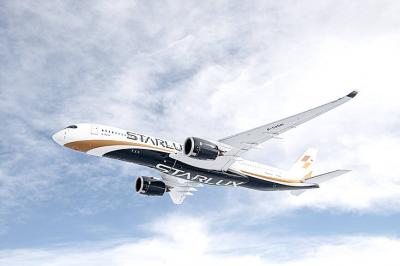
Starlux Airlines Co (星宇航空) today unveiled a long-haul network expansion plan at a shareholders’ meeting in Taipei, including direct flights to Barcelona, Spain, and Zurich, Switzerland, as well as a service connecting Taipei, Sydney and New Zealand. Starlux is to become the first Taiwanese carrier to offer non-stop services to the two European cities, while the inaugural oceanic route is expected to expand transit opportunities within the Australia-New Zealand market, Starlux said. Flight services to Chicago, Dallas, Washington and New York are under evaluation, the airline added. Prior to the shareholders’ meeting, the airline earlier this year announced that it would be

Taiwanese prosecutors suspect that three people successfully smuggled at least one shipment of Nvidia Corp artificial intelligence (AI) chips to China after first exporting them to Japan, people familiar with the matter said. The trio was detained last week by the Keelung District Prosecutors’ Office for allegedly falsifying documents related to exports of Super Micro Computer Inc servers containing advanced Nvidia chips, which the US has barred from sale to China without a license from Washington. The move marked Taiwan’s first public crackdown on AI chip diversion after years of pressure from the US to take a more active role in curtailing
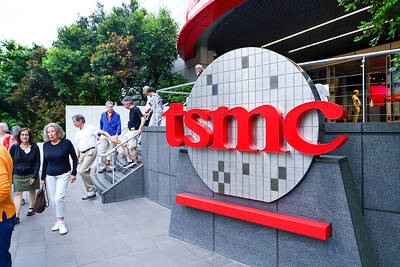
Taiwan Semiconductor Manufacturing Co (TSMC, 台積電) employee bonuses are likely to grow more than 30 percent this year, in line with the past few years as the company’s profits continue to set new records, an anonymous source cited TSMC chairman C.C. Wei (魏哲家) as saying yesterday. TSMC, the world’s largest contract chipmaker, is committed to taking care of its workers, the source said, citing Wei’s meeting with employees yesterday morning. Wei also expressed gratitude to employees for their contribution to the company’s improving bottom line, the source added. Since 2023, TSMC’s employee bonuses have grown at an annual rate of


 RSS
RSS