


The five-day Computex Taipei wrapped up yesterday, attracting more than 120,000 visitors around the world with its dazzling display of the latest products and technologies and generating about US$23 billion in business, up 15 percent from last year, organizers said.
Visitor numbers grew 20 percent from a year ago, according to data provided by Taiwan External Trade Development Council (TAITRA). They included 35,017 international buyers from 216 countries and areas, up from 184 last year, with the top five being the US, Japan, China, Hong Kong and South Korea, the figures showed.
NEW PARTICIPANTS
“The biggest difference in this year’s trade show was that it attracted companies from countries we didn’t expect to come,” said Jeremy Horng (洪銘欽), deputy executive director of TAITRA’s exhibition department.
“This indicates that the impact of Computex Taipei has expanded across the world,” Horng said, adding that the eurozone debt crisis didn’t have much on an impact on the number of European companies attending the show.
The number of exhibitors from emerging countries such as Malaysia, Russia, India and Brazil increased significantly this year, he said.
TAITRA data showed that the number of participating companies from Russia and Vietnam increased by more than 50 percent this year, while Malaysian exhibitors rose nearly 30 percent.
A total of 2,014 one-on-one procurement match-making meetings took place on the first two days of the computer trade show, generating more than US$230 million in business, compared with the US$100 million generated last year, TAITRA said.
Procurements by companies from emerging economies, including Turkey, the United Arab Emirates, Russia, Poland, Bulgaria, Romania, India, Argentina and Chile totaled US$38.8 million.
POPULAR PRODUCTS
Organizers said that among the products that drew the most interest from representatives attending the procurement match-making meetings were e-readers, 3D monitors, notebooks, storage-related products and servers.
Entering the tablet PC market, Asustek Computer Inc (華碩電腦) launched its Eee Pad, which combines a computer, a multimedia player and an e-book.
Acer Inc (宏碁), the world’s top brand notebook maker, unveiled its LumiRead e-reader and has been working with publishers such as US-based Barnes & Noble, Libri in Germany and FangZheng in China to provide e-books in English, German and Chinese.
However, organizers voiced concern that about 150 companies were not able to participate this year because of limited space at the show, adding that World Trade Center Exhibition Hall 2 might be open to exhibitors next year, in addition to the four venues used this year.
“If all five exhibition halls are in use next year, the number of booths will increase by about 350,” Horng said, adding that Nangang Exhibition Hall 2 is scheduled to be completed at the end of 2012, which will open up an additional 2,500 booths.
Looking ahead, organizers said that Computex Taipei would continue to secure its status as the world’s second-largest and Asia’s largest information and communications technology trade show.
“It is still hard to outflank CeBIT Germany in the near future because of space restrictions,” Horng said, noting that the Germany exhibition offers about 450,000m² in space, which is 4.5 times larger than that in Taiwan.
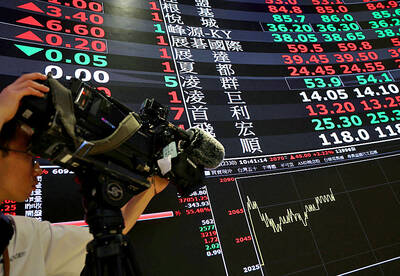
After several years flying high as Asia’s best Nvidia Corp proxy, Taiwan Semiconductor Manufacturing Co (TSMC, 台積電) is increasingly vying with other artificial intelligence (AI) stocks for investor attention. Stock traders are chasing a wider array of beneficiaries as mainstream usage of AI creates demand for hardware beyond the most-advanced chips TSMC makes for Nvidia. Subthemes from the deepening memory crunch to advances in robotics are also luring bids. At the same time, investment caps on single stocks are pushing funds to diversify, while retail investors long familiar with TSMC through its US depositary receipts are being offered a broader set of

Netherlands-based semiconductor equipment supplier ASML Holding NV yesterday said that it is planning to hire an additional 1,000 people in Taiwan this year in response to growing demand from clients. ASML had previously planned to recruit 600 people this year, but that the plan has been adjusted upward, ASML vice president and ASML Taiwan general manager Grace Wang (汪佳慧) told reporters. ASML has a workforce of more than 4,500 in Taiwan, accounting for about 10 percent of its global total, Wang said. This year’s recruitment campaign would focus on adding people in the customer support, manufacturing and supply chain domains to assist ASML

UNDER MICROSCOPE: Taiwan detained three people who allegedly conspired to buy servers in Taiwan and export them using fraudulent documentation, prosecutors said Nvidia Corp chief executive officer Jensen Huang (黃仁勳) on Saturday urged Super Micro Computer Inc to tighten up on compliance after Taiwan detained three people this week for allegedly making fraudulent declarations about artificial intelligence (AI) servers made by its US partner. The development marked the nation’s first crackdown on semiconductor smuggling, which grew after the US slapped restrictions on exports of high-end chips such as Nvidia AI accelerators to China. Nvidia is “rigorous” in explaining regulations to all of its partners, Huang told reporters after arriving in Taipei. “Ultimately Super Micro has to run their own company,” he said in response to

Nvidia Corp yesterday announced that CEO Jensen Huang (黃仁勳) would attend an employee meeting in Taipei tomorrow to celebrate the launch of the company’s Taiwan headquarters project. Huang would attend a gathering at the site of Nvidia’s planned headquarters in Beitou Shilin Technology Park (北投士林科技園區), the company said in a statement. After arriving in Taiwan on Saturday last week, Huang told reporters that he plans to meet with Quanta Computer Inc (廣達) chairman Barry Lam (林百里) and Taiwan Semiconductor Manufacturing Co (TSMC, 台積電) chairman C.C. Wei (魏哲家), and would attend the groundbreaking ceremony for Nvidia’s Taiwan headquarters tomorrow. Nvidia has not yet applied


 RSS
RSS