


Motech Industries Inc (茂迪), the nation’s largest solar cell maker, has signed an agreement with Itogumi Construction Co to form a joint photovoltaic (PV) module venture in Japan.
The Tainan-based company said in a statement yesterday the two companies signed the agreement on Tuesday, under which Motech would purchase a module factory from Itogumi Lumber Co, a subsidiary of Itogumi Construction, to focus on the Japanese market.
“Japan has always been a solar PV market with great potential … The joint venture will strengthen Motech’s position in the Japanese market and reinforce Motech’s strategy of vertical integration,” Motech chief executive officer and chairman Simon Tsuo (左元淮) said in a statement.
The new venture, called Itogumi Motech Inc, will be located in Hokkaido, employ 35 people and have an annual capacity of 27 megawatts in solar-module output.
The statement did not disclose the dollar terms of the investment, but it said the venture would help increase Motech’s presence in the global solar power industry.
Shares of Motech were not affected by the news yesterday, remaining unchanged at NT$118.50 (US$3.71) on the over-the-counter market. So far this year, the stock has declined 22.04 percent, compared with a fall of 4.65 percent on the GRETAI Securities Market index.
Established in 1981 originally as a measurement equipment maker, Motech began producing solar cells in 1999 and had an annual output of 600 megawatts last year. The company said previously that it planned to expand capacity to between 800 megawatts and 1 gigawatt this year.
Motech’s Japanese venture is one of the company’s latest efforts to pursue long-term vertical integration by investing in module assembly plants abroad. It intends to set up the venture through its subsidiary Noble Town Holdings Co, the statement said.
The deal also represents the firm’s second module plant acquisition after Taiwan Semiconductor Manufacturing Co (TSMC, 台積電) in early December bought a 20 percent share in the solar cell maker for NT$6.2 billion. Later that month, Motech said it signed a contract with GE Energy to buy a solar module plant in Delaware at a cost of US$4.54 million.
While concerns remain in the solar cell sector over the impact of German subsidy cuts and falling average selling prices, analysts say a recent management change at Motech would see more TSMC influence on the company’s operations, which could help improve its profitability and competitiveness.
The company said on March 15 that Norman Shen (沈楨林), its former chief financial officer, had resigned to pursue other career goals. This followed a board decision earlier this month to appoint Chang Pin-heng (張秉衡), TSMC vice president of Materials Management and Risk Management, to serve as the new chief executive officer, effective on Wednesday.
“We believe that TSMC’s involvement will allow Motech to develop higher manufacturing efficiency and potentially obtain more favorable supplier pricing … We think Chang will be a significant resource to the Motech management team,” Citigroup analyst Timothy Lam (林子謙) said in a client note.

The domestic unit of the Chinese-owned, Dutch-headquartered chipmaker Nexperia BV will soon be able to produce semiconductors locally within China, according to two company sources. Nexperia is at the center of a global tug-of-war over critical semiconductor technology, with a Dutch court in February ordering a probe into alleged mismanagement at the company. The geopolitical tussle has disrupted supply chains, with some carmakers reportedly forced to cut production due to chip shortages. Local production would allow Nexperia’s domestic arm, Nexperia Semiconductors (China) Ltd (安世半導體中國), to bypass restrictions in place since October on the supply of silicon wafers — etched with tiny components to

Singapore-based ride-hailing and delivery giant Grab Holdings Ltd has applied for regulatory approval to acquire the Taiwan operations of Germany-based Delivery Hero SE's Foodpanda in a deal valued at about US$600 million. Grab submitted the filing to the Fair Trade Commission on Friday last week, with the transaction subject to regulatory review and approval, the company said in a statement yesterday. Its independent governance structure would help foster a healthy and competitive market in Taiwan if the deal is approved, Grab said. Grab, which is listed on the NASDAQ, said in the filing that US-based Uber Technologies Inc holds about 13 percent of

Taiwan Semiconductor Manufacturing Co (TSMC, 台積電) yesterday received government approval to deploy its advanced 3-nanometer (3nm) process at its second fab currently under construction in Japan, the Ministry of Economic Affairs said in a news release. The ministry green-lit the plan for the facility in Kumamoto, which is scheduled to start installing equipment and come online in 2028 with a monthly production capacity of 15,000 12-inch wafers, the ministry said. The Department of Investment Review in June 2024 authorized a US$5.26 billion investment for the facility, slated to manufacture 6- to 12nm chips, significantly less advanced than 3nm process. At a meeting with
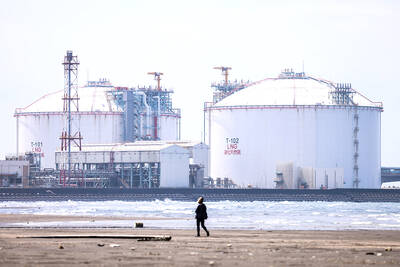
Taiwan is open to joining a global liquefied natural gas (LNG) program if one is created, but on the condition that countries provide delivery even in a scenario where there is a conflict with China, an energy department official said yesterday. While Taiwan’s priority is to have enough LNG at home, the nation is open to exploring potential strategic reserves in other countries such as Japan or South Korea, Energy Administration Deputy Director-General Chen Chung-hsien (陳崇憲) said. While the LNG market does not have a global reserve for emergencies like that of oil, the concept has been raised a few times —


 RSS
RSS