


The impact of Typhoon Morakot is likely to interrupt the nation’s economic recovery by postponing production until next month, but post-disaster reconstruction work will offer a firm support that the nation needs, economists said.
The typhoon, which struck Taiwan between Aug. 7 and Aug. 10, has triggered the nation’s most severe flooding and mudslides in 50 years. It impaired roads and bridges, disrupted power and water supplies and damaged 27 percent of the nation’s farmland, causing hundreds of millions of dollars in total losses.
“The destruction from the typhoon will continue to be felt throughout the island’s economy in coming quarters,” Tine Olsen, an economist at Moody’s Economy.com based in Sydney, said in a research note on Friday.
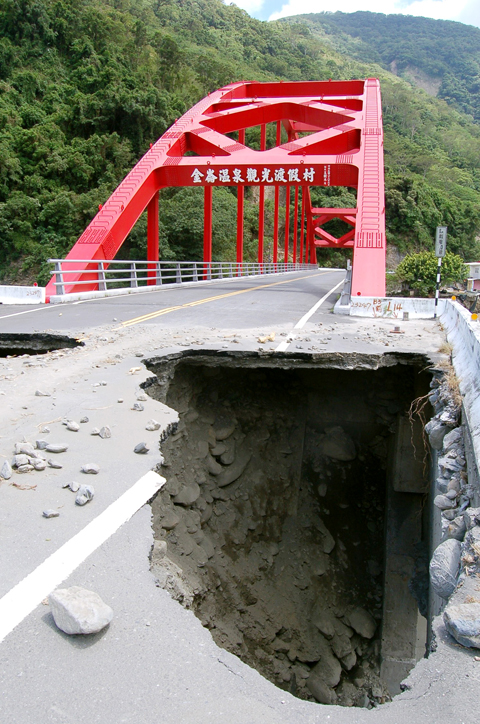
PHOTO: WANG HSIU-TING, TAIPEI TIMES
As of 9am yesterday, agricultural losses caused by the typhoon had amounted to NT$12.24 billion (US$372 million), according to statistics compiled by the Council of Agriculture.
Some 15,963 out of 1.59 million households throughout Chiayi, Kaohsiung, Pingtung and Taitung counties were still experiencing power outages, while 57,885 out of 860,000 households in typhoon-hit areas remained without running water, the Ministry of Economic Affairs said yesterday.
Morkot also created havoc on public transportation and infrastructure. It caused damage to 246 sections of roads, with 95 sections waiting for repairs as of yesterday, the Central Disaster Emergency Operation Center said in a statement.
About 20 bridges were either damaged or washed away after Morakot, the Ministry of Transportation and Communications said last week, but the Chinese-language **United Evening News reported on Saturday that 70 bridges were destroyed, citing Yao Nai-jia (姚乃嘉), a professor at the Center for Bridge Engineering Research at National Central University.
As Kaohsiung Port, the nation’s largest container port, is located in areas where Morakot hit public transportation, Olsen said it would cause a delay in both inbound and outbound shipments.
“Though the bottleneck in outbound shipments will not make long-run dents in the economy, it will postpone production from August to September,” she said. “The disruption of supply of inputs could nevertheless take a bite [out] of output, since production will be lower when imports arrive late.”
Olsen warned that damage to production facilities in disaster areas — if not repaired soon — could also weigh on production in the third quarter, and possibly into the fourth quarter.
An example is Advanced Semiconductor Engineering Inc (日月光半導體), the world’s largest chip packaging and testing company, which last week had to truck in water to maintain normal operations at its factories in Kaohsiung’s Nantze Export Processing Zone (楠梓加工出口區) after Morakot muddied up local water supplies.
Cheng Cheng-mount (鄭貞茂), head economist at Citigroup Taiwan Inc, said the typhoon damage this time was mainly in agriculture, tourism and some infrastructure projects, but the damage to Taiwan’s nominal GDP growth rate would be less than 0.1 percentage point.
“Major tech factories were unscathed and with still low capacity utilization ratio, we don’t think the typhoon damage will justify a downward vision to our GDP forecast for this year,” Cheng said in a client note on Friday.
Johnny Chen (陳擎宏), deputy manager of the economics and industry research department at First Commercial Bank (第一銀行), also said the typhoon damage would have little impact on the economy.
“The disaster will probably tip the gauge slightly downward for this quarter but will push it up by a bigger scale later as the government pumps in more funds to fix broken bridges, roads and other infrastructure,” Chen said by telephone on Friday, after the Executive Yuan announced it would draft a special budget of around NT$110 billion to fund the reconstruction work.
If a special statute for this level of extra funds is approved by the Legislature on Thursday, Chen said the reconstruction work would be a benefit to the economy as it helps raise demand for construction materials and create more job opportunities, while Olsen said the reconstruction projects would push investments higher in the fourth quarter and into next year.
The Directorate-General of Budget, Accounting and Statistics (DGBAS) is due to release its second-quarter GDP figure and forecasts for the following two quarters and the whole year on Thursday.
Economists had previously predicted the DGBAS would adjust its GDP data upward next week in the wake of faster-than-expected economic improvements in the April-June period.
Now, Chen said the DGBAS might have to consider the negative impact of the typhoon, although he did not provide a specific forecast. On May 20, the DGBAS predicted the economy would decline 2.98 percent in the July-September quarter from a year ago, before seeing a 5.2-percent recovery in the fourth quarter.
Nevertheless, Chen said the GDP figure is not a perfect indicator of the quality of people’s life.
“It does not factor in property losses or people killed by the disaster,” he said.

Taiwanese firms have increased investment in the Philippines in recent years as Manila’s ties with Washington deepen and global supply chains continue to shift away from China, an expert at the Chung-Hua Institution for Economic Research (CIER, 中華經濟研究院) said yesterday. The Philippines had not been among Taiwanese investors’ top choices in Southeast Asia, CIER Taiwan ASEAN Studies Center director Kristy Hsu (徐遵慈) said at a seminar in Taipei. However, Taiwan’s investment in the country has grown significantly since the COVID-19 pandemic, reaching US $257 million last year, a high in recent years, she said. Although Taiwan’s total investment in the Philippines still lags

Intel Corp regards Taiwan Semiconductor Manufacturing Co (TSMC, 台積電) as a longstanding partner, as the US chipmaker would continue outsourcing production of advanced chips to TSMC, Intel chief executive officer Lip-Bu Tan (陳立武) said yesterday. “I don’t look at people as competitors. I look at the collaboration... Nvidia is also, you know, a good friend,” Tan told a news conference following his keynote speech at the Computex trade show in Taipei. “It’s a very trusted partnership for us... We are a big, top customer for them, and we’re going to continue doing that,” he said, referring to TSMC, the world’s largest foundry

Hon Hai Precision Industry Co (鴻海精密) yesterday said it would work with US chipmaker Intel Corp to jointly develop and deploy next-generation artificial intelligence (AI) infrastructure and intelligent computing platforms in a move to capture booming demand for AI computing systems. Hon Hai, also known as Foxconn Technology Group (富士康), said in a statement that the partnership would combine its global manufacturing scale, system integration expertise and AI data center deployment capabilities with Intel’s strengths in processor architecture, silicon technologies and software ecosystem. The companies said they plan to work on equipment used in AI data centers, including server racks powered by

Artificial intelligence (AI) agents would supplant smartphones as the center of people’s digital lives, fundamentally reshaping personal devices and driving a major computing upgrade cycle, Qualcomm Inc CEO Cristiano Amon said yesterday. In his keynote speech for this year’s Computex trade show in Taipei, Amon said that the rise of "agentic AI" — AI systems capable of reasoning, planning and carrying out tasks autonomously — would transform how people interact with technology across phones, PCs, vehicles and wearable devices. Describing the technology as the next major evolution in computing, Amon said that "2026 is the year of agents.” For decades, smartphones have sat


 RSS
RSS