


As expected, Formosa Plastics Corp (台塑) yesterday elected Cher Wang (王雪紅), a daughter of its founder, to its board, while again keeping her brother Winston Wong (王文洋) from the family business.
In a shareholders meeting in Taipei, Cher’s sister Susan Wang (王瑞華) and Lee Chih-tsuen (李志村), chairman of Taipei-listed Formosa Plastics, were re-elected to the 15-member board.
Formosa Plastics is the world’s second-biggest maker of polyvinyl chloride, or PVC. The company is the second major unit of Formosa Plastics Group (FPG, 台塑集團), Taiwan’s largest diversified industrial company, to reshuffle its board amid market speculations that Wong would return to the group after he left an FPG unit in 1995 and after his father Wang Yung-ching (王永慶) died in October last year.
Winston has recently triggered a confrontation with other members in the family. On May 13, he filed a complaint in a state court in Newark, New Jersey, seeking to manage their father’s fortune after Wang Yung-ching died in the US without a will.
On Thursday, FPG’s oil-refining unit Formosa Petrochemical Corp (台塑石化) surprised the market by electing Winston’s brother Walter Wang (王文祥) to its board, escalating the tension between Wong and his other family members.
“The election of Cher Wang is a move to create an atmosphere of family unity,” said Gavin Tsai, an analyst at Polaris Securities Co (寶來證券).
Cher is chairwoman of mobile phone maker HTC Corp (宏達電) and also Taiwan’s richest woman, according to a list published by Forbes magazine in June last year.
William Wong (王文淵), chief executive officer of FPG, declined to answer reporters’ questions about whether the family members have other arrangements for Winston. “[We] will see,” local cable TV station USTV quoted him as saying yesterday.
Formosa Plastics’ Lee said he also was not aware of whether Winston will sit on the board of another Formosa unit, Formosa Chemicals & Fibre Corp (台灣化纖), which will hold its board election on June 19.
Lee said the suit filed by Winston was not expected to impact on Formosa Plastics’ operations, which saw profits fall 59 percent last year to NT$19.7 billion (US$604 million) as the global recession hit demand for PVC.
Earlier yesterday, Lee told shareholders that the world’s petrochemicals output capacity may rise less than previously forecast because of project delays in the Middle East.
Global ethylene output capacity will probably increase by less than 4 million tonnes this year, below a previous forecast of about 9 million tonnes, he said.
“Conditions aren’t as bad as previously thought,” Lee said.
Demand for petrochemical products has improved, helped by Chinese purchases, he said.
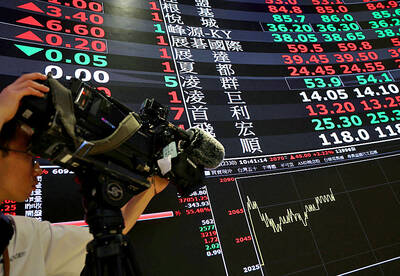
After several years flying high as Asia’s best Nvidia Corp proxy, Taiwan Semiconductor Manufacturing Co (TSMC, 台積電) is increasingly vying with other artificial intelligence (AI) stocks for investor attention. Stock traders are chasing a wider array of beneficiaries as mainstream usage of AI creates demand for hardware beyond the most-advanced chips TSMC makes for Nvidia. Subthemes from the deepening memory crunch to advances in robotics are also luring bids. At the same time, investment caps on single stocks are pushing funds to diversify, while retail investors long familiar with TSMC through its US depositary receipts are being offered a broader set of

Netherlands-based semiconductor equipment supplier ASML Holding NV yesterday said that it is planning to hire an additional 1,000 people in Taiwan this year in response to growing demand from clients. ASML had previously planned to recruit 600 people this year, but that the plan has been adjusted upward, ASML vice president and ASML Taiwan general manager Grace Wang (汪佳慧) told reporters. ASML has a workforce of more than 4,500 in Taiwan, accounting for about 10 percent of its global total, Wang said. This year’s recruitment campaign would focus on adding people in the customer support, manufacturing and supply chain domains to assist ASML

UNDER MICROSCOPE: Taiwan detained three people who allegedly conspired to buy servers in Taiwan and export them using fraudulent documentation, prosecutors said Nvidia Corp chief executive officer Jensen Huang (黃仁勳) on Saturday urged Super Micro Computer Inc to tighten up on compliance after Taiwan detained three people this week for allegedly making fraudulent declarations about artificial intelligence (AI) servers made by its US partner. The development marked the nation’s first crackdown on semiconductor smuggling, which grew after the US slapped restrictions on exports of high-end chips such as Nvidia AI accelerators to China. Nvidia is “rigorous” in explaining regulations to all of its partners, Huang told reporters after arriving in Taipei. “Ultimately Super Micro has to run their own company,” he said in response to
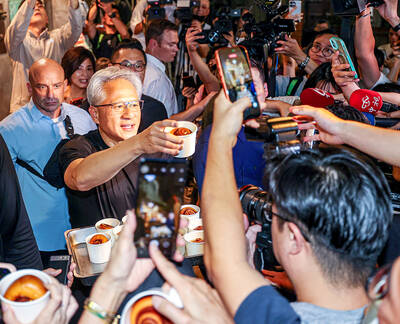
Nvidia Corp yesterday announced that CEO Jensen Huang (黃仁勳) would attend an employee meeting in Taipei tomorrow to celebrate the launch of the company’s Taiwan headquarters project. Huang would attend a gathering at the site of Nvidia’s planned headquarters in Beitou Shilin Technology Park (北投士林科技園區), the company said in a statement. After arriving in Taiwan on Saturday last week, Huang told reporters that he plans to meet with Quanta Computer Inc (廣達) chairman Barry Lam (林百里) and Taiwan Semiconductor Manufacturing Co (TSMC, 台積電) chairman C.C. Wei (魏哲家), and would attend the groundbreaking ceremony for Nvidia’s Taiwan headquarters tomorrow. Nvidia has not yet applied


 RSS
RSS