


Acer Inc (宏碁), the world’s third- largest maker of personal computers, reported a 17 percent increase in fourth-quarter profit after grabbing market share with its low-cost netbook and cutting expenses.
Net income climbed to NT$2.81 billion (US$83 million), or NT$1.08 per share, from NT$2.4 billion, or NT$0.99, a year earlier, the Taipei-based company said in a statement yesterday.
Profit missed the NT$2.97 billion median of 11 analyst estimates compiled by Bloomberg News.
Sales of the Aspire One netbook and acquisitions helped boost Acer’s market share by 2.4 percentage points in the period at the expense of Dell Inc and Lenovo Group Ltd (聯想), researcher IDC said.
The company may extend gains as the global recession prompts consumers to switch to netbooks, compact computers that sell for less than half the price of standard notebooks.
“As the consumer’s interest moves to favor the value segment, we expect Acer to continue its aggressive market share gains in 2009,” Jenny Lai (賴惠娟), who rates the company “buy” at CLSA Asia-Pacific Markets in Taipei, wrote in a report on Monday.
Revenue for the period dropped 8 percent to NT$135 billion after the July introduction of the Aspire One, an ultra-compact model that retails for about US$400, and the global economic downturn prompted consumers to switch to cheaper computers. Acer held around 45 percent of the netbook market during the period, CLSA estimates showed.
Fourth-quarter operating profit climbed 15 percent from a year earlier to NT$3.98 billion, while operating margin was 2.94 percent, Acer said in the statement.
Acer’s shares have added 20 percent this year to close at NT$51, outpacing a 14 percent advance in the benchmark TAIEX index.
The Taiwanese company took the top spot in the netbook segment from Asustek Computer Inc (華碩電腦) which inspired the market with its own Eee PC low-cost laptop in October 2007.
Other netbook makers including Hewlett-Packard Co, Dell and Lenovo held a combined market share of about 20 percent, Taipei-based Market Intelligence and Consulting Institute said.
Acer’s computer shipments climbed 25 percent during the fourth quarter, the most among the top five vendors, allowing it to climb to 11.8 percent of the market, IDC said on Jan. 14. Hewlett-Packard and Dell maintained their lead amid a 0.4 percent decline in global sales by units.
Overall computer shipments will drop 4.5 percent this year, while notebooks will climb 4.3 percent, IDC forecast on March 5.
Netbook sales will almost double this year to 21 million units, even as the total PC market shrinks 12 percent, researcher Gartner Inc said last month.
Gains of as much as 10 percent in some markets will help Acer add 2 percentage points to 3 percentage points to its global laptop share this year, it said on Feb. 23.
Notebooks contribute about 65 percent of the company’s revenue.
Acer’s release last month of a 10-inch version of its Aspire One model and four new mobile phones will help boost sales this year, Vincent Chen (陳豊丰), who rates the stock “buy” at Yuanta Financial Holding Co (元大金控), wrote in a March 24 report.
Rebounding Russian and European currencies could also help boost demand in those markets, he wrote.

Taiwanese firms have increased investment in the Philippines in recent years as Manila’s ties with Washington deepen and global supply chains continue to shift away from China, an expert at the Chung-Hua Institution for Economic Research (CIER, 中華經濟研究院) said yesterday. The Philippines had not been among Taiwanese investors’ top choices in Southeast Asia, CIER Taiwan ASEAN Studies Center director Kristy Hsu (徐遵慈) said at a seminar in Taipei. However, Taiwan’s investment in the country has grown significantly since the COVID-19 pandemic, reaching US $257 million last year, a high in recent years, she said. Although Taiwan’s total investment in the Philippines still lags

Intel Corp regards Taiwan Semiconductor Manufacturing Co (TSMC, 台積電) as a longstanding partner, as the US chipmaker would continue outsourcing production of advanced chips to TSMC, Intel chief executive officer Lip-Bu Tan (陳立武) said yesterday. “I don’t look at people as competitors. I look at the collaboration... Nvidia is also, you know, a good friend,” Tan told a news conference following his keynote speech at the Computex trade show in Taipei. “It’s a very trusted partnership for us... We are a big, top customer for them, and we’re going to continue doing that,” he said, referring to TSMC, the world’s largest foundry
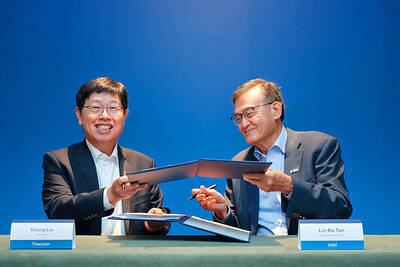
Hon Hai Precision Industry Co (鴻海精密) yesterday said it would work with US chipmaker Intel Corp to jointly develop and deploy next-generation artificial intelligence (AI) infrastructure and intelligent computing platforms in a move to capture booming demand for AI computing systems. Hon Hai, also known as Foxconn Technology Group (富士康), said in a statement that the partnership would combine its global manufacturing scale, system integration expertise and AI data center deployment capabilities with Intel’s strengths in processor architecture, silicon technologies and software ecosystem. The companies said they plan to work on equipment used in AI data centers, including server racks powered by

Artificial intelligence (AI) agents would supplant smartphones as the center of people’s digital lives, fundamentally reshaping personal devices and driving a major computing upgrade cycle, Qualcomm Inc CEO Cristiano Amon said yesterday. In his keynote speech for this year’s Computex trade show in Taipei, Amon said that the rise of "agentic AI" — AI systems capable of reasoning, planning and carrying out tasks autonomously — would transform how people interact with technology across phones, PCs, vehicles and wearable devices. Describing the technology as the next major evolution in computing, Amon said that "2026 is the year of agents.” For decades, smartphones have sat


 RSS
RSS