


Taishin Financial Holding Co (台新金控) said yesterday it was planning to expand its share of the consumer finance market this year but would be cautious in dealing with corporate loans amid predictions of an industry-wide restructuring caused by the current economic crisis.
The seven-year-old company posted an after-tax loss of NT$5.4 billion (US$154.5 million) last year, including one-time provisions in the fourth quarter of NT$5.5 billion to clean up its debt relief portfolio and reserve for weakening corporate loans, its financial report said.
“We will adopt a cautious strategy in coping with the downturn that is expected to last until the fourth quarter,” Taishin Financial president Lin Keh-hsiao (林克孝) told an investor presentation. “We’ll embark on brand reposition, cost control and risk reduction.”
Lin, whose company has predicted Taiwan’s economy would contract 4.9 percent this year, said it would also seek to raise its capital adequacy ratio to 105 percent, from the current 101 percent.
The company plans to raise NT$3.5 billion by the end of the third quarter through the issuing of 700 million new shares at NT$5 each, he said.
Tashin Financial’s stock traded at NT$4.95 per share yesterday on the Taiwan Stock Exchange, down from its peak of NT$16.5 last year.
Lin was more cautious when asked to comment on a potential merger with Chang Hwa Commercial Bank (彰化銀行). Taishin Financial controls a 22.5-percent stake in the bank.
“That was a move agreed upon when we purchased the bank’s shares,” Lin said. “We will pursue the direction when the environment turns favorable.”
Minister of Finance Lee Sush-der (李述德) said in an interview with the Chinese-language Economic Daily News on Thursday that a merger was not up to Taishin Financial to decide but to the board of state-run Chang Hwa, in which the government has an 18 percent stake.
Meanwhile, Greg Gibb, Taishin Financial’s chief operating officer, said the firm was assessing cooperation with a strategic partner to inject more capital to fortify its financial strength.
Gibb said the company is in talks with two to three potential investors, but refused to provide further details.
As for the company’s plan to form a life insurance venture with Dutch insurer Aegon NV, announced in December 2007, Lin said that the project would continue even though Aegon is reportedly looking for buyers for its local operation.
He declined to say if Taishin was interested in Aegon’s local operations.

Cairo’s new monorail slices across the city skyline, running above the familiar chaos of blaring horns and aging buses’ exhaust fumes that mark rush hour below. The US$4.5 billion monorail, opened this month, is among Egypt’s most prominent new transport projects, part of a debt-funded infrastructure drive criticized for sapping state finances while bringing limited benefits to most of the country’s 109 million people. “It feels like you’re in a different country,” said Ramy Sayed, a restaurant manager, aboard a driverless Innovia 300 train. “No noise, no traffic, we’re not used to this.” The eastern line runs 56km from the bustling middle-class

Starlux Airlines Co (星宇航空) today unveiled a long-haul network expansion plan at a shareholders’ meeting in Taipei, including direct flights to Barcelona, Spain, and Zurich, Switzerland, as well as a service connecting Taipei, Sydney and New Zealand. Starlux is to become the first Taiwanese carrier to offer non-stop services to the two European cities, while the inaugural oceanic route is expected to expand transit opportunities within the Australia-New Zealand market, Starlux said. Flight services to Chicago, Dallas, Washington and New York are under evaluation, the airline added. Prior to the shareholders’ meeting, the airline earlier this year announced that it would be

Taiwanese prosecutors suspect that three people successfully smuggled at least one shipment of Nvidia Corp artificial intelligence (AI) chips to China after first exporting them to Japan, people familiar with the matter said. The trio was detained last week by the Keelung District Prosecutors’ Office for allegedly falsifying documents related to exports of Super Micro Computer Inc servers containing advanced Nvidia chips, which the US has barred from sale to China without a license from Washington. The move marked Taiwan’s first public crackdown on AI chip diversion after years of pressure from the US to take a more active role in curtailing
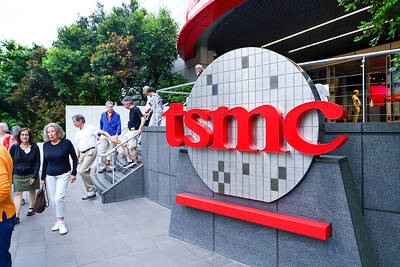
Taiwan Semiconductor Manufacturing Co (TSMC, 台積電) employee bonuses are likely to grow more than 30 percent this year, in line with the past few years as the company’s profits continue to set new records, an anonymous source cited TSMC chairman C.C. Wei (魏哲家) as saying yesterday. TSMC, the world’s largest contract chipmaker, is committed to taking care of its workers, the source said, citing Wei’s meeting with employees yesterday morning. Wei also expressed gratitude to employees for their contribution to the company’s improving bottom line, the source added. Since 2023, TSMC’s employee bonuses have grown at an annual rate of


 RSS
RSS