


Political concern rattles bourse
Shares closed 2.2 percent lower yesterday on weak fundamentals and the political uncertainty generated by former president Chen Shui-bian’s (陳水扁) questioning on corruption allegations, dealers said.
The weighted index fell 101.7 points to 4,638.57 on turnover of NT$55.46 billion (US$1.69 billion).
Financials led the decline with a 5.24 percent fall. The construction sector plunged 4.99 percent, paper dropped 3.76 percent and electronics was off 2.14 percent.
Cement soared by 5.46 percent, boosted by China’s unveiling of a US$586 billion economic stimulus package on Sunday.
“A majority of the electronics companies reported poor third-quarter operating results,” discouraging potential investors, Grand Cathay Securities (大華證券) analyst Mars Hsu said.
The questioning of Chen by prosecutors on corruption charges also weighed on the market.
“Investors feared that should Chen be taken into custody, his supporters may launch widespread demonstrations,” Hsu said.
TSMC to cancel shares
The board of Taiwan Semiconductor Manufacturing Co (TSMC, 台積電), the world’s biggest contract chipmaker, yesterday approved a plan to cancel 279 million treasure shares it repurchased from the open market earlier this year.
The shares to be canceled account for 1.07 percent of total issued shares. The cancelation will reduce TSMC’s registered capital stock by NT$2.79 billion (US$85 million) to approximately NT$256 billion, TSMC said in a statement.
The board set next Wednesday as the record date for the capital reduction.
The board also gave the go-ahead to the promotion of Rick Cassidy to vice president. Cassidy is currently the president of TSMC North America and will continue to serve in that position.
Pegatron/Unihan’s sales drop
Pegatron Corp (和聯) and Unihan Corp (永碩) yesterday reported combined revenues of NT$52.76 billion (US$1.6 billion) last month, down 2 percent from September, they said in a statement.
Pegatron Corp and Unihan Corp were spun off by Eee PC maker Asustek Computer Inc (華碩電腦) in January. Asus now focuses on its own-brand business, while Pegatron and Unihan specialize in production for major international personal computer and electronics vendors.
Pegatron/Unihan’s sales breakdown last month showed shipments of 3.2 million motherboards and desktops, up 18 percent from September; 800,000 to 900,000 laptops (not including Eee PCs), down 2 percent; and 1.15 million graphics and TV cards, up 13 percent.
Accumulated revenues in the first 10 months of this year reached NT$397.97 billion.
Banks to adjust rates monthly
Eleven domestic banks agreed to adjust their mortgage rates on a monthly — rather than quarterly or longer — basis after a meeting with the central bank yesterday.
The central bank had lowered interest rates four times in the last six weeks, but most homeowners have yet to benefit from lower mortgage payments because lenders adjust rates every three or six months in line with contract terms.
Starting today, homeowners may apply to change their mortgage rates every month, the central bank said in a statement.
They may do so with the Bank of Taiwan (臺灣銀行), Land Bank of Taiwan (土地銀行), First Commercial Bank (第一銀行), Taipei Fubon Bank (台北富邦銀行), Chinatrust Commercial Bank (中國信託銀行), Chang Hwa Commercial Bank (彰化銀行), E.Sun Bank (玉山銀行), Cathay United Bank (國泰世華銀行), Bank SinoPac (永豐銀行), Taiwan Cooperative Bank (合庫銀行) and Hua Nan Commercial Bank (華南銀行).
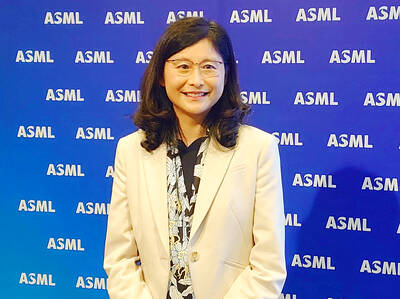
Netherlands-based semiconductor equipment supplier ASML Holding NV yesterday said that it is planning to hire an additional 1,000 people in Taiwan this year in response to growing demand from clients. ASML had previously planned to recruit 600 people this year, but that the plan has been adjusted upward, ASML vice president and ASML Taiwan general manager Grace Wang (汪佳慧) told reporters. ASML has a workforce of more than 4,500 in Taiwan, accounting for about 10 percent of its global total, Wang said. This year’s recruitment campaign would focus on adding people in the customer support, manufacturing and supply chain domains to assist ASML
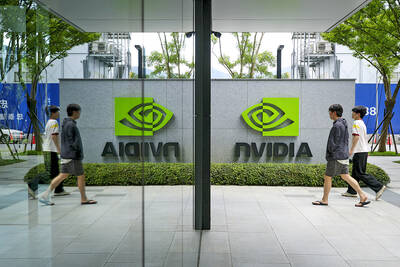
UNDER MICROSCOPE: Taiwan detained three people who allegedly conspired to buy servers in Taiwan and export them using fraudulent documentation, prosecutors said Nvidia Corp chief executive officer Jensen Huang (黃仁勳) on Saturday urged Super Micro Computer Inc to tighten up on compliance after Taiwan detained three people this week for allegedly making fraudulent declarations about artificial intelligence (AI) servers made by its US partner. The development marked the nation’s first crackdown on semiconductor smuggling, which grew after the US slapped restrictions on exports of high-end chips such as Nvidia AI accelerators to China. Nvidia is “rigorous” in explaining regulations to all of its partners, Huang told reporters after arriving in Taipei. “Ultimately Super Micro has to run their own company,” he said in response to

Nvidia Corp yesterday announced that CEO Jensen Huang (黃仁勳) would attend an employee meeting in Taipei tomorrow to celebrate the launch of the company’s Taiwan headquarters project. Huang would attend a gathering at the site of Nvidia’s planned headquarters in Beitou Shilin Technology Park (北投士林科技園區), the company said in a statement. After arriving in Taiwan on Saturday last week, Huang told reporters that he plans to meet with Quanta Computer Inc (廣達) chairman Barry Lam (林百里) and Taiwan Semiconductor Manufacturing Co (TSMC, 台積電) chairman C.C. Wei (魏哲家), and would attend the groundbreaking ceremony for Nvidia’s Taiwan headquarters tomorrow. Nvidia has not yet applied
Huawei Technologies Co (華為) said it has come up with a new pathway to shorten its gap with industry leader Taiwan Semiconductor Manufacturing Co (TSMC, 台積電), potentially achieving a breakthrough in making advanced semiconductors without cutting-edge equipment. Right now there is about a five-year gap between what TSMC is capable of and what Huawei, together with its manufacturing partner Semiconductor Manufacturing International Corp (中芯), can produce. Huawei is to start making 1.4-nanometer chips by 2031 with its own “LogicFolding” technology, Huawei semiconductor chief He Tingbo (何庭波) said in a rare public appearance during a chip conference yesterday, while TSMC has


 RSS
RSS