


With the Cabinet deciding today to lower the securities transactions tax, academics were doubtful yesterday that the measure represented a sound and lasting remedy to boost the stock market.
Minister of Finance Lee Sush-der (李述德) told reporters on Monday that the government was considering slashing the levy after the TAIEX shed 783.83 points, or 11 percent, last week.
The business community and some lawmakers have suggested the tax be lowered from the current 0.3 percent to 0.15 percent to reverse the bearish sentiment among investors.
Liang Kuo-yuan (梁國源), president of Polaris Research Institute (寶華綜合經濟研究院), said he had reservations about the cut, adding that while it could boost the index in the short term, the rally could not last if the economic climate at home and abroad remained drab.
“The tax cut, if it is realized, can definitely stimulate the local bourse,” Liang said by telephone.
“But the magnitude and duration [of the rally] would be limited, as the tax has little bearing on the risks involved in equity investment,” Liang said.
Liang said the stock showing had more to do with domestic and foreign economic indicators and that the government should rather focus its energies on improving the overall investment environment.
Yang Chia-yen (楊家彥), a researcher at the Taiwan Institute of Economic Research (台灣經濟研究院), also frowned on the tax cut, but for different reasons.
Yang said he considered it inappropriate for the government to intervene in the stock market unless doing so was necessary to avert a crash.
Yang attributed the market’s recent roller-coaster performance chiefly to international factors over which the tax cut would have little influence.
“The government should think twice about the wisdom of the planned tax cut,” Yang said in a telephone interview.
“It could buoy share prices for a few days and ease burdens for heavy stock traders, [but] at the cost of hurting state coffers,” Yang said.
The securities transactions tax contributed NT$128.8 billion (US$4.05 billion) to the nation’s NT$1.73 trillion in tax revenues last year, Ministry of Finance statistics showed.
Yang said he wondered how the government could manage to remain financially healthy with less tax income, while seeking to spend more to spur domestic demand.
The Cabinet is scheduled to announce more stimulus measures today after pushing a NT$130 billion package through the legislature in July to foster economic growth.
Day Jaw-yang (戴肇洋), a research director at the Taiwan Research Institute (台綜院), said he opposed the tax cut as it would be irrelevant in saving the stock market in the long run.
Day said investors were suffering from a crisis in confidence and that the tax cut was no remedy.
Some financial officials have recommended a flexible tax policy, which would allow the ministry to adjust the levy as it sees fits depending on the market showing.

Cairo’s new monorail slices across the city skyline, running above the familiar chaos of blaring horns and aging buses’ exhaust fumes that mark rush hour below. The US$4.5 billion monorail, opened this month, is among Egypt’s most prominent new transport projects, part of a debt-funded infrastructure drive criticized for sapping state finances while bringing limited benefits to most of the country’s 109 million people. “It feels like you’re in a different country,” said Ramy Sayed, a restaurant manager, aboard a driverless Innovia 300 train. “No noise, no traffic, we’re not used to this.” The eastern line runs 56km from the bustling middle-class

Taiwanese firms have increased investment in the Philippines in recent years as Manila’s ties with Washington deepen and global supply chains continue to shift away from China, an expert at the Chung-Hua Institution for Economic Research (CIER, 中華經濟研究院) said yesterday. The Philippines had not been among Taiwanese investors’ top choices in Southeast Asia, CIER Taiwan ASEAN Studies Center director Kristy Hsu (徐遵慈) said at a seminar in Taipei. However, Taiwan’s investment in the country has grown significantly since the COVID-19 pandemic, reaching US $257 million last year, a high in recent years, she said. Although Taiwan’s total investment in the Philippines still lags
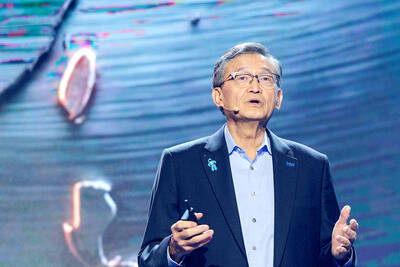
Intel Corp regards Taiwan Semiconductor Manufacturing Co (TSMC, 台積電) as a longstanding partner, as the US chipmaker would continue outsourcing production of advanced chips to TSMC, Intel chief executive officer Lip-Bu Tan (陳立武) said yesterday. “I don’t look at people as competitors. I look at the collaboration... Nvidia is also, you know, a good friend,” Tan told a news conference following his keynote speech at the Computex trade show in Taipei. “It’s a very trusted partnership for us... We are a big, top customer for them, and we’re going to continue doing that,” he said, referring to TSMC, the world’s largest foundry

Artificial intelligence (AI) agents would supplant smartphones as the center of people’s digital lives, fundamentally reshaping personal devices and driving a major computing upgrade cycle, Qualcomm Inc CEO Cristiano Amon said yesterday. In his keynote speech for this year’s Computex trade show in Taipei, Amon said that the rise of "agentic AI" — AI systems capable of reasoning, planning and carrying out tasks autonomously — would transform how people interact with technology across phones, PCs, vehicles and wearable devices. Describing the technology as the next major evolution in computing, Amon said that "2026 is the year of agents.” For decades, smartphones have sat


 RSS
RSS