


Taishin Financial Holdings Co (台新金控) yesterday reported a net profit of NT$1.02 billion (US$32.73 million), or NT$0.03 per share, for the first seven months of the year, a decline of NT$3.77 billion compared with the same period last year.
The six-year-old company attributed its lackluster performance to mark-to-market losses in the equities trading and underwriting portfolio as well as an increase in provisions to strengthen coverage ratio.
“The showing in the first half is not satisfactory,” Taishin Financial president Lin Keh-hsiao (林克孝) said during an investor presentation in Taipei yesterday.
“But the worst is over. We expect to see better growth in the second half when some of our efforts will start to pay off,” he said.
Lin said the company raised its coverage ratio from 60 percent in the first quarter to 69 percent in the second quarter in support of long-term growth in unsecured lending.
The company will also press ahead with its plan to raise capital by selling 45 million shares, Lin said.
“We expect to expand our market scale before the end of the year to meet the need for strategic deployment across the Taiwan Strait,” Lin said. “The company will take advantage of improved cross-strait ties and reach out to more customers in the hope of reaping a harvest next year.”
Taishin International Bank (台新銀行), the company’s banking subsidiary, posted a 20 percent drop in wealth management fees compared with the first quarter on falling sales of funds and other products, chief financial officer Carol Lai (賴昭吟) said.
The second half would likely see weaker fee income with an increased focus on assets under management and customer acquisition, Lai said.
Taishin Financial chief operating officer Greg Gibb said the company was assessing a strategic alliance with its counterparts in China, which have expressed an interest in the company’s consumer finance, credit card and asset management business.
Despite market concerns on asset quality, Gibb said Taishin Financial continued to demonstrate improvements in unsecured lending and better than market performance in secured lending.
Gibb said the company would accelerate cost-saving initiatives in back office functions as part of an effort to make Taishin Financial more competitive and efficient.
Andy Chang (張書評), a financial analyst at Taiwan Ratings Corp (中華信評), said the financial industry would continue to face tough profitability challenges in the second half as it did in the first half as capital markets around the world remain volatile.
Chang said that many domestic financial service providers suffered unexpected losses in foreign exchange.
It remained to be seen if any banks are poised to benefit from improved cross-strait relations, noting that talks of expansion or alliance are still on the drawing board, he said.
“It will take longer time to gauge the impact of cross-strait ties,” Chang said.

Cairo’s new monorail slices across the city skyline, running above the familiar chaos of blaring horns and aging buses’ exhaust fumes that mark rush hour below. The US$4.5 billion monorail, opened this month, is among Egypt’s most prominent new transport projects, part of a debt-funded infrastructure drive criticized for sapping state finances while bringing limited benefits to most of the country’s 109 million people. “It feels like you’re in a different country,” said Ramy Sayed, a restaurant manager, aboard a driverless Innovia 300 train. “No noise, no traffic, we’re not used to this.” The eastern line runs 56km from the bustling middle-class
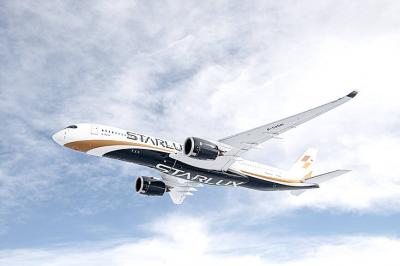
Starlux Airlines Co (星宇航空) today unveiled a long-haul network expansion plan at a shareholders’ meeting in Taipei, including direct flights to Barcelona, Spain, and Zurich, Switzerland, as well as a service connecting Taipei, Sydney and New Zealand. Starlux is to become the first Taiwanese carrier to offer non-stop services to the two European cities, while the inaugural oceanic route is expected to expand transit opportunities within the Australia-New Zealand market, Starlux said. Flight services to Chicago, Dallas, Washington and New York are under evaluation, the airline added. Prior to the shareholders’ meeting, the airline earlier this year announced that it would be

Taiwanese prosecutors suspect that three people successfully smuggled at least one shipment of Nvidia Corp artificial intelligence (AI) chips to China after first exporting them to Japan, people familiar with the matter said. The trio was detained last week by the Keelung District Prosecutors’ Office for allegedly falsifying documents related to exports of Super Micro Computer Inc servers containing advanced Nvidia chips, which the US has barred from sale to China without a license from Washington. The move marked Taiwan’s first public crackdown on AI chip diversion after years of pressure from the US to take a more active role in curtailing
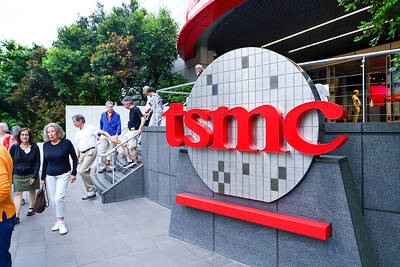
Taiwan Semiconductor Manufacturing Co (TSMC, 台積電) employee bonuses are likely to grow more than 30 percent this year, in line with the past few years as the company’s profits continue to set new records, an anonymous source cited TSMC chairman C.C. Wei (魏哲家) as saying yesterday. TSMC, the world’s largest contract chipmaker, is committed to taking care of its workers, the source said, citing Wei’s meeting with employees yesterday morning. Wei also expressed gratitude to employees for their contribution to the company’s improving bottom line, the source added. Since 2023, TSMC’s employee bonuses have grown at an annual rate of


 RSS
RSS