


South Korea’s Samsung Electronics is to invest US$1 billion in a “state of the art” microchip manufacturing facility in the Philippines, it was reported yesterday.
The Manila Bulletin newspaper said the facility would be built on a 30 hectare site in the Clark Special Economic Zone near the former US airforce base north of Manila.
Quoting unnamed sources, the paper said “it will be a state-of-the-art” facility with construction starting “within the year.”
At present, Samsung has two operations in the country, Samsung Electronics Philippines Manufacturing Corp and Samsung Electronics Philippines Corp.
The entry of Samsung in Clark will boost the zone as a hub for electronics chipmaking, an unnamed official said.
“This means the country can move upstream to design and manufacturing, as opposed to the low value-added testing and packaging operations,” the official said.
“People at Clark have been in touch with Samsung. They have been talking, exploring possibilities. There is encouraging progress,” Trade and Industry Secretary Peter Favila told Dow Jones Newswires in a phone interview.
Favila said he was still awaiting a full report on the matter, declining to give details of the planned investment.
“Samsung Electronics is exploring various investment opportunities in Southeast Asian countries, but no decision has been made,” company spokeswoman Lee Eun-hee said.
This possible development comes a year after US-based semiconductor firm Texas Instruments Inc formalized plans to invest around US$1 billion over 10 years in a new test and assembly facility in the Philippines.
In related news, Hynix Semiconductor Inc, the world’s No. 2 memory chipmaker, said yesterday it would buy a 2 percent stake in Taiwan-based chip design house Phison Electronics Corp (群聯電子).
Hynix said in a filing with the Korea Exchange that it would spend NT$346.5 million (US$11.4 million) for the stake under an alliance deal aimed at technology cooperation and joint product development.
Under the agreement, the South Korean chipmaker will also supply Phison with NAND flash memory chips until the end of next year and receive an initial payment of US$26.4 million.

France cannot afford to ignore the third credit-rating reduction in less than a year, French Minister of Finance Roland Lescure said. “Three agencies have downgraded us and we can’t ignore this cloud,” he told Franceinfo on Saturday, speaking just hours after S&P lowered his country’s credit rating to “A+” from “AA-” in an unscheduled move. “Fundamentally, it’s an additional cloud to a weather forecast that was already pretty gray. It’s a call for lucidity and responsibility,” he said, adding that this is “a call to be serious.” The credit assessor’s move means France has lost its double-A rating at two of the

AI BOOST: Although Taiwan’s reliance on Chinese rare earth elements is limited, it could face indirect impacts from supply issues and price volatility, an economist said DBS Bank Ltd (星展銀行) has sharply raised its forecast for Taiwan’s economic growth this year to 5.6 percent, citing stronger-than-expected exports and investment linked to artificial intelligence (AI), as it said that the current momentum could peak soon. The acceleration of the global AI race has fueled a surge in Taiwan’s AI-related capital spending and exports of information and communications technology (ICT) products, which have been key drivers of growth this year. “We have revised our GDP forecast for Taiwan upward to 5.6 percent from 4 percent, an upgrade that mainly reflects stronger-than-expected AI-related exports and investment in the third

Mercuries Life Insurance Co (三商美邦人壽) shares surged to a seven-month high this week after local media reported that E.Sun Financial Holding Co (玉山金控) had outbid CTBC Financial Holding Co (中信金控) in the financially strained insurer’s ongoing sale process. Shares of the mid-sized life insurer climbed 5.8 percent this week to NT$6.72, extending a nearly 18 percent rally over the past month, as investors bet on the likelihood of an impending takeover. The final round of bidding closed on Thursday, marking a critical step in the 32-year-old insurer’s search for a buyer after years of struggling to meet capital adequacy requirements. Local media reports
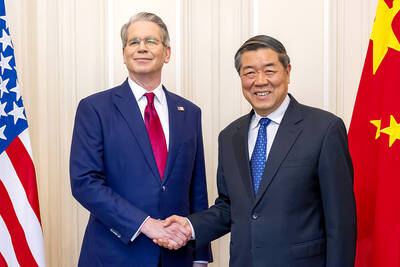
RARE EARTHS: The call between the US Treasury Secretary and his Chinese counterpart came as Washington sought to rally G7 partners in response to China’s export controls China and the US on Saturday agreed to conduct another round of trade negotiations in the coming week, as the world’s two biggest economies seek to avoid another damaging tit-for-tat tariff battle. Beijing last week announced sweeping controls on the critical rare earths industry, prompting US President Donald Trump to threaten 100 percent tariffs on imports from China in retaliation. Trump had also threatened to cancel his expected meeting with Chinese President Xi Jinping (習近平) in South Korea later this month on the sidelines of the APEC summit. In the latest indication of efforts to resolve their dispute, Chinese state media reported that


 RSS
RSS