


Rejecting allegations that he had dipped his hands into the company’s coffers, Kuo Ching-chiang (郭清江), the former chairman and chief executive officer of Sino Swearingen Aircraft Corp (SSAC), said he had created invaluable “goodwill” with the lossmaking Taiwan-US joint venture.
During an interview with the Taipei Times at the China University of Technology in Taipei on Saturday, Kuo said the company was already operating in the red when he took over nearly three years ago.
SSAC reported a deficit of US$485.56 million as of September 2005 when he assumed the chairmanship, said Kuo, who has been barred from leaving the country as prosecutors conduct an investigation into allegations of embezzlement and corruption.
“I cannot assume responsibility for a problem that I didn’t make,” said Kuo, 66, who has a doctorate in aeronautics and astronautics from the Massachusetts Institute of Technology and worked at Rockwell and Boeing for some 20 years.
The Taiwanese government invested about US$530.2 million in SSAC between March 1995 and September 2005. The government injected another US$116 million in the company during Kuo’s term between September 2005 and June last year. As of the end of Kuo’s tenure, the government had invested a total of US$646.2 million in SSAC, in which the Taiwanese government holds a more than 90 percent share.
Before the March 22 presidential election, opposition lawmakers accused Kuo of embezzling US$600 million (NT$20 billion) from SSAC. The Special Investigation Panel under the Supreme Prosecutors’ Office are currently investigating the case.
Kuo said SSAC had assets of US$44.62 million when he took over in September 2005, citing financial documents provided by SSAC chief financial officer Kelly Simmons. When he tendered his resignation in June last year, the company’s total assets had nearly doubled to US$86.76 million, documents showed.
“Reports by Chinese-language newspapers that SSAC had US$300 million in the bank when I took over are simply ridiculous. What are they talking about? I don’t understand,” he said.
Kuo said that the company’s balance sheet showed a US$90 million debt for the first time during his tenure, but that was mainly from a loan by major shareholders to SSAC as part of their US$116 million investment (including US$38 million in cash and US$78 million in loans).
Kuo said he should not be blamed for this debt because “it was the shareholders’ decision to loan the company money, not mine.”
Kuo has been credited with helping SSAC obtain a US Federal Aviation Administration Type Certificate for its high-performance SJ30-2 jet in 2005 and a Certification of Airworthiness for two production airplanes last year.
“All these are firsts in the past 40 four years for a new company with a new type of business jet,” he said.
Kuo said he had showed the company’s financial documents to prosecutors and demanded justice if the allegations were found to be a political plot by opposition lawmakers to damage his reputation and harm the Democratic Progressive Party government.
Kuo said the Ministry of Economic Affairs was aware he was innocent.
“Most of the media reports are either false or distorted. But, under the pressure of lawmakers, the ministry still forwarded my case to the Special Investigation Panel,” he said.
SSAC has practically ceased its manufacturing operation and is on the brink of bankruptcy because of funding problems. The government has only injected US$8.18 million into the company since July last year to maintain the company’s daily administrative operations. It had also suspended a deal to sell an 80 percent stake to a venture capital firm from the United Arab Emirates (UAE) for US$150 million in February, after opposition lawmakers accused it of trying to sell off SSAC at too low a price.
Kuo said the UAE deal is valuable to Taiwan because, based on his understanding, the investor was willing not only to shoulder the US$85 million loan but also to pay royalty fees to shareholders on future new aircraft sales.
“The UAE investment is the only alternative that would allow SSAC to stay in business as the government has stopped funding it and there are no other interested buyers,” Kuo said.
If the deal collapses and the company has to file for bankruptcy protection, SSAC would face litigation risks and that could damage Taiwan’s reputation, he said.

Taiwanese firms have increased investment in the Philippines in recent years as Manila’s ties with Washington deepen and global supply chains continue to shift away from China, an expert at the Chung-Hua Institution for Economic Research (CIER, 中華經濟研究院) said yesterday. The Philippines had not been among Taiwanese investors’ top choices in Southeast Asia, CIER Taiwan ASEAN Studies Center director Kristy Hsu (徐遵慈) said at a seminar in Taipei. However, Taiwan’s investment in the country has grown significantly since the COVID-19 pandemic, reaching US $257 million last year, a high in recent years, she said. Although Taiwan’s total investment in the Philippines still lags

Intel Corp regards Taiwan Semiconductor Manufacturing Co (TSMC, 台積電) as a longstanding partner, as the US chipmaker would continue outsourcing production of advanced chips to TSMC, Intel chief executive officer Lip-Bu Tan (陳立武) said yesterday. “I don’t look at people as competitors. I look at the collaboration... Nvidia is also, you know, a good friend,” Tan told a news conference following his keynote speech at the Computex trade show in Taipei. “It’s a very trusted partnership for us... We are a big, top customer for them, and we’re going to continue doing that,” he said, referring to TSMC, the world’s largest foundry
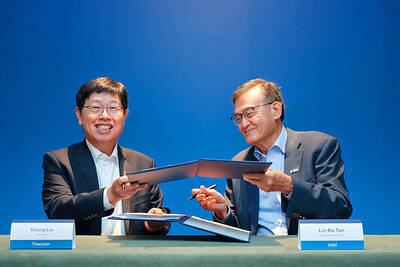
Hon Hai Precision Industry Co (鴻海精密) yesterday said it would work with US chipmaker Intel Corp to jointly develop and deploy next-generation artificial intelligence (AI) infrastructure and intelligent computing platforms in a move to capture booming demand for AI computing systems. Hon Hai, also known as Foxconn Technology Group (富士康), said in a statement that the partnership would combine its global manufacturing scale, system integration expertise and AI data center deployment capabilities with Intel’s strengths in processor architecture, silicon technologies and software ecosystem. The companies said they plan to work on equipment used in AI data centers, including server racks powered by
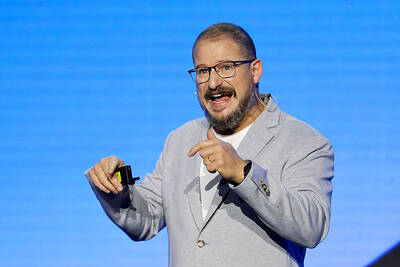
Artificial intelligence (AI) agents would supplant smartphones as the center of people’s digital lives, fundamentally reshaping personal devices and driving a major computing upgrade cycle, Qualcomm Inc CEO Cristiano Amon said yesterday. In his keynote speech for this year’s Computex trade show in Taipei, Amon said that the rise of "agentic AI" — AI systems capable of reasoning, planning and carrying out tasks autonomously — would transform how people interact with technology across phones, PCs, vehicles and wearable devices. Describing the technology as the next major evolution in computing, Amon said that "2026 is the year of agents.” For decades, smartphones have sat


 RSS
RSS