


While the defeat of the US Senate immigration bill was a dismaying disappointment to illegal immigrants and the groups that support them, it also created major worries for employers across the country who depend on immigrant workers.
Employers from agriculture and food-processing industries, as well as construction contractors and commercial landscapers were among the most persistent forces pushing for passage of the Senate bill, which failed on Thursday when senators voted 53 to 46 not to proceed to a vote.
The measure would have provided a path to legal status for millions of illegal immigrants, who make up a significant percentage of workers in many low-wage, labor intensive industries.
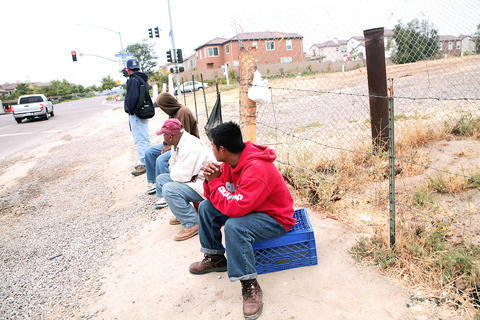
PHOTO: NY TIMES NEWS SERVICE
The bill's defeat was hailed on Thursday by conservative groups and others who said it would have rewarded law-breaking immigrants and would have wrongly excused the employers who hired them. Now, employers say they face a bleak landscape of intensified raids by the immigration authorities and growing pressure to purge illegal immigrants from their work force, but no new options to bring in temporary foreign workers or help illegal workers become legal.
"It leaves most of our guys in a pretty tough spot," said Brewster Bevis, director of legislative affairs for Associated Builders and Contractors, a national organization of construction businesses.
"Most of our members are good actors, they believe the workers they have hired are legal," Bevis said. "But they wanted this reform so they can sleep better at night and don't have to fear potentially being visited by ICE," the US Immigrations and Customs Enforcement agency.
Meatpacking employers were especially concerned about the defeat of the bill. Senate conservatives who opposed it, backed by a surge of support from irate voters, said they wanted to secure the nation's borders and crack down on employers of illegal immigrants before considering legalization measures.
"Immigration policy is divorced from enforcement, and the American employer, for one, is caught in the middle," said Jack Shandley, a vice president at Swift & Co, a meatpacking company in Greeley, Colorado. Immigration agents arrested 1,282 Swift workers in raids last December that cost the company more than US$45 million in lost production and worker replacement costs.
Leaders on all sides of the unusual coalition of business groups and immigrant advocate organizations that supported the bill said they would have to hunker down with a status quo they called dysfunctional.
"More people are going into hiding," said Juan Salgado, president of the Illinois Coalition for Immigrant and Refugee Rights, based in Chicago, which works with many illegal immigrants.
Salgado said most illegal immigrants have family ties to legal immigrants and US citizens and would not be likely to return to their home countries despite the heightened risk of deportation.
"What it means in practice," he said, "is that every day you get in the car and go to work to feed the children, but you are thinking: I may not come back. If they take me what happens to my family?"
Immigrant advocates said many illegal immigrants were not acutely disappointed because they did not have high expectations that the bill would pass.
The setback was more significant for the employers, who were represented by the American Chamber of Commerce the Essential Worker Immigration Coalition. Supporting the bill was a tricky proposition for many employers, and their advocacy remained muted through the debate.
They had to call for legalizing illegal workers without admitting they employed any in their own work sites.
Business leaders said they were troubled to find themselves on the wrong side of Republican lawmakers who had long been their allies. One of the most active companies behind the bill was Pilgrim's Pride, the nation's largest chicken company, with 56,500 workers, based in Pittsburg, Texas.
Senators John Cornyn and Kay Bailey Hutchison, both Republicans of Texas, voted to kill the bill.
Cliff Butler, vice chairman of Pilgrim's Pride, said he was dismayed by calls from the bill's opponents for stepped-up deportation of illegal immigrants.
"I was surprised by how little import was given to the impact of that on millions of good people, and what it would to our economy to remove that labor force," Butler said. "They just ignored that totally."
Farmers and construction contractors said they anticipated labor shortages. They worried that they would have to continue to rely on the existing system for verifying the immigration status of new hires, which is known as Basic Pilot, even though it is error-prone and inefficient. Swift had participated for years in the program before the raids last year.
Farming and farmworker groups were slightly more optimistic. A proposal for a temporary worker program for agriculture, known as AgJobs, was incorporated into the Senate bill. Democrat Senator Dianne Feinstein of California said she would seek to revive AgJobs in coming months by attaching it to other legislation.

Taiwanese firms have increased investment in the Philippines in recent years as Manila’s ties with Washington deepen and global supply chains continue to shift away from China, an expert at the Chung-Hua Institution for Economic Research (CIER, 中華經濟研究院) said yesterday. The Philippines had not been among Taiwanese investors’ top choices in Southeast Asia, CIER Taiwan ASEAN Studies Center director Kristy Hsu (徐遵慈) said at a seminar in Taipei. However, Taiwan’s investment in the country has grown significantly since the COVID-19 pandemic, reaching US $257 million last year, a high in recent years, she said. Although Taiwan’s total investment in the Philippines still lags

Intel Corp regards Taiwan Semiconductor Manufacturing Co (TSMC, 台積電) as a longstanding partner, as the US chipmaker would continue outsourcing production of advanced chips to TSMC, Intel chief executive officer Lip-Bu Tan (陳立武) said yesterday. “I don’t look at people as competitors. I look at the collaboration... Nvidia is also, you know, a good friend,” Tan told a news conference following his keynote speech at the Computex trade show in Taipei. “It’s a very trusted partnership for us... We are a big, top customer for them, and we’re going to continue doing that,” he said, referring to TSMC, the world’s largest foundry

Artificial intelligence (AI) agents would supplant smartphones as the center of people’s digital lives, fundamentally reshaping personal devices and driving a major computing upgrade cycle, Qualcomm Inc CEO Cristiano Amon said yesterday. In his keynote speech for this year’s Computex trade show in Taipei, Amon said that the rise of "agentic AI" — AI systems capable of reasoning, planning and carrying out tasks autonomously — would transform how people interact with technology across phones, PCs, vehicles and wearable devices. Describing the technology as the next major evolution in computing, Amon said that "2026 is the year of agents.” For decades, smartphones have sat

Hon Hai Precision Industry Co (鴻海精密) yesterday said it would work with US chipmaker Intel Corp to jointly develop and deploy next-generation artificial intelligence (AI) infrastructure and intelligent computing platforms in a move to capture booming demand for AI computing systems. Hon Hai, also known as Foxconn Technology Group (富士康), said in a statement that the partnership would combine its global manufacturing scale, system integration expertise and AI data center deployment capabilities with Intel’s strengths in processor architecture, silicon technologies and software ecosystem. The companies said they plan to work on equipment used in AI data centers, including server racks powered by


 RSS
RSS