


On a cool Monday evening, students hurried across Shinchon, a university district in western Seoul.
At the district's Anycall Studio, three schoolgirls were giggling while snapping pictures with a 10-megapixel camera phone, and having them printed on the spot.
A young man examined a play station and tested a few handset games shown on a liquid-crystal-display television.
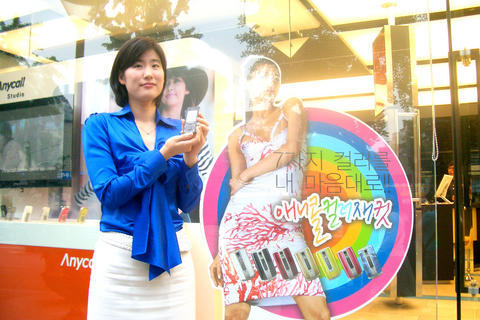
PHOTO: JASON TAN, TAIPEI TIMES
With a price tag of US$2 million, the two-story studio is Samsung Electronics Co's one-and-only handset brand store in South Korea, showcasing the latest mobile phones, including award-winning handsets and overseas models.
The second studio is located in Shanghai. In addition, Samsung Galleries in Moscow and New York showcase Samsung's complete lineup, including Anycall branded phones.
"Selling phones isn't the showrooms' purpose. We want to offer convenience to consumers, letting them know how mobile phones can interact with their daily lives," Ryu Jae-hyun, Samsung Taiwan's director of mobile communication, told the Taipei Times during a media trip to Seoul last week.
By the second half of the year, the Seoul store will be copied in Taipei's bustling commercial Xinyi District.
The Taipei store will be on a smaller scale, but the presence is definitely important to prove Samsung's commitment to the local market, said Ryu, who has been posted in Taipei for more than two years.
Despite being a late entrant into Taiwan's market, Samsung has managed to clinch the No. 4 position after Nokia Oyj, Motorola Inc and Sony Ericsson.
The South Korean chaebol broke the 10 percent mark by securing a 11. 3 percent share in March, up from 8.1 percent last October.
"We came to Taiwan later than others, that's why awareness of the Anycall brand is slightly lagging," said Roh Ki-hak, Samsung's senior vice president of mobile communication.
But it is setting an ambitious goal to secure a 15 percent share by the end of the year by selling a total of 1 million phones in Taiwan, he said.
Thanks to the high-end Ultra edition phones launched last year, Samsung sold 34.8 million worldwide in the first three months of this year, a quarterly record for the company -- despite an overall seasonal market shrinkage.
Riding on the successful Ultra edition series, Samsung will debut the F308, a new mobile phone model its says is the first to offer both a phone and portable music player in a dual-faced design.
The combination of phone and music player is a desirable but complicated function, which meant that the design team had to create a simple, clear cut interface for users, Lee Kyung-jin, a designer at Samsung's mobile communication division, said during a phone launch in the company's Seoul office last week.
The F308 is a cellphone on one side, but flip it over and the user has a music player at their fingertips.
Samsung, the world's third-largest handset brand, sold 118 million handsets worldwide last year, up from 103 million in 2005 and 86.5 million units in 2004, the company's statistics showed.
"We aim to sell 135 million units this year and chances are high that we will surpass that number," Roh said.
Phone makers including Samsung are trying to cash in at the expense of Motorola, as the No. 2 maker undergoes restructuring to recover from sagging sales after the glory of its hit Razr line of phones faded.
To cope with the increase in demand, Samsung said last Tuesday it would invest 200 billion won (US$216.4 million) into increasing output at its Gumi plant -- Samsung's only domestic handset facility approximately 260km southeast of Seoul.
The output from Gumi will rise to 75 million units this year from 69 million last year.
It is also considering several locations, including Vietnam, for its next overseas handset plant, adding to the current facilities in China, India and Brazil.
The next growth momentum will come from emerging markets, including China, India and Africa, Roh said.
"Users in these markets need lower-end phones. When we launch such products, we will add differentiation to our low-end phones to make them stand out," he said.
But industry watchers said competition is fierce.
"Samsung's Ultra edition phones are well received but rivals like LG or Motorola also focus on slim phones," Fox Su (
However, Lee is convinced that Samsung phones will continue to enjoy high popularity.
"Handsets are no longer merely a communication item. We create brand originality in our phones by adding the element of sensibility'," Lee said.

The domestic unit of the Chinese-owned, Dutch-headquartered chipmaker Nexperia BV will soon be able to produce semiconductors locally within China, according to two company sources. Nexperia is at the center of a global tug-of-war over critical semiconductor technology, with a Dutch court in February ordering a probe into alleged mismanagement at the company. The geopolitical tussle has disrupted supply chains, with some carmakers reportedly forced to cut production due to chip shortages. Local production would allow Nexperia’s domestic arm, Nexperia Semiconductors (China) Ltd (安世半導體中國), to bypass restrictions in place since October on the supply of silicon wafers — etched with tiny components to

Singapore-based ride-hailing and delivery giant Grab Holdings Ltd has applied for regulatory approval to acquire the Taiwan operations of Germany-based Delivery Hero SE's Foodpanda in a deal valued at about US$600 million. Grab submitted the filing to the Fair Trade Commission on Friday last week, with the transaction subject to regulatory review and approval, the company said in a statement yesterday. Its independent governance structure would help foster a healthy and competitive market in Taiwan if the deal is approved, Grab said. Grab, which is listed on the NASDAQ, said in the filing that US-based Uber Technologies Inc holds about 13 percent of

Taiwan Semiconductor Manufacturing Co (TSMC, 台積電) yesterday received government approval to deploy its advanced 3-nanometer (3nm) process at its second fab currently under construction in Japan, the Ministry of Economic Affairs said in a news release. The ministry green-lit the plan for the facility in Kumamoto, which is scheduled to start installing equipment and come online in 2028 with a monthly production capacity of 15,000 12-inch wafers, the ministry said. The Department of Investment Review in June 2024 authorized a US$5.26 billion investment for the facility, slated to manufacture 6- to 12nm chips, significantly less advanced than 3nm process. At a meeting with

Taiwan is open to joining a global liquefied natural gas (LNG) program if one is created, but on the condition that countries provide delivery even in a scenario where there is a conflict with China, an energy department official said yesterday. While Taiwan’s priority is to have enough LNG at home, the nation is open to exploring potential strategic reserves in other countries such as Japan or South Korea, Energy Administration Deputy Director-General Chen Chung-hsien (陳崇憲) said. While the LNG market does not have a global reserve for emergencies like that of oil, the concept has been raised a few times —


 RSS
RSS