


Riding on last year's achievement of launching the Alternative Minimum Tax (AMT) scheme, the Ministry of Finance plans to submit its inheritance and gift tax reform proposal in the next legislative session, which starts next month, finance minister Ho Chih-chin (
The proposal will include two parts: Lowering the maximum marginal rate for inheritance and gift taxes from the current 50 percent to 40 percent, and introducing an improved wealth transfer system in the mid-term, allowing taxpayers more flexibility to bestow assets to children.
Slashing the tax rate to 40 percent would reduce incentives for the well-heeled to place wealth abroad simply to avoid the high tax rate, and further lure capital back in the long run, Ho said during an exclusive interview.
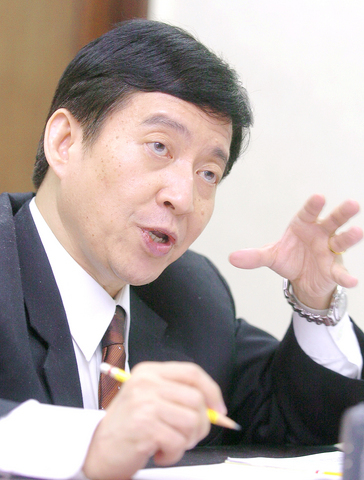
PHOTO: LIAO CHEN-HUEI, TAIPEI TIMES
Ho, who just took over the ministerial job on July 4, is a tax expert with eight years of experience as the senior economist at the US Internal Revenue Service (IRS) and another five years as the IRS' principal economist.
Inheritance taxes
He estimated that if the tax base remained unchanged, state coffers could lose around NT$6 billion (US$183 billion) annually when the maximum inheritance and gift tax rate is lowered to 40 percent.
Revenues from the two taxes amount to NT$30 billion per year, with NT$20 billion hailing from the inheritance tax and another NT$10 billion from the gift tax.
"Tax revenues might decrease for the first several years but the figure should climb back in the long term due to capital inflows," he said, adding that the ministry is still studying ways to offset local governments' losses.
During the transitional period, Ho also plans to introduce an improved wealth transfer system to allow moderately well-off households, or what he termed the "small rich," more flexibility in giving away their wealth to children.
The ministry just raised the tax-free threshold for gifts to NT$1.11 million this year, and that for inheritance to NT$7.99 million.
But unlike the present situation, in which the tax-free portion of inheritance is only applicable after a parent's death, taxpayers would be able to make use of the amount in advance.
Details such as whether the inheritance tax-free threshold will be further raised are open for discussion, he said.
Such reforms are expected to pave the way for unifying inheritance and gift taxes in order to ultimately establish a life-long wealth transfer system based on the US model, Ho said.
The implementation of the system would require close cooperation between the land administration, banking institutions, and depositary and clearing units to track down each taxpayer's wealth transfer records.
In the next legislative session, Ho also hopes to push for amendments to levy income taxes on military personnel and teachers.
It's "so close, yet so far," Ho said, referring to the ministry's repeated failure to push through the much-anticipated tax scheme.
"The Ministry of National Defense and the Ministry of Education have done their part. Now the finance ministry needs to give it a final push. But of course the decision is still in the hands of the Legislative Yuan," he said.
Value-added tax
However, the plan to reform consumption taxes in the second half of the year will have to be postponed due to political uncertainties and energy price markups, the minister said.
The Cabinet was instructed in 2003 to cancel commodity taxes on rubber tires, drinks, plate glass and electric appliances, as well as abolishing stamp and entertainment taxes.
To make up for tax-revenue losses, the Cabinet's financial reform committee suggested raising the value-added tax (VAT) by one to two percentage points from its current level of 5 percent.
Raising VAT by one percentage point would rake in an extra NT$40 billion of tax revenue, according to the ministry. However, manufacturers would be expected to transfer the extra burden onto consumers by raising retail prices.
"Commodity prices have seen significant changes recently. A new round of assessments is required and therefore the consumption tax reform should be postponed to next year," he said.
Government figures showed that the consumer price index (CPI) -- a key barometer of inflation -- rose 1.35 percent in the January-July period from a year ago. Although prices for tissues, flour and public transportation are also on the rise, the government still estimates that annual CPI growth can be kept under 2 percent.
Other issues
Reiterating his desire to serve this country, Ho said that tax reforms should be evaluated and programmed together, rather than fixing one piece here and another part there at different times.
Therefore, he said the ministry will review the 10-percent tax on companies' undistributed surplus earnings, the Statute for Upgrading Industries (
Ho vowed to bring the US systems of tax enforcement and tax schemes as a model for his native country.
"It's not that important whether a system is good or bad. It can be criticized any time. But it must be fair and enforced by reliable and consistent people, as with the example of the US Internal Revenue Service. Although it's a tax-collection agency, the IRS is widely respected in the US for its integrity," he said.
He said that the ministry is introducing a new tax inspection system modeled on one in the US to pursue fair taxation. Ho expects the new system, which will target the "big fish" who evade taxes, to inject an additional NT$30 billion into state coffers next year.

Taiwanese firms have increased investment in the Philippines in recent years as Manila’s ties with Washington deepen and global supply chains continue to shift away from China, an expert at the Chung-Hua Institution for Economic Research (CIER, 中華經濟研究院) said yesterday. The Philippines had not been among Taiwanese investors’ top choices in Southeast Asia, CIER Taiwan ASEAN Studies Center director Kristy Hsu (徐遵慈) said at a seminar in Taipei. However, Taiwan’s investment in the country has grown significantly since the COVID-19 pandemic, reaching US $257 million last year, a high in recent years, she said. Although Taiwan’s total investment in the Philippines still lags
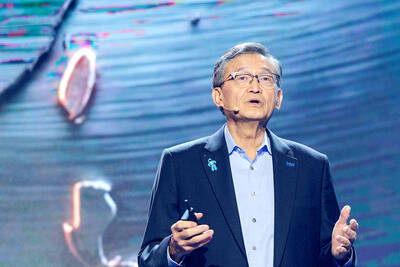
Intel Corp regards Taiwan Semiconductor Manufacturing Co (TSMC, 台積電) as a longstanding partner, as the US chipmaker would continue outsourcing production of advanced chips to TSMC, Intel chief executive officer Lip-Bu Tan (陳立武) said yesterday. “I don’t look at people as competitors. I look at the collaboration... Nvidia is also, you know, a good friend,” Tan told a news conference following his keynote speech at the Computex trade show in Taipei. “It’s a very trusted partnership for us... We are a big, top customer for them, and we’re going to continue doing that,” he said, referring to TSMC, the world’s largest foundry

Hon Hai Precision Industry Co (鴻海精密) yesterday said it would work with US chipmaker Intel Corp to jointly develop and deploy next-generation artificial intelligence (AI) infrastructure and intelligent computing platforms in a move to capture booming demand for AI computing systems. Hon Hai, also known as Foxconn Technology Group (富士康), said in a statement that the partnership would combine its global manufacturing scale, system integration expertise and AI data center deployment capabilities with Intel’s strengths in processor architecture, silicon technologies and software ecosystem. The companies said they plan to work on equipment used in AI data centers, including server racks powered by

Artificial intelligence (AI) agents would supplant smartphones as the center of people’s digital lives, fundamentally reshaping personal devices and driving a major computing upgrade cycle, Qualcomm Inc CEO Cristiano Amon said yesterday. In his keynote speech for this year’s Computex trade show in Taipei, Amon said that the rise of "agentic AI" — AI systems capable of reasoning, planning and carrying out tasks autonomously — would transform how people interact with technology across phones, PCs, vehicles and wearable devices. Describing the technology as the next major evolution in computing, Amon said that "2026 is the year of agents.” For decades, smartphones have sat


 RSS
RSS