


The German chipmaker Infineon on Friday finally gave the green light for shares in its memories unit to be floated on the stock market, a move the group hopes will reinforce its bottom line.
The company's memory chip subsidiary Qimonda is to be listed in an initial public offer on the New York Stock Exchange, probably in the second week of August.
The IPO will consist of 63 million American Depository Receipts, or ADRs, of which 21 million will come from the stake held by Infineon.
Another 42 million ADRs will come through a capital increase by Qimonda.
With a price range of between US$16 and US$18 per share, the operation is expected to raise US$1 billion to US$1.1 billion, of which some US$300 million will go towards Infineon's coffers.
Qimonda expects to receive proceeds of US$672 million to US$756 million from the sale of the 42 million ADRs, and intends to spend it on research and development.
The forecasts have decreased slightly because until recently the same overall figure was being mentioned, but in euros.
"I think the price is right and proper," Infineon's finance director Peter Fischl said on Friday, while Infineon president and chief executive officer Wolfgang Ziebart said the group never "gave an estimate of what we are expecting."
But the impending listing is raising concern about the group's strategy.
Infineon has for some time threatened to sever ties with the memory-chip part of the business because it is subject to large fluctuations in demand and prices.
The separation with Qimonda will see the company "enter a new era," Ziebart said recently.
Infineon will initially retain an 80 percent stake, but intends to sell it off at some point, it said.
But news that the IPO would go ahead came just as the group's problem child was beginning to perform well, while its two remaining divisions, one which makes memory chips for cars, electronics and industrial use and the other for telecommunications, put in poor performances.
This was a good sign for buyers looking to snap up Qimonda shares but looked bad for Infineon, which is set to lose nearly 40 percent of its sales following the spin-off.
Its biggest client in this regard, Taiwan-based BenQ Corp (
BenQ is a supplier of computer, communications and consumer electronics products.
"Investors and employees alike would like to know how Infineon is going to get back its old stature," the German daily Handelsblatt said this week.
"Even after listing Qimonda, Infineon is not going to have peace of mind," it said.

Netherlands-based semiconductor equipment supplier ASML Holding NV yesterday said that it is planning to hire an additional 1,000 people in Taiwan this year in response to growing demand from clients. ASML had previously planned to recruit 600 people this year, but that the plan has been adjusted upward, ASML vice president and ASML Taiwan general manager Grace Wang (汪佳慧) told reporters. ASML has a workforce of more than 4,500 in Taiwan, accounting for about 10 percent of its global total, Wang said. This year’s recruitment campaign would focus on adding people in the customer support, manufacturing and supply chain domains to assist ASML
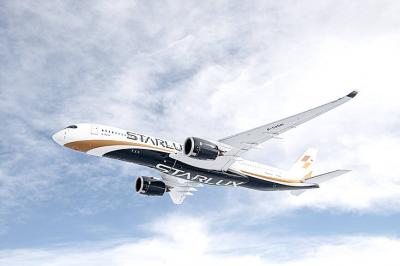
Starlux Airlines Co (星宇航空) today unveiled a long-haul network expansion plan at a shareholders’ meeting in Taipei, including direct flights to Barcelona, Spain, and Zurich, Switzerland, as well as a service connecting Taipei, Sydney and New Zealand. Starlux is to become the first Taiwanese carrier to offer non-stop services to the two European cities, while the inaugural oceanic route is expected to expand transit opportunities within the Australia-New Zealand market, Starlux said. Flight services to Chicago, Dallas, Washington and New York are under evaluation, the airline added. Prior to the shareholders’ meeting, the airline earlier this year announced that it would be

UNDER MICROSCOPE: Taiwan detained three people who allegedly conspired to buy servers in Taiwan and export them using fraudulent documentation, prosecutors said Nvidia Corp chief executive officer Jensen Huang (黃仁勳) on Saturday urged Super Micro Computer Inc to tighten up on compliance after Taiwan detained three people this week for allegedly making fraudulent declarations about artificial intelligence (AI) servers made by its US partner. The development marked the nation’s first crackdown on semiconductor smuggling, which grew after the US slapped restrictions on exports of high-end chips such as Nvidia AI accelerators to China. Nvidia is “rigorous” in explaining regulations to all of its partners, Huang told reporters after arriving in Taipei. “Ultimately Super Micro has to run their own company,” he said in response to

Nvidia Corp yesterday announced that CEO Jensen Huang (黃仁勳) would attend an employee meeting in Taipei tomorrow to celebrate the launch of the company’s Taiwan headquarters project. Huang would attend a gathering at the site of Nvidia’s planned headquarters in Beitou Shilin Technology Park (北投士林科技園區), the company said in a statement. After arriving in Taiwan on Saturday last week, Huang told reporters that he plans to meet with Quanta Computer Inc (廣達) chairman Barry Lam (林百里) and Taiwan Semiconductor Manufacturing Co (TSMC, 台積電) chairman C.C. Wei (魏哲家), and would attend the groundbreaking ceremony for Nvidia’s Taiwan headquarters tomorrow. Nvidia has not yet applied


 RSS
RSS