


The Cabinet's announcement late on Thursday night that Joseph Lyu (呂桔誠) would be replaced by economics professor Ho Chih-chin (何志欽) as the new minister of finance was warmly received in academic and industry circles.
Ho, 54, with a PhD in economics from the University of Michigan, is head of the economics department at National Taiwan University. Having served as principal economist at the US Internal Revenue Service, Ho is familiar with the US' alternative maximum tax (AMT) and inheritance and gift tax schemes.
"It is a very positive personnel change," said Hwa Erh-cheng (
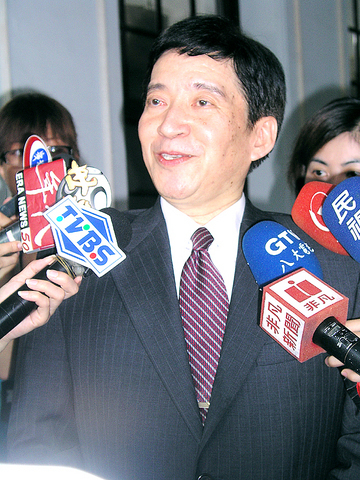
PHOTO: HSIEH WEN-HUA, TAIPEI TIMES
The new finance chief is a good-natured scholar and his 15-year experience as a US public servant could help him deal with political challenges and effectively defend and promote the ministry's policies, Hwa said.
Outside Ho's university office yesterday morning, the new minister told reporters that he felt nervous yet honored to assume his new post.
"I'll do my best to improve the nation's finance system and promote a fair and sound taxation system," Ho said, adding that stabilizing the ministry's personnel structure will be his primary task.
Last year, when then finance minister Lin Chuan (
In February, Ho was invited by the Presidential Office to report on inheritance and gift tax reforms. He supports adjusting inheritance and gift tax rates as well as integrating their tax bases in the short term, while unifying these two tax schemes as a long-term goal to establish a lifelong wealth transfer system for fair taxation.
Now the ministry is studying the possibility and drafting measures to facilitate the reform.
Pundits have said that Ho's professional expertise includes taxation and the national treasury, which are the most important tasks the finance ministry now needs to address.
The Financial Supervisory Commission, which was established two years ago, has taken over governance of banking, insurance and securities.
Shirley Yang (楊慶祺), a fund manager who manages funds worth NT$1.2 billion (US$37 million) at Invesco Taiwan Ltd (景順投信), said the industry holds high expectations for Ho's arrival, and hopes he can jump-start the much-needed but temporarily stalled taxation reform and dispel public doubts about the governance of state-controlled financial institutions.
She said the government's second-stage financial reform has aroused concern that state banks would fall into the hands of private conglomerates. The ministry should be cautious in privatizing these state-owned banks, or "it could as well integrate these businesses to form a large-scale financial holding firm," Yang suggested.
The ministry's hand-over ceremony is expected to be held next Wednesday, according to a close aide of the outgoing Lyu, although the ministry has yet to issue a formal notice.
It is widely believed that Lyu was replaced for his failure to safeguard state shareholding in Mega Financial Holding Co (兆豐金控) and controversies in a syndicated loan granted to Taiwan Development Corp (台灣土地開發) when he served as chairman of the Bank of Taiwan (台灣銀行).
Lyu will become a minister without portfolio.
Although most legislators know little about Ho, many have said they expressed hopes that the new minister could get the hang of the job as soon as possible to narrow the state deficit, promote fair taxation and closely guard the nation's assets.
Some Democratic Progressive Party (DPP) lawmakers, were unhappy about the abrupt change of personnel.
"This is the arrogance of power. We did not know about the news until the media unveiled it. The Executive Yuan didn't discuss it with the caucus," DPP Legislator Lin Chung-mo (林重謨) said yesterday.
DPP caucus whip Chen Chin-jun (陳景峻) said that he and two other caucus whips were kept completely in the dark about the move and felt the Executive Yuan had shown a lack of respect for caucus members.
In response, Premier Su Tseng-chang (蘇貞昌) apologized yesterday afternoon and said that the Executive Yuan will improve communication channels between the Cabinet and caucus and will be more attentive to the announcement of personnel reshuffles.
additional reporting by By Jewel Huang

Taiwanese firms have increased investment in the Philippines in recent years as Manila’s ties with Washington deepen and global supply chains continue to shift away from China, an expert at the Chung-Hua Institution for Economic Research (CIER, 中華經濟研究院) said yesterday. The Philippines had not been among Taiwanese investors’ top choices in Southeast Asia, CIER Taiwan ASEAN Studies Center director Kristy Hsu (徐遵慈) said at a seminar in Taipei. However, Taiwan’s investment in the country has grown significantly since the COVID-19 pandemic, reaching US $257 million last year, a high in recent years, she said. Although Taiwan’s total investment in the Philippines still lags

Intel Corp regards Taiwan Semiconductor Manufacturing Co (TSMC, 台積電) as a longstanding partner, as the US chipmaker would continue outsourcing production of advanced chips to TSMC, Intel chief executive officer Lip-Bu Tan (陳立武) said yesterday. “I don’t look at people as competitors. I look at the collaboration... Nvidia is also, you know, a good friend,” Tan told a news conference following his keynote speech at the Computex trade show in Taipei. “It’s a very trusted partnership for us... We are a big, top customer for them, and we’re going to continue doing that,” he said, referring to TSMC, the world’s largest foundry

Hon Hai Precision Industry Co (鴻海精密) yesterday said it would work with US chipmaker Intel Corp to jointly develop and deploy next-generation artificial intelligence (AI) infrastructure and intelligent computing platforms in a move to capture booming demand for AI computing systems. Hon Hai, also known as Foxconn Technology Group (富士康), said in a statement that the partnership would combine its global manufacturing scale, system integration expertise and AI data center deployment capabilities with Intel’s strengths in processor architecture, silicon technologies and software ecosystem. The companies said they plan to work on equipment used in AI data centers, including server racks powered by
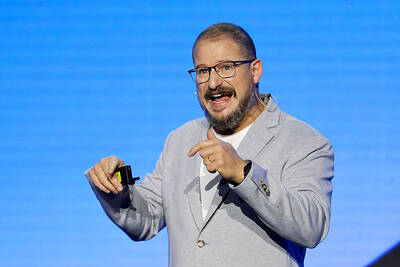
Artificial intelligence (AI) agents would supplant smartphones as the center of people’s digital lives, fundamentally reshaping personal devices and driving a major computing upgrade cycle, Qualcomm Inc CEO Cristiano Amon said yesterday. In his keynote speech for this year’s Computex trade show in Taipei, Amon said that the rise of "agentic AI" — AI systems capable of reasoning, planning and carrying out tasks autonomously — would transform how people interact with technology across phones, PCs, vehicles and wearable devices. Describing the technology as the next major evolution in computing, Amon said that "2026 is the year of agents.” For decades, smartphones have sat


 RSS
RSS