

The government will delay a planned sale of at least US$1.6 billion of shares in Bank of Taiwan (
The Ministry of Finance plans to begin selling its stake in the combined lender around June next year, Finance Minister Lin Chuan (林全) said in a statement in his New Year briefing. The government had planned to reduce its stake in Bank of Taiwan to below 50 percent by the end of this year, it said.
"We'll suggest the Cabinet adjusts the schedule to complete the Bank of Taiwan privatization to June 30, 2008," Liu Teng-cheng (
The Ministry of Finance said in November last year that Bank of Taiwan would buy Central Trust to form a group with 12 percent of the nation's US$700 billion banking market. The government is pushing banks to combine as it opens the industry to competition from global lenders such as Citigroup Inc and HSBC Holdings Plc.
Liu said the sale could be even bigger as Bank of Taiwan may be merged with Land Bank of Taiwan (土地銀行), the nation's third-biggest lender. The combined firm would have assets of NT$4.78 trillion (US$146 billion), Cabinet Secretary-General Cho Jung-tai (卓榮泰) said on Dec. 20.
Taiwan is studying the feasibility of combining the state-owned firms to create a lender ranking among the world's top 80 banks, Cho said. The government may sell shares in the combined lender at home and overseas, aiming to bring in expertise and foreign investors, he said.
Plans to merge the Bank of Taiwan with Land Bank of Taiwan and Central Trust, which is a wholly government-owned lender that is also involved in insurance and wharehousing, in 2000 and 2002 were scrapped after workers protested against possible job losses.
The government has received parliamentary approval to sell NT$52.6 billion of Bank of Taiwan shares, or 34 percent of its stake, between 2004 and this year, the statement said.
That figure didn't include Central Trust, Liu said, without giving further details.
Liu said the ministry has yet to sell any shares of Bank of Taiwan. He added that the parliament's approval is valid for five years.
Taiwan's banking industry is dominated by government-owned lenders and family-owned financial groups. The latter have been slow to follow the government's lead in seeking mergers.
Bank of Taiwan was formed in 1946 as the first government-owned bank after the Japanese occupation ended. It offers loans and deposits, foreign exchange, credit cards and other services at 147 branches, according to a company Web site. About 48 percent of its customers work for the military or government departments.
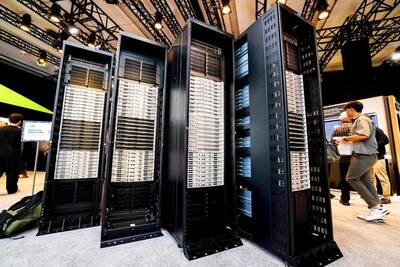
AM Intelligence, an Indian artificial intelligence (AI) infrastructure company, has ordered 9,000 Nvidia Corp Vera Rubin systems, seeking to become one of the first adopters of the advanced computing platform in Asia. Servers equipped with the rack-scale systems are slated to come online next year in southern India, the Hyderabad-based company said in a statement yesterday. Customers include major cloud service providers, AI labs and organizations aiming to develop homegrown Indian AI models, it said. Supplies of high-end Nvidia compute clusters remain tight. Demand from data centers and companies such as Microsoft Corp, Alphabet Inc’s Google and Amazon.com Inc to train AI models

In China’s hilly Guizhou Province, a cluster of European-style buildings complete with clock tower and multi-arched bridge emits a low, permanent hum — a clue to its unexpected identity as tech giant Huawei’s largest data center. The town-like complex is unique in design, but not in its placement. Dozens of data centers have been constructed in the southwestern province in the past few years. They are part of a government strategy that has seen much of the digital infrastructure for breakneck artificial intelligence (AI) development across China’s eastern seaboard established in the country’s less populated, rural west. The build-out is ongoing. China

Xiaomi Corp (小米) has launched a mobile processor for its marquee devices, putting pressure on Qualcomm Inc and MediaTek Inc (聯發科), which for years supplied the key component to the Chinese company. The Xring O3 system-on-a-chip advances Xiaomi’s in-house semiconductor design efforts with more power-efficient image processing and better artificial intelligence capabilities, the Beijing-based company said in a post on Sina Weibo yesterday. The company’s new silicon is made using a 3-nanometer fabrication process, Xiaomi founder Lei Jun (雷軍) said in a WeChat post . That is closer to the node used for Apple Inc’s most recent A19 Pro chips and well ahead
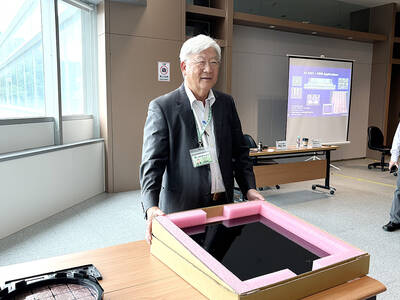
STRATEGIC GAMBLE: After developing FOPLP for six years, the chip packager has secured a 100 percent utilization rate for the new technology, its chairman said Chip packaging service provider Powertech Technology Inc (力成科技) yesterday said that its advanced fan-out panel-level packaging (FOPLP) production line has secured a 100 percent utilization rate through 2030 ahead of its scheduled volume production next year. Powertech made the remarks during the first public unveiling of its FOPLP production capabilities. The company expressed strong confidence in its long-term order pipeline, saying that robust market traction has mitigated any client acquisition concerns. “Our capacity has been fully booked by two major customers. Customers are not an issue through 2030,” Powertech chairman Tsai Du-kung (蔡篤恭) told reporters at the company’s plant in the Hsinchu


 RSS
RSS