


Shareholders of BenQ Corp (明基), the nation's biggest mobile phone manufacturer, approved the acquisition of Siemens AG's money-losing handset unit during a special meeting in Taoyuan yesterday, despite some voicing doubts about the merger's effect.
About 65 percent of the shareholders attended the meeting yesterday, with 85.3 percent of those giving the thumbs-up to the merger deal. The deal, which was announced early last month, will take effect on Oct. 1 after BenQ obtained at least 75 percent of Siemens' transactions, BenQ chairman Lee Kun-yao (李焜耀) said.
"I cannot say I'm fully confident about the future, but [I'm] ambitious," Lee said, reflecting his somewhat aggressive attitude about the takeover deal.
As part of the deal, the German electronics giant will have to pay BenQ 250 million euros (US$302 million) -- 85 percent of that in cash and the rest in the form of assets and technology.
Siemens will also invest 50 million euros in BenQ shares, becoming the Taiwanese company's strategic shareholder.
"The business will break even next year the earliest," Lee said.
Shareholders also endorsed a plan to issue a global depositary receipt (GDR) at a maximum of NT$1.5 billion (US$47 million) around September or October, with a majority expected to be purchased by Siemens.
The Munich-based Siemens yesterday posted a 52 percent drop in third-quarter net profit because of losses in the mobile phone unit it is selling to BenQ. The company, which now shifts its focus to its more profitable industrial operations including power turbines and automation equipment, earned 389 million euros, or 42 cents a share, compared with 815 million euros, or 88 cents a share, in the same period a year ago, a news agency reported.
BenQ's chief marketing officer Jerry Wang (王文燦) said the company will
integrate their respective advantageous retailing positions in European and
Asia Pacific markets to sell mobile phones. The company expects to launch 14
to 15 new handsets under the co-brand BenQ-Siemens in the fourth quarter, he
added.
It is worth noticing that after Lee flew to Germany recently to appease the
opposition from the labor union, around 90 percent of the 6,000-strong
workforce in Siemens' handset division decided to stay with their jobs.
Lee stressed his determination yesterday, saying that the company will prove
its abilities by achieving strong sales.

Cairo’s new monorail slices across the city skyline, running above the familiar chaos of blaring horns and aging buses’ exhaust fumes that mark rush hour below. The US$4.5 billion monorail, opened this month, is among Egypt’s most prominent new transport projects, part of a debt-funded infrastructure drive criticized for sapping state finances while bringing limited benefits to most of the country’s 109 million people. “It feels like you’re in a different country,” said Ramy Sayed, a restaurant manager, aboard a driverless Innovia 300 train. “No noise, no traffic, we’re not used to this.” The eastern line runs 56km from the bustling middle-class

Taiwanese firms have increased investment in the Philippines in recent years as Manila’s ties with Washington deepen and global supply chains continue to shift away from China, an expert at the Chung-Hua Institution for Economic Research (CIER, 中華經濟研究院) said yesterday. The Philippines had not been among Taiwanese investors’ top choices in Southeast Asia, CIER Taiwan ASEAN Studies Center director Kristy Hsu (徐遵慈) said at a seminar in Taipei. However, Taiwan’s investment in the country has grown significantly since the COVID-19 pandemic, reaching US $257 million last year, a high in recent years, she said. Although Taiwan’s total investment in the Philippines still lags
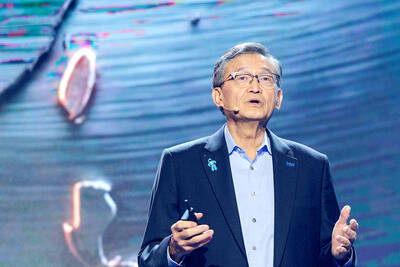
Intel Corp regards Taiwan Semiconductor Manufacturing Co (TSMC, 台積電) as a longstanding partner, as the US chipmaker would continue outsourcing production of advanced chips to TSMC, Intel chief executive officer Lip-Bu Tan (陳立武) said yesterday. “I don’t look at people as competitors. I look at the collaboration... Nvidia is also, you know, a good friend,” Tan told a news conference following his keynote speech at the Computex trade show in Taipei. “It’s a very trusted partnership for us... We are a big, top customer for them, and we’re going to continue doing that,” he said, referring to TSMC, the world’s largest foundry

Artificial intelligence (AI) agents would supplant smartphones as the center of people’s digital lives, fundamentally reshaping personal devices and driving a major computing upgrade cycle, Qualcomm Inc CEO Cristiano Amon said yesterday. In his keynote speech for this year’s Computex trade show in Taipei, Amon said that the rise of "agentic AI" — AI systems capable of reasoning, planning and carrying out tasks autonomously — would transform how people interact with technology across phones, PCs, vehicles and wearable devices. Describing the technology as the next major evolution in computing, Amon said that "2026 is the year of agents.” For decades, smartphones have sat


 RSS
RSS