


Dingko Nan (
An Aborigine of the Puyuma Tribe, Nan, 51, usually starts his day by putting on traditional Puyuma garments at his handicraft store, "Lima Workshop" (
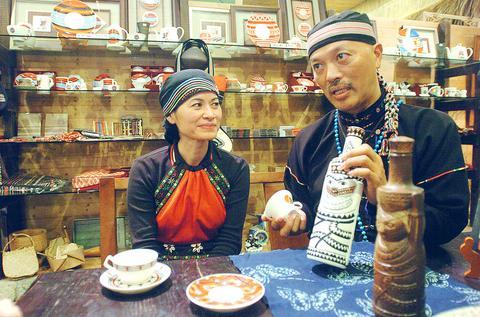
PHOTO: GEORGE TSORNG, TAIPEI TIMES
The shelves inside the workshop are lined with Aboriginal knitwear, as well as pottery pieces and ceramics bearing Aboriginal totems.
"We usually first check how many guests would visit us for the day and then plan how much food to serve," Nan said, while his Hakka wife, Lisuun Chang (張秀娥), bustled around serving Hakka delicacies to guests.
Guests at Lima usually sense the hosts' zeal and hospitality as soon as they walk into the store. In addition to the vitality and artistry portrayed in the Aboriginal artwork, Nan also brings guests audio enjoyment by performing Aboriginal songs in his naturally powerful voice.
"My husband was the champion at a national Aboriginal mother-tongue singing contest in 1997," Chang said proudly. She, also dressed in Puyuma apparel, usually shares with guests ancient Puyuma legends and fairy tales during the intermissions.
The workshop is not only a place for them to sell products. In fact, Nan and Chang have turned their store in the remote countryside into a community workshop where they hope to help contribute to the advancement of Aboriginal peoples' lives in the longer term.
Before they opened the shop, Nan established a trading company called Di Gang Enterprises Co (帝岡企業) about 10 years ago, and has been exporting ceramics products ever since.
During the ceramics industry's golden days, it was easy to make over NT$10 million in revenue every year, he said.
In addition to their work, with their passion for Aboriginal culture, Nan and Chang spent three years visiting various Aboriginal tribes and collecting materials involving indigenous traditional customs, as well as totems used in textiles, festivities and local economies.
But as the ceramics industry suffered huge losses due to industry migration to China during the past few years, Nan sensed the necessity to redesign products to differentiate between rivals in Taiwan and abroad. The research the couple did showed them exactly the right elements to add to their products.
"It started during a visit to the US in 2001. I visited several handicraft stores in different states and was impressed by the development of minority handicraft stores there," Nan said.
"I knew perfectly well how to make a living, and what to make to do this. But this is not enough [for our tribal people]," he said.
"As a descendant of a Puyuma king, I feel obligated to promote my culture to the world, not just sell ceramic products," he said.
With this idea in mind, the couple asked elderly people from different tribes to design their products -- ranging from dishes, tea services, notebooks and backpacks -- with patterns and totems from their culture. In the meantime, they set up booths at department stores and local fairs to test the water.
Consumer reaction proved their decision was right, and the Miaoli County Government touts Lima on its Web site as one of the must-visit tourist sites. Apart from supplying souvenir items for government or corporate clients, Lima also showcases its products at an outlet near gate 4 of the City Hall MRT station in Taipei, as well as in gift shops at airports and internationally recognized hotels.
Even the best job has challenges. Despite their obvious success, Chang said they soon discovered a big difference between themselves and their fellow tribesmen -- the haves and have-nots of entrepreneurial spirit.
"It's hard to size up Aboriginal productivity in quantitative terms because they are not born manuf-acturers," Chang said.
"A shortage of funds also makes it hard for them [Aboriginals] to buy the equipment necessary for mass production," she said.
With years of experience in the export business, Chang said they comply with commercial rules and pay attention to the smallest details so as to safeguard their credibility. But teaching Aboriginal people the rules of commerce is a long-term educational effort, she said.
Chang recalled that there was a time when she asked an Aborigine woman to finish knitting work within a certain number of days, but was greeted with a sense of resentment.
"That Aborigine said I'm not an Aborigine and have no right to tell them what to do," Chang said, her eyes brimming with tears.
The imbalances between productivity and market demands forced Nan to employ a conservative business strategy concerning Lima.
"Many Internet companies contacted us and said they wanted to help market our products. But we turned down their offers because we don't want to disappoint customers if our Aboriginal friends couldn't finish their handicraft work in time," he said.
The couple also believe that having customers come to them is the best way of selling.
"Interaction is key to Aboriginal culture and our greatest satisfaction is to see our guests leave with big smiles, knowing that they will come back," Chang said.
Their efforts seemed to have paid off well. For a small shop in such a remote area, Lima does very well, making around NT$800,000 to NT$900,000 a month on average.
"That's the basic income we need to survive ourselves, as well as pay our six staffers here and about 20 part-time workers in the ceramics factory," Chang said.
This couple has no time to be idle, because their next goal is to make Lima a well-known brand while at the same time creating more jobs for Aboriginal people.
Taiwan's Aboriginal people have long been a disadvantaged group in the job market, due to a comparatively low education, home-bound characteristics, and a negative image perpetuated by a stereotype of being lazy and drinking too much.
Although the Indigenous Right-to-Work Law (原住民族工作權保障法) regulates the employment of a fixed ratio of Aborigines in various levels of government, public schools and state-run enterprises, the unemployment rate among the group, with a population of about 440,000, remains high. According to the latest statistics of the Council of Indigenous Peoples, the jobless rate among Aborigines is 5.76 percent, higher than the national average of 4.41 percent.
Hsieh Ming-hui (
Besides agriculture and handicrafts, the council also encourages them to develop tourist businesses, using their unique cultural heritage. But with scant funds, the council can hardly meet the needs of a considerable number of Aborigines, Hsieh said.
This long-running problem also worried Nan and Chang, who are planning to move their production center back to a tribe in Taitung that would create job opportunities for local people.
So far, Lima's products are made by hand and production is therefore small. By opening a factory in the tribe and transferring production techniques to the people, the couple hopes to expand their capacity to reach mass-production figures.
"Were the plan viable, we'll launch more aggressive marketing activities to increase our market strength," Chang said.
One idea Chang came up with is to duplicate Lima's Miaoli store in Taipei and offer a combined tour package, featuring Aboriginal culture and pottery classes.
"But it's hard to find a good location where customer traffic is strong enough to absorb the typical high rentals in Taipei," she said.
Some of their overseas clients have suggested they set up factories in China to reduce costs, but they refused.
"Our roots are here. Eventual-ly, we hope to draw other Aborigines to join us in exploiting Aboriginal industry, which is the best way to solve the present jobless predicament," Chang said.

Netherlands-based semiconductor equipment supplier ASML Holding NV yesterday said that it is planning to hire an additional 1,000 people in Taiwan this year in response to growing demand from clients. ASML had previously planned to recruit 600 people this year, but that the plan has been adjusted upward, ASML vice president and ASML Taiwan general manager Grace Wang (汪佳慧) told reporters. ASML has a workforce of more than 4,500 in Taiwan, accounting for about 10 percent of its global total, Wang said. This year’s recruitment campaign would focus on adding people in the customer support, manufacturing and supply chain domains to assist ASML

UNDER MICROSCOPE: Taiwan detained three people who allegedly conspired to buy servers in Taiwan and export them using fraudulent documentation, prosecutors said Nvidia Corp chief executive officer Jensen Huang (黃仁勳) on Saturday urged Super Micro Computer Inc to tighten up on compliance after Taiwan detained three people this week for allegedly making fraudulent declarations about artificial intelligence (AI) servers made by its US partner. The development marked the nation’s first crackdown on semiconductor smuggling, which grew after the US slapped restrictions on exports of high-end chips such as Nvidia AI accelerators to China. Nvidia is “rigorous” in explaining regulations to all of its partners, Huang told reporters after arriving in Taipei. “Ultimately Super Micro has to run their own company,” he said in response to

Nvidia Corp yesterday announced that CEO Jensen Huang (黃仁勳) would attend an employee meeting in Taipei tomorrow to celebrate the launch of the company’s Taiwan headquarters project. Huang would attend a gathering at the site of Nvidia’s planned headquarters in Beitou Shilin Technology Park (北投士林科技園區), the company said in a statement. After arriving in Taiwan on Saturday last week, Huang told reporters that he plans to meet with Quanta Computer Inc (廣達) chairman Barry Lam (林百里) and Taiwan Semiconductor Manufacturing Co (TSMC, 台積電) chairman C.C. Wei (魏哲家), and would attend the groundbreaking ceremony for Nvidia’s Taiwan headquarters tomorrow. Nvidia has not yet applied

Huawei Technologies Co (華為) said it has come up with a new pathway to shorten its gap with industry leader Taiwan Semiconductor Manufacturing Co (TSMC, 台積電), potentially achieving a breakthrough in making advanced semiconductors without cutting-edge equipment. Right now there is about a five-year gap between what TSMC is capable of and what Huawei, together with its manufacturing partner Semiconductor Manufacturing International Corp (中芯), can produce. Huawei is to start making 1.4-nanometer chips by 2031 with its own “LogicFolding” technology, Huawei semiconductor chief He Tingbo (何庭波) said in a rare public appearance during a chip conference yesterday, while TSMC has


 RSS
RSS