


Chinese Petroleum Corp (CPC, 中油) president Chen Bao-lang (陳寶郎), who took over the helm of the nation's biggest refiner on Thursday, said helping put the state-owned company into private hands is one of his main objectives.
Chen's promotion was the third change at the top of a state-owned company in a week. The government may be hoping that management changes will help remove obstacles that have slowed stake sales in the past. It needs money to help plug a a record NT$257 billion (US$7.5 billion) budget deficit.
"They are at a disadvantage," Kevin Yang, vice president of International Investment Trust Co (國際投信), who manages the equivalent of US$90 million, said of state-owned companies. "They have to serve government policies and don't consider making profit their ultimate goals. They must be privatized to be competitive. The main barriers are objections from law-makers and labor unions."
Also on the block are Taiwan Power Co (Taipower, 台電), where Lin Ching-chi (林清吉), took over as chairman on Tuesday, and Taiwan Sugar Corp, where Lin Neng-pai (林能白) assumed the chairmanship the same day.
The asset sales are focused on the government's 65 percent stake in Chunghwa Telecom Co (中華 電信); its 97 percent stake in Taiwan Power and its 100 percent holding in Chinese Petroleum.
The government may be hoping for more success than it's had with Chunghwa. Plans to sell two-thirds of the company foundered when investors shunned the government's asking price at four auctions.
The Commission of National Corporations suggested in 2002 that the government sell at least part of CPC at NT$19 a share. That would be 32 times CPC's earnings last year. CPC, with net assets of NT$268 billion, posted an earnings-per-share (EPS) of NT$0.59 last year. Taiwan Power, with assets of N$523 billion, had an EPS of NT$0.73.
Competitors in private ownership show better performances.
A CPC internal study said it should pare its workforce to 11,000 from 15,400, company spokesman Liao Tsang- long (

Netherlands-based semiconductor equipment supplier ASML Holding NV yesterday said that it is planning to hire an additional 1,000 people in Taiwan this year in response to growing demand from clients. ASML had previously planned to recruit 600 people this year, but that the plan has been adjusted upward, ASML vice president and ASML Taiwan general manager Grace Wang (汪佳慧) told reporters. ASML has a workforce of more than 4,500 in Taiwan, accounting for about 10 percent of its global total, Wang said. This year’s recruitment campaign would focus on adding people in the customer support, manufacturing and supply chain domains to assist ASML
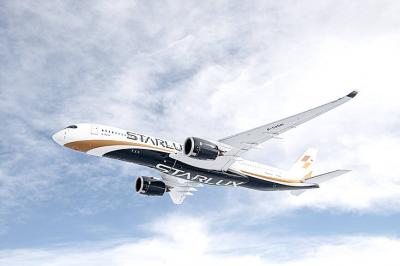
Starlux Airlines Co (星宇航空) today unveiled a long-haul network expansion plan at a shareholders’ meeting in Taipei, including direct flights to Barcelona, Spain, and Zurich, Switzerland, as well as a service connecting Taipei, Sydney and New Zealand. Starlux is to become the first Taiwanese carrier to offer non-stop services to the two European cities, while the inaugural oceanic route is expected to expand transit opportunities within the Australia-New Zealand market, Starlux said. Flight services to Chicago, Dallas, Washington and New York are under evaluation, the airline added. Prior to the shareholders’ meeting, the airline earlier this year announced that it would be

UNDER MICROSCOPE: Taiwan detained three people who allegedly conspired to buy servers in Taiwan and export them using fraudulent documentation, prosecutors said Nvidia Corp chief executive officer Jensen Huang (黃仁勳) on Saturday urged Super Micro Computer Inc to tighten up on compliance after Taiwan detained three people this week for allegedly making fraudulent declarations about artificial intelligence (AI) servers made by its US partner. The development marked the nation’s first crackdown on semiconductor smuggling, which grew after the US slapped restrictions on exports of high-end chips such as Nvidia AI accelerators to China. Nvidia is “rigorous” in explaining regulations to all of its partners, Huang told reporters after arriving in Taipei. “Ultimately Super Micro has to run their own company,” he said in response to

Nvidia Corp yesterday announced that CEO Jensen Huang (黃仁勳) would attend an employee meeting in Taipei tomorrow to celebrate the launch of the company’s Taiwan headquarters project. Huang would attend a gathering at the site of Nvidia’s planned headquarters in Beitou Shilin Technology Park (北投士林科技園區), the company said in a statement. After arriving in Taiwan on Saturday last week, Huang told reporters that he plans to meet with Quanta Computer Inc (廣達) chairman Barry Lam (林百里) and Taiwan Semiconductor Manufacturing Co (TSMC, 台積電) chairman C.C. Wei (魏哲家), and would attend the groundbreaking ceremony for Nvidia’s Taiwan headquarters tomorrow. Nvidia has not yet applied


 RSS
RSS