


Drug stocks, fortified by hopes of bigger US sales, lifted European shares on Friday to end the week flat, though still near their best levels of the year.
The FTSE Eurotop 300 index ended the day up 0.5 percent at 939.91 points, with more than two shares rising for each one falling.
The benchmark struggled to match this year's peak set last week as Wall Street trading was mixed, but is up 10.5 percent for the year after its hefty rally from a six-year nadir in March.
"The market is no longer as good value as it was. Although we have a lot of headwind behind it with economic data coming up nicely, we have had several months in a row of good performance and I would not be surprised to see a pause," said Richard Champion of Pavilion Asset Management.
Among the standouts, ING Groep fell 1.4 percent to 18.6 euros as the Dutch firm, Europe's number three insurer, offered cautious guidance after reporting a weaker than expected third-quarter net operating profit.
Italian bank Capitalia reported forecast-beating quarterly numbers, sending its shares higher.
Parmalat ended the week down 12 percent on concerns about the Italian food group's balance sheet, sinking further on Friday on news its finance director had resigned.
Autos lagged as new car sales in western Europe slipped last month, and a dip in US retail sales last month was blamed on weaker demand. Europe's biggest carmaker Volkswagen said it would cut investment over the next five years, and its stock eased a touch to 44.9 euros.
The DJ Euro Stoxx 50 index, a benchmark of euro zone blue chips, closed up 0.8 percent at 2,656.9 points, while the FTSE 100 in London clocked up its best close since late August last year after hitting fresh yearly highs.
The construction sector benefited from signs of a European and Japanese economic recovery, hitting new highs for the year.
Glass maker Saint-Gobain rose three percent, while cement makers Lafarge, Holcim and Heidelbergercement all rose two percent or more.
"We are having a bit more rotation into what has underperformed, like some of the cyclicals. People are scouting around for what has not been involved in the rally," Champion said.
The DJ Stoxx health index hit yearly high on hopes reform of the US Medicare program for seniors would boost demand for prescription medicines in the world's biggest market.
"Investors are getting more confident that there will be a Medicare drug benefit passed in the near term," said Marc Booty, pharmaceuticals analyst at Commerzbank.
Pavilion Asset Management's Champion said it was too early to call a turn in the healthcare sector.
French drug firm Aventis SA rose 5.8 percent, while Britain's GlaxoSmithKline Plc tacked on 2.4 percent. Swiss Novartis AG rallied 3.7 percent, while Anglo-Swedish AstraZeneca gained 2.8 percent.
The Eurotop 300 index is only some six points from its yearly high set a week ago, underpinned by third-quarter earnings, the best since the start of 2000, and further signs of recovery.
Eurostat data on Friday confirmed the euro zone economy grew at 0.4 percent in the third quarter, its fastest rate in a year, and should pick up even more steam in the next six months.
Data on Friday showed a strong improvement in the University of Michigan index of US consumer confidence, and a surprise rise in producer prices.
After investors pushed stocks to new highs, there remained nagging doubts about the rally's sustainability, said Anais Faraj, strategist at Nomura.
"We remain positive, though acknowledge the rough terrain," Faraj added.
JP Morgan investment bank said global growth was supporting European equities and, at this point in the economic cycle, equities usually outperform bonds as earnings grow while bond yields see little lift, thus reducing pressure on a stock's valuation multiple.
In New York, as bourses shut the Dow Jones Industrial Average was flat at 9,846 points, while the NASDAQ Composite had shed 0.6 percent to 1,956 points.
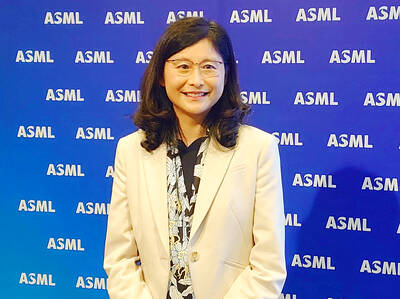
Netherlands-based semiconductor equipment supplier ASML Holding NV yesterday said that it is planning to hire an additional 1,000 people in Taiwan this year in response to growing demand from clients. ASML had previously planned to recruit 600 people this year, but that the plan has been adjusted upward, ASML vice president and ASML Taiwan general manager Grace Wang (汪佳慧) told reporters. ASML has a workforce of more than 4,500 in Taiwan, accounting for about 10 percent of its global total, Wang said. This year’s recruitment campaign would focus on adding people in the customer support, manufacturing and supply chain domains to assist ASML
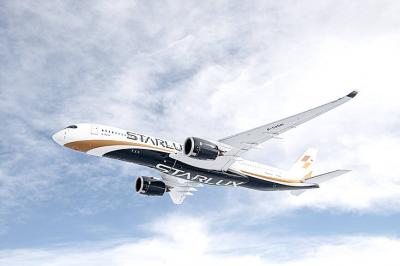
Starlux Airlines Co (星宇航空) today unveiled a long-haul network expansion plan at a shareholders’ meeting in Taipei, including direct flights to Barcelona, Spain, and Zurich, Switzerland, as well as a service connecting Taipei, Sydney and New Zealand. Starlux is to become the first Taiwanese carrier to offer non-stop services to the two European cities, while the inaugural oceanic route is expected to expand transit opportunities within the Australia-New Zealand market, Starlux said. Flight services to Chicago, Dallas, Washington and New York are under evaluation, the airline added. Prior to the shareholders’ meeting, the airline earlier this year announced that it would be

UNDER MICROSCOPE: Taiwan detained three people who allegedly conspired to buy servers in Taiwan and export them using fraudulent documentation, prosecutors said Nvidia Corp chief executive officer Jensen Huang (黃仁勳) on Saturday urged Super Micro Computer Inc to tighten up on compliance after Taiwan detained three people this week for allegedly making fraudulent declarations about artificial intelligence (AI) servers made by its US partner. The development marked the nation’s first crackdown on semiconductor smuggling, which grew after the US slapped restrictions on exports of high-end chips such as Nvidia AI accelerators to China. Nvidia is “rigorous” in explaining regulations to all of its partners, Huang told reporters after arriving in Taipei. “Ultimately Super Micro has to run their own company,” he said in response to

Nvidia Corp yesterday announced that CEO Jensen Huang (黃仁勳) would attend an employee meeting in Taipei tomorrow to celebrate the launch of the company’s Taiwan headquarters project. Huang would attend a gathering at the site of Nvidia’s planned headquarters in Beitou Shilin Technology Park (北投士林科技園區), the company said in a statement. After arriving in Taiwan on Saturday last week, Huang told reporters that he plans to meet with Quanta Computer Inc (廣達) chairman Barry Lam (林百里) and Taiwan Semiconductor Manufacturing Co (TSMC, 台積電) chairman C.C. Wei (魏哲家), and would attend the groundbreaking ceremony for Nvidia’s Taiwan headquarters tomorrow. Nvidia has not yet applied


 RSS
RSS